

Former President Mikheil Saakashvili led the Rose Revolution to become the leader of Georgia, but he was also a highly controversial politician .
On July 3rd, Saakashvili appeared in a televised court hearing. He caused concern when he lifted his shirt, revealing an extremely thin, emaciated body, a sunken stomach, and a gaunt face.
The former Georgian president said that despite his failing health, he "remains in high spirits and determined to serve his country." "A completely innocent man is being held captive. I have not committed any crime," he said.
Saakashvili, 55, served as president of Georgia from 2004-2007 and 2008-2013. He was convicted in absentia in 2018 for abuse of office and sentenced to six years in prison. Saakashvili denies this, claiming the case was politically motivated and that he went to Ukraine to avoid arrest.
However, the former Georgian president was arrested upon his return to the country in October 2021 and has been imprisoned ever since. He has repeatedly gone on hunger strikes to protest the charges against him. Saakashvili is currently being held in a private hospital, where he was transferred last year after a 50-day hunger strike.
Saakashvili and his supporters claim he was poisoned. The former president, who is now 1.95 meters tall, weighs only about 60 kg, half his weight before his arrest. "Putting me in prison will not break me. I will still actively participate in Georgian politics," he emphasized.
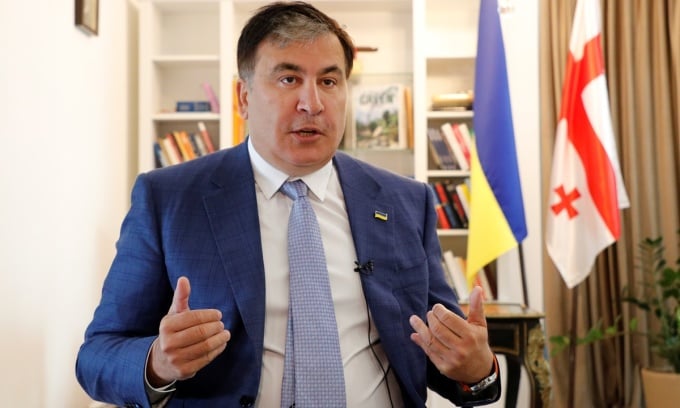
Former Georgian President Mikheil Saakashvili is interviewed at his home in the suburbs of Kyiv, Ukraine, in 2020. Photo: Reuters
Saakashvili was born on December 21, 1967, in Tbilisi, the capital of Georgia. He graduated from the Faculty of Law at the Kyiv University of International Relations, Ukraine, and subsequently pursued graduate studies in France, Italy, the Netherlands, and Columbia University in the United States. From 1993 to 1995, he worked for a law firm in New York.
Saakashvili later returned to Georgia at the invitation of Zurab Zhvania, then chairman of the Georgian Civic Union (SMK) party, and was elected to parliament in November 1995.
From 1995 to 1998, he served as chairman of the National Assembly's Legislative Affairs Committee and lobbied for faster and more comprehensive policy reforms, but without success.
In August 1998, he was elected head of the SMK party in parliament. By October 2000, he was appointed Minister of Justice and began reforming Georgia's legal system and improving prison conditions. As a populist, he called on the public to support efforts to crack down on corruption among high-ranking officials.
In August 2001, Saakashvili directly opposed President Shevardnadze and unexpectedly resigned following a mysterious burglary at his home. He was re-elected to parliament in the same year's election and, in October, founded the United National Movement (UNM) party. Saakashvili was then elected chairman of the Tbilisi city council. In this position, he implemented policies to increase pensions, donate textbooks to schools, and personally helped repair dilapidated residential buildings.
On November 3, 2003, the Georgian government announced that the For a New Georgia party, which supported President Shevardnadze, had won the parliamentary elections.
Saakashvili, along with Zhvania and parliamentary speaker Nino Burdjanadze, launched protests in Tbilisi and other cities alleging that the election results had been rigged and calling for Shevardnadze's resignation. Shevardnadze's approval ratings have plummeted since 2000 due to economic problems, poor management of basic services, and corruption within the government and security apparatus.
On November 22, 2003, Saakashvili and his supporters occupied the parliament building without resistance, carrying roses. President Shevardnadze fled the building and announced his resignation the following day.
This protest movement is now known as the Rose Revolution. Saakashvili's crucial role in the protests helped him get elected president in 2004.
He immediately appointed a new group of government officials to find solutions to Georgia's range of problems and focused on tackling corruption. However, most importantly, Saakashvili kept the country united against separatist movements in regions such as Abkhazia, Ajaria, and South Ossetia.
Saakashvili rose to prominence during his first presidential term, but a series of allegations of civil rights violations and his increasingly hardline policies fueled widespread opposition movements.
Irakli Okruashvili, a former defense minister under the Saakashvili regime, founded the Georgian Unity Movement party in 2007 and began making direct accusations against him.
Okruashvili was subsequently arrested, triggering opposition protests in late 2007. On November 2, 2007, approximately 50,000 people gathered outside the parliament building in Tbilisi to call for Saakashvili's resignation.
The protests continued until November 7, 2007, when riot police were deployed to disperse the crowds and Saakashvili declared a nationwide state of emergency for 15 days. After calling for early elections, he resigned as president on November 25, 2007.
Saakashvili went on to win the presidential election in January 2008, but by far fewer votes than in the 2004 election.
Immediately after Saakashvili took office, the conflict between the Georgian government and the breakaway region of South Ossetia intensified. Georgian government forces clashed with local separatist fighters as well as with Russian forces that had crossed the border. Russia stated that its purpose was to protect Russian citizens and peacekeepers present in the region.
Violence spread across the country as Russian forces moved through the breakaway Abkhazia region in northwestern Georgia. Georgia and Russia subsequently signed a ceasefire brokered by France. Russian forces withdrew from undisputed areas, but tensions persisted.
Saakashvili faced growing criticism. Opposition groups, which had protested Saakashvili's use of force during the November 2007 demonstrations, disapproved of his handling of the tensions and accused him of plunging Georgia into a fierce, costly conflict that they could not win.
In 2012, Saakashvili's UNM party faced a challenge from the newly formed opposition coalition Georgian Dream (GD), led by billionaire Bidzina Ivanishvili.
Weeks before the October 2012 parliamentary elections, polls showed the UNM still leading the GD, but the party's standing was damaged when videos of Georgian prison guards beating and sexually abusing prisoners went viral, sparking public outrage. Ultimately, the UNM lost to the GD, and Saakashvili resigned in 2013.
After his presidential term ended, Saakashvili briefly taught at Tufts University in Medford, Massachusetts. Georgian authorities filed charges against him during this time, preventing him from returning to his country. In 2018, he was tried in absentia and convicted of abuse of power in two separate trials.
Saakashvili arrived in Ukraine in 2015 at the invitation of then-President Petro Poroshenko. Ukraine was then facing pressure for reforms due to conflict with pro-Russian separatists in the east. This was a situation similar to what Saakashvili faced during his second presidential term. Saakashvili was granted Ukrainian citizenship, renouncing his Georgian citizenship, and was appointed governor of the Odessa region of Ukraine.
The following year, he accused the Ukrainian president of corruption, resigned as governor, and formed an opposition party against Poroshenko. While Saakashvili was in the US in June 2017, Poroshenko revoked his citizenship. Saakashvili returned to Ukraine via Poland but was arrested in February 2018 and deported back to Poland. Saakashvili moved to the Netherlands, where his wife holds citizenship, and found work as a lecturer.
In 2019, Saakashvili returned to Ukraine after his citizenship was restored by President Volodymyr Zelensky. In May 2020, Zelensky appointed him head of the Ukrainian Reform Commission.
A few weeks before the 2020 Georgian parliamentary elections, Saakashvili announced his intention to return home. Despite lacking citizenship and facing threats of imprisonment upon re-entry, the UNM still nominated him as a candidate for prime minister. However, the UNM lost the election, and Saakashvili remained in Ukraine.
In 2021, he returned to Georgia with the intention of calling on people to organize large-scale anti-government protests ahead of the local elections in October. He was arrested just hours after announcing his return.
Back home, Saakashvili is a controversial political figure, but even many of his opponents feel dissatisfied with how the former Georgian president is being treated.
"There were many systemic human rights violations under Saakashvili, but in a state governed by the rule of law, you need to make appropriate accusations, not like this," commented Eka Tsimakuridze from the Georgian Democracy Index. "You can have strong political disagreements with Saakashvili, but the fact that he risks dying while imprisoned would be a disaster for the country."
"If Saakashvili dies in prison, it will create a wound that will be difficult to heal in Georgian society," she said.
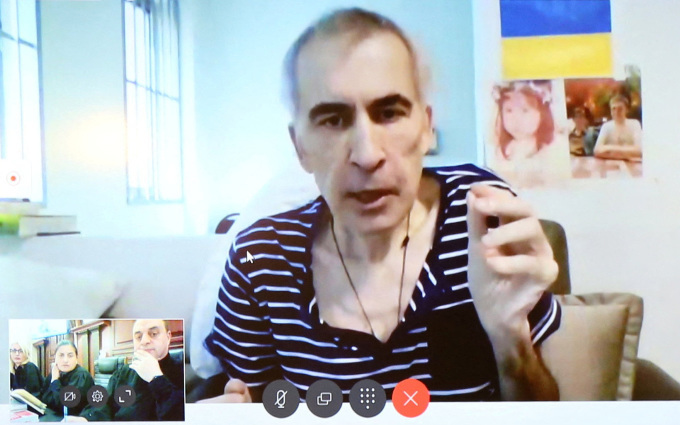
Former Georgian President Mikheil Saakashvili appears in court in Tbilisi on July 3. Photo: Reuters
Ukrainian President Zelensky said on July 3 that Saakashvili "is being tortured," demanding that Tbilisi hand him over to Kyiv. Besides Ukraine, many other countries have also voiced their outrage over the conditions former president Saakashvili is being subjected to.
"Torturing an opposition leader to death is unacceptable for a country that wants to join the European Union (EU)," Moldovan President Maia Sandu wrote on Twitter earlier this year, calling on Georgia to release Saakashvili immediately.
Late last year, Saakashvili wrote a handwritten letter to French President Emmanuel Macron, in which he wrote: "SOS. I am dying, I have very little time left."
However, Georgian authorities believe Saakasvhili is faking his health condition in order to be released from prison.
Vu Hoang (Based on BBC, Guardian, Britannica )
Source link

















![[Photo] Prime Minister Pham Minh Chinh holds a phone call with the CEO of Russia's Rosatom Corporation.](/_next/image?url=https%3A%2F%2Fvphoto.vietnam.vn%2Fthumb%2F1200x675%2Fvietnam%2Fresource%2FIMAGE%2F2025%2F12%2F11%2F1765464552365_dsc-5295-jpg.webp&w=3840&q=75)









































Comment (0)