

A tech-savvy young man in India bought a pair of AirPods Pro 2 for his hearing-impaired grandmother, knowing the device had a hearing aid feature. However, he quickly discovered that this feature was geographically blocked in India due to regulatory restrictions.
However, instead of giving up, Rithwik Jayasimha and the Lagrange Point tech enthusiasts built a Faraday cage and used a microwave to trick the hearing aid into unlocking the headset's function.
According to the group, the cheapest hearing aids in India cost over 15 million VND, exceeding the affordability of most users. On the other hand, AirPods Pro 2 are only half the price of the cheapest hearing aids, around 7 million VND, making them a great alternative for those with hearing problems. However, to use the earbuds as hearing aids, you need to be in a country where Apple doesn't geographically block this feature, running iOS or iPadOS 18.1 or later, own AirPods Pro 2, and ensure that it uses firmware 7B19 or later.
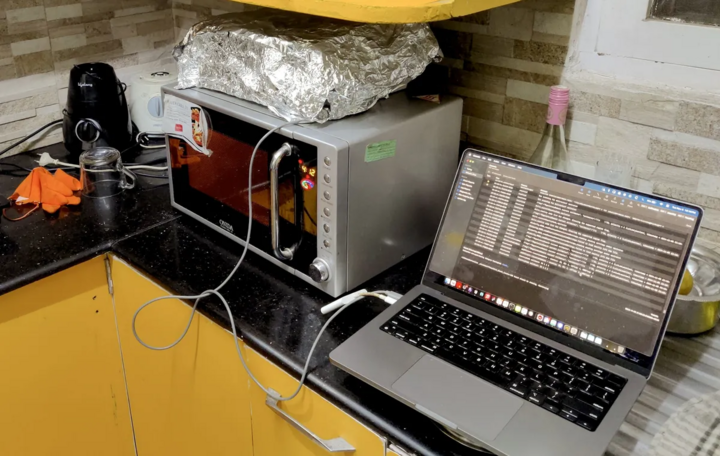
A geo-hacking tool for iPad. (Image: X)
Although Jayasimha had all the necessary hardware and software to set up AirPods Pro 2 as hearing aids, due to geographical issues, they needed to set the AirPods' location to outside of India. Easier said than done; although they spoofed the IP location and language of the iPad used to set up the headphones, the device still detected it as being located in India.
After several rounds of testing, one member of the team discovered that iPads use the SSID and MAC address broadcast by surrounding routers (Wi-Fi modems) to determine their geographical location. Therefore, even when the iPad has no cellular network and GPS is turned off, it can still accurately pinpoint its location.
The team decided to place the iPad and an ESP32 board, which simulates the environment of hundreds of Wi-Fi SSIDs located in Menlo Park, California, inside a makeshift Faraday cage (a cardboard box lined with aluminum foil). Below, they placed a microwave oven running at full power to disrupt and jam any 2.4G Wi-Fi signals in the vicinity.
The microwave oven was turned on at high power to emit strong electromagnetic waves in the 2.4 GHz frequency band – the same frequency as Wi-Fi. These waves could interfere with and disrupt local Wi-Fi signals, allowing their team to prevent the iPad from detecting real Wi-Fi signals in the surroundings and instead only recognize fake SSIDs from the ESP32 board.
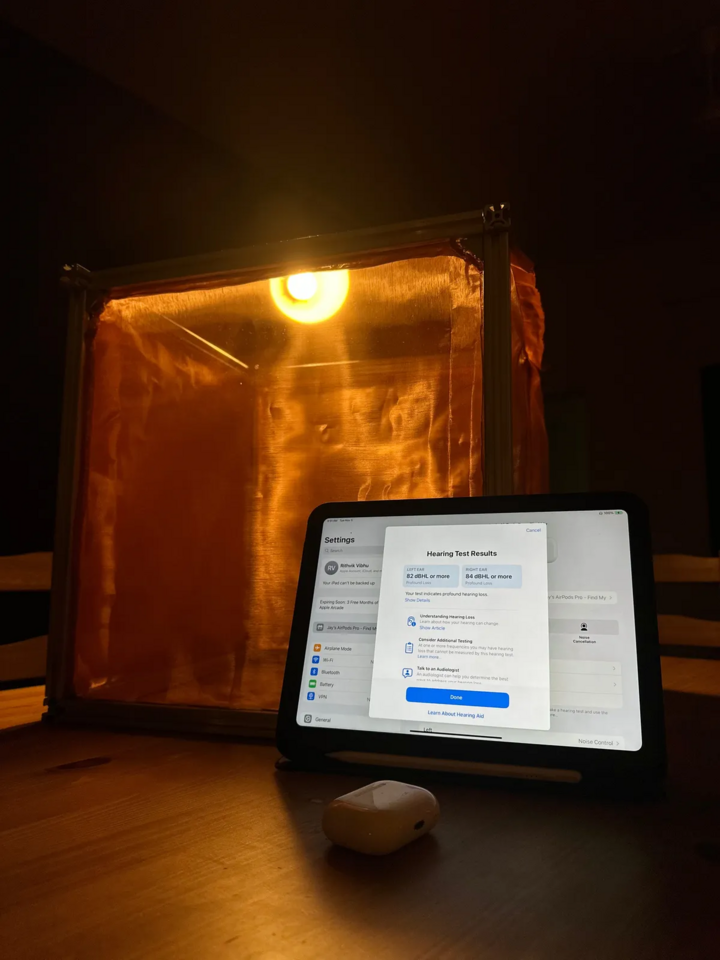
After perfecting the process, they began offering this lock-picking service with more sophisticated Faraday cages. (Photo: X)
In this way, the iPad only receives fake SSIDs from the ESP32 board and cannot detect real Wi-Fi networks in India, tricking it into believing it is in Menlo Park, California, USA.
Then, they ran a script on the MacBook instructing the iPad to restart and turn on its Wi-Fi antenna five minutes later. Several initial attempts failed, requiring the team to adjust the Faraday cage, the microwave, and restart the device. But finally, after about three hours of tinkering, the Mac Console indicated the iPad was showing as being in the US. With that result, the team pulled the iPad out of the Faraday cage, connected the AirPods, and the hearing aid setup process appeared on the screen. They succeeded.
Even after the iPad was removed from the Faraday cage, it remained fooled because it had "remembered" the fake SSIDs and MAC addresses of the Wi-Fi networks broadcast by the ESP32. While inside the Faraday cage, the iPad stored this information and believed it was in Menlo Park, California, because it couldn't identify the real Wi-Fi networks around it.
Apple's location database stores Wi-Fi information to locate the device, and when the iPad receives simulated Wi-Fi networks from ESP32, it synchronizes this data as if it were a real network in Menlo Park. After leaving the Faraday cage, the iPad doesn't automatically update its location immediately but continues to use the fake SSID and MAC address data it had recorded.
Once the setup is complete and features are enabled, if the AirPods are disconnected from the iPad, they will retain these settings and will not automatically re-check location. As long as the AirPods are not reset or connected to another device requiring location verification, they will continue to function as if they were in the U.S.
After figuring out the process, the team repeated it several more times and built a more stable Faraday cage. Now that they understand the process, they started a hearing aid unlocking service at Lagrange Point so that anyone in the Bengaluru area can benefit from this feature.
Source


![[Photo] Closing Ceremony of the 10th Session of the 15th National Assembly](/_next/image?url=https%3A%2F%2Fvphoto.vietnam.vn%2Fthumb%2F1200x675%2Fvietnam%2Fresource%2FIMAGE%2F2025%2F12%2F11%2F1765448959967_image-1437-jpg.webp&w=3840&q=75)


![[Photo] Prime Minister Pham Minh Chinh holds a phone call with the CEO of Russia's Rosatom Corporation.](/_next/image?url=https%3A%2F%2Fvphoto.vietnam.vn%2Fthumb%2F1200x675%2Fvietnam%2Fresource%2FIMAGE%2F2025%2F12%2F11%2F1765464552365_dsc-5295-jpg.webp&w=3840&q=75)

















































![[OFFICIAL] MISA GROUP ANNOUNCES ITS PIONEERING BRAND POSITIONING IN BUILDING AGENTIC AI FOR BUSINESSES, HOUSEHOLDS, AND THE GOVERNMENT](https://vphoto.vietnam.vn/thumb/402x226/vietnam/resource/IMAGE/2025/12/11/1765444754256_agentic-ai_postfb-scaled.png)

















































Comment (0)