

 |
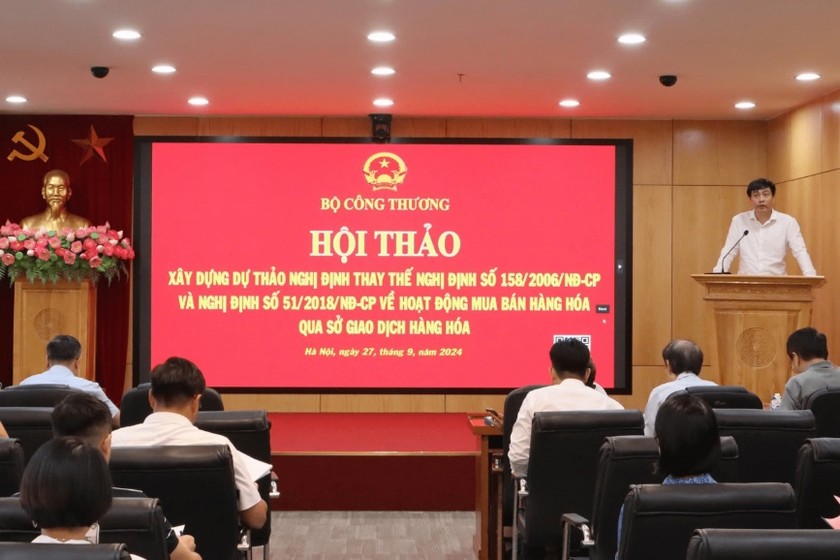
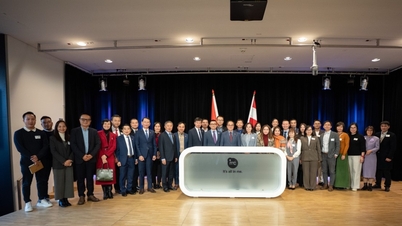
| Mr. Bui Nguyen Anh Tuan, Deputy Director of the Domestic Market Department, Ministry of Industry and Trade, chaired the workshop. (Photo: PV) |
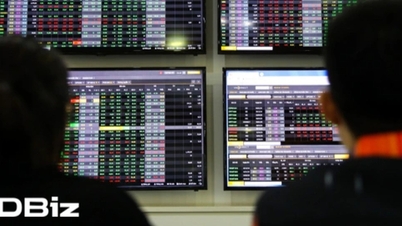
(PLVN) - Trading goods through the Commodity Exchange (MXV) is like a "game," with no real goods being traded. Meanwhile, coffee is already exported and traded on the commodity exchange in the UK. Therefore, regulations are needed requiring that goods traded on the Commodity Exchange be real goods.
Many issues were not regulated in the 2005 Commercial Law.
On the morning of September 27th, the Ministry of Industry and Trade organized a workshop to gather feedback on the draft Decree replacing Decree No. 158/2006/ND-CP and Decree No. 51/2018/ND-CP on the trading of goods through commodity exchanges (hereinafter referred to as the draft Decree).
Mr. Bui Nguyen Anh Tuan, Deputy Director of the Domestic Market Department and Deputy Head of the Drafting Committee, stated that the decrees on the trading of goods have been implemented in detail since the 2005 Commercial Law. However, in recent years, the National Assembly has enacted many laws impacting this field, such as the 2017 Law on Foreign Trade Management, the 2018 Law on Cybersecurity, the 2018 Law on Competition, the 2020 Law on Investment, the 2020 Law on Enterprises, and the 2024 Law on Credit Institutions...
Therefore, to align with current legal regulations, it is necessary to amend and supplement the decrees regulating this activity. In addition, the implementation of legal documents on the trading of goods via e-commerce platforms has revealed many shortcomings, obstacles, and overlaps that need to be addressed. Furthermore, Vietnam has participated in, negotiated, and signed numerous free trade agreements at both bilateral and multilateral levels, leading to the need to build intermediary trading systems for import and export goods with international markets.
Therefore, there is an urgent need to amend and supplement the current legal regulations on the buying and selling of goods via e-commerce platforms to align with relevant existing laws and the development of the market in the current period.
At the conference, many opinions suggested that the draft Decree exceeded the scope of the 2005 Commercial Law and contained many new concepts not yet regulated in the Law. Specifically, Lawyer Dinh Dung Sy stated that after studying the entire draft, he found the Decree's scope to be very broad, encompassing many new issues that go beyond the scope of the Commercial Law, which mandates the Government to provide guidance on the trading of goods through commodity exchanges. These issues include futures commodity exchanges; commodity transaction control committees; and futures trading companies.
Many provisions of the draft need to be reconsidered.
A representative from MVX commented that the draft Decree contains several provisions restricting small and medium-sized enterprises (SMEs) from participating in activities through the Exchange, which could violate the Law on Supporting SMEs. Furthermore, currently, 98% of Vietnam's economy is comprised of SMEs, the commodity exchange in Vietnam is also small, and many agricultural products such as coffee, pepper, and cashew nuts are produced and traded by small-scale household businesses. Therefore, the issue of restricting the types of participants needs to be reconsidered. Meanwhile, most exchanges worldwide do not restrict the types of participants.
Dr. Tran Van Binh, a specialist in commodity exchanges and a trading member of MXV, stated that trading on the exchange is extremely risky because the commodities are virtual. “There are no real commodities, not even 1%; currently, no Vietnamese products are listed on the domestic exchange. Trading commodities today is like a game; most accounts are opened for speculation by individuals; businesses opening accounts to hedge against risk are virtually nonexistent,” Dr. Binh said.
Dr. Binh analyzed that the nature of a commodity exchange must involve real goods, so to develop a commodity exchange, it's necessary to develop trading units... For example, coffee has already been exported and traded on commodity exchanges in the UK; therefore, in Vietnam, it's impossible for this commodity not to be traded on a real exchange. According to Dr. Binh, member companies trading on the exchange, once assessed, can open their own exchanges, thus forming a commodity trading market on the exchange. "There should be a decree regulating the buying and selling of goods on the exchange, stipulating that there must be real goods; it cannot be left as a 'game' as it is currently," Dr. Binh suggested.
In a private interview with a reporter from PLVN Newspaper, Dr. Binh stated that trading on the Vietnam Commodity Exchange (MXV) is currently conducted in a way where investors place orders for goods and deposit margin. For example, an investor places an order for a December contract to take delivery, but if the market price rises later, the investor may sell. However, if the investor waits to take delivery, they must have the goods available for delivery. Currently, on the MXV, "even if you wait, there are no goods available." "This is a problem that needs to be fundamentally changed so that the exchange can move in the right direction. Because the essence of a commodity exchange is to ensure there are no situations of 'good harvest, low prices' or 'poor harvest, high prices,' especially with Vietnamese agricultural products," Dr. Binh said.
Source: https://baophapluat.vn/thay-doi-de-mua-ban-qua-so-giao-dich-phai-co-giao-dich-hang-hoa-that-post526875.html


![[Photo] Prime Minister Pham Minh Chinh holds a phone call with the CEO of Russia's Rosatom Corporation.](/_next/image?url=https%3A%2F%2Fvphoto.vietnam.vn%2Fthumb%2F1200x675%2Fvietnam%2Fresource%2FIMAGE%2F2025%2F12%2F11%2F1765464552365_dsc-5295-jpg.webp&w=3840&q=75)


![[Photo] Closing Ceremony of the 10th Session of the 15th National Assembly](/_next/image?url=https%3A%2F%2Fvphoto.vietnam.vn%2Fthumb%2F1200x675%2Fvietnam%2Fresource%2FIMAGE%2F2025%2F12%2F11%2F1765448959967_image-1437-jpg.webp&w=3840&q=75)




























































Comment (0)