

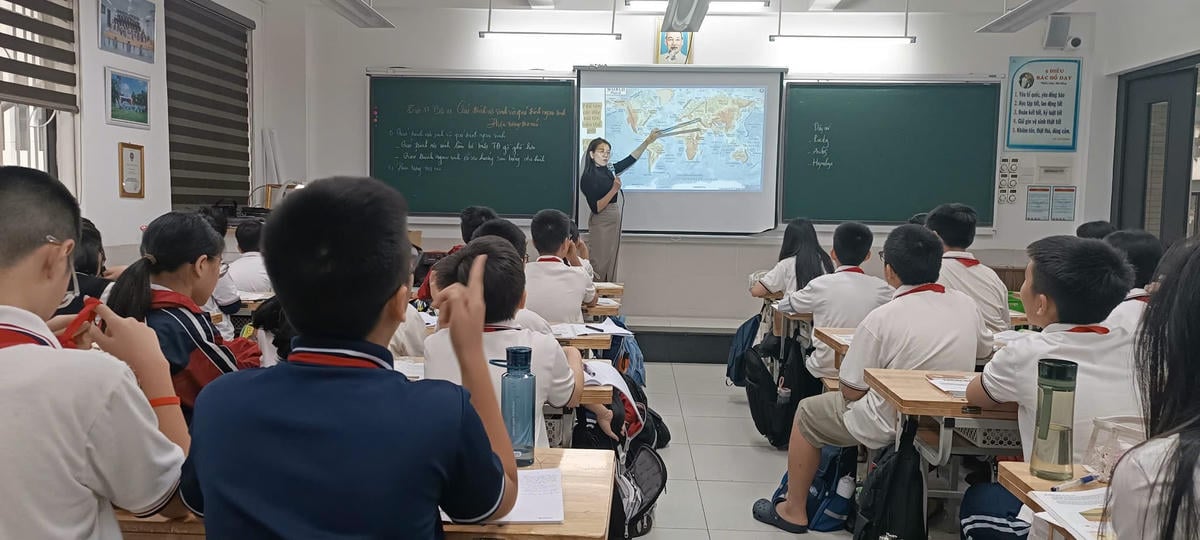
2 stages of education
The draft Guidelines for piloting AI education content in general schools, drafted by the Ministry of Education and Training, is being sent to the Departments of Education and Training for comments. Accordingly, the AI education content framework for students is developed based on four main knowledge streams, corresponding to four competency domains, which are intertwined and complementary to each other, including: human-centered thinking, AI ethics, AI techniques and applications, and AI system design.
The content framework will be designed to correspond to two educational stages, including the basic education stage (including primary and secondary school levels) and the career-oriented education stage (high school level). Specifically, at the primary level, students mainly experience simple, intuitive AI applications to form initial concepts and recognize the role of AI in life. They are educated about protecting personal data and respecting copyright.
At the secondary level, students learn how to use AI tools to create digital products and solve learning problems. They are equipped with basic knowledge about how AI works and begin to develop a sense of ethics and civic responsibility in a digital society.
At the high school level, students are encouraged to explore, design and improve simple AI applications through science projects. The program focuses on developing problem-solving thinking, creativity and mastery of AI tools, helping students apply AI to create products to serve the community and orient their future careers.
In addition to the core educational content, students can choose elective study topics to enhance practical skills, learn more about AI application areas or AI system development and programming techniques.
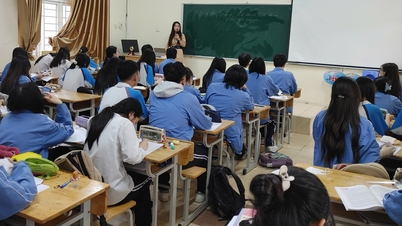
Teacher Chung Thi Phuong Thuy - Thanh Loc High School (Thanh Loc Ward, Ho Chi Minh City) expressed her support for the plan to bring AI into schools because currently, both students and teachers have been applying AI in teaching and learning very popularly. However, they are still mainly self-studying and researching without guidance or training from the authorities.
Ms. Le Thi Thanh Mai - former Head of Student Affairs Department (Ho Chi Minh City National University) also agreed that the question now is no longer "to use or not to use" AI, but how to use it properly to become a brave and humane digital citizen. "When properly oriented, AI will become a lever to improve knowledge, promote creativity and contribute to training a generation of brave digital citizens" - Ms. Mai commented.
Standardizing AI in Learning
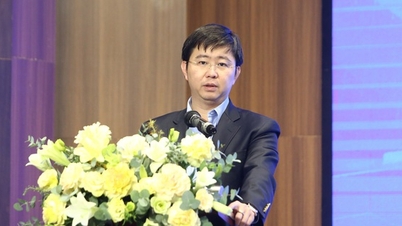
In fact, AI is being deployed very vigorously in schools, Prof. Dr. Le Anh Vinh - Director of the Vietnam Institute of Educational Sciences, said that if adequate information is not provided and appropriate education methods are not used, the use of AI in schools will not be as effective as expected. To bring AI education into schools, it is necessary to rely on three main pillars: a consistent policy framework, comprehensive and flexible teaching programs and materials, and human and financial resources.
The need to standardize AI in learning is urgent for the education sector and all stakeholders, to ensure that technology is applied effectively, transparently and safely. Not only should educational content on AI, digital security and technology ethics be included in the curriculum in an appropriate manner for each level, experts also pointed out the role of the Ministry of Education and Training in issuing a code of conduct for AI in education and building a digital competency framework for teachers and students, including skills to use AI properly.
In addition, the role of schools in organizing implementation and monitoring. Specifically, educational institutions play a bridging role, directly applying policies in designing internal regulations on the use of AI in teaching, testing and assessment, choosing reputable, certified and secure AI tools.
Teachers are not only users but also supervisors, guiding students to distinguish between learning support and AI dependence with negative effects that scientists have warned about recently. In student assessment, it is also necessary to shift to forms such as direct discussion, question and answer, testing analytical skills... to reduce cheating. AI can be used to personalize exercises, quickly grade papers, and analyze errors to improve teaching effectiveness, but care must be taken not to abuse AI.
If students use AI to solve exercises instead of self-studying, teachers use AI to mechanically grade papers, and educational institutions deploy technology without control, it can lead to bias in assessing real abilities. Experts even warn of the consequences of “AI brain hollowing”, a phenomenon of cognitive decline caused by AI that reduces critical thinking, weakens basic knowledge, and disappears problem-solving skills…
Source: https://daidoanket.vn/thi-diem-tri-tue-nhan-tao-trong-truong-hoc-bai-ban-phu-hop-voi-tung-cap-hoc.html
![[Photo] Cat Ba - Green island paradise](/_next/image?url=https%3A%2F%2Fvphoto.vietnam.vn%2Fthumb%2F1200x675%2Fvietnam%2Fresource%2FIMAGE%2F2025%2F12%2F04%2F1764821844074_ndo_br_1-dcbthienduongxanh638-jpg.webp&w=3840&q=75)
















































![[VIMC 40 days of lightning speed] Da Nang Port: Unity - Lightning speed - Breakthrough to the finish line](https://vphoto.vietnam.vn/thumb/402x226/vietnam/resource/IMAGE/2025/12/04/1764833540882_cdn_4-12-25.jpeg)













































Comment (0)