

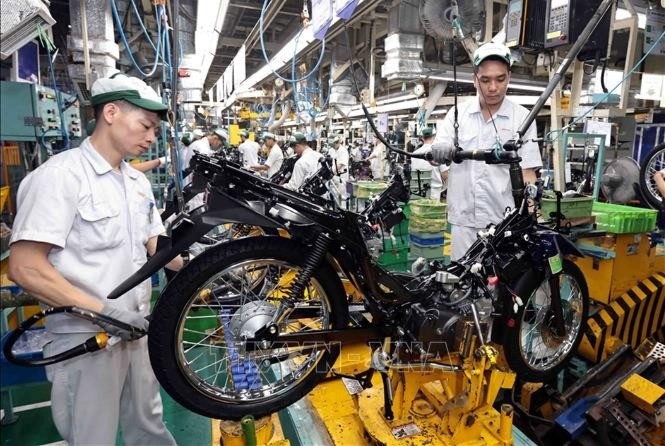
Recent market surveys show that many scooter models that were once in high demand, such as the Honda Vision, Honda Lead, and Yamaha Janus, are being sold by some dealerships at prices lower than the manufacturer's listed price, ranging from several hundred thousand to over one million dong.
Specifically, the Honda Vision, Vietnam's best-selling scooter, is currently seeing a slight price reduction. The Premium version, originally priced at 32.98 million VND, is now selling for 32.49 million VND; the Sport version has dropped from 36.61 million VND to approximately 36.29 million VND. Similarly, the Honda Lead, a model favored by female users who appreciate a spacious storage compartment, is experiencing a more significant price drop. The Special version (with ABS) is now priced from 45.64 million VND to 44.99 million VND; the Standard version is priced from 39.58 million VND to 38.99 million VND.
The Yamaha Janus, a direct competitor to the Vision in the mainstream segment, has a suggested retail price starting from 29.151 million VND and is currently being offered at a discounted price through a promotional program that includes a 2 million VND registration fee discount or 0% interest installment payments for all versions.
Not only scooters, but many familiar manual transmission motorcycle models have also seen significant price reductions. This segment still holds a large market share, especially in rural areas – where the ban on gasoline-powered vehicles has not yet been implemented.
The Honda Wave Alpha, a popular commuter motorcycle, has a suggested retail price of around 18.2 million VND, but is actually available at dealerships for only 17.5 – 17.7 million VND, often with gifts or support for vehicle registration fees. The Honda Future 125, a more premium commuter motorcycle, is also seeing a price reduction of about 500,000 VND compared to the listed price.
According to a Yamaha dealer in Hanoi : "In the current situation, dealers are accepting reduced profit margins, or even selling at break-even, to sell gasoline-powered motorcycles during this sensitive period. After July 2026, if we can't sell them in the city center, we will have to shift our distribution to other provinces."
According to some dealerships, the number of customers looking to buy cars has increased again in recent days, mainly those whose daily activities are outside the Ring Road 1, wanting to take advantage of the current favorable prices, while the vehicle conversion policies in Hanoi are still in the preparation phase.
Buy a gasoline-powered car for "temporary use," then transfer ownership.
Following the Government's issuance of Directive 20/CT-TTg on July 12, 2025, which clearly states that Hanoi will cease the circulation of fossil fuel-powered vehicles within Ring Road 1 from July 1, 2026, and will eventually expand this further, consumer sentiment has also undergone significant changes.
Instead of panicking, many people are taking advantage of this time to buy cheap gasoline-powered vehicles, especially those that were previously overpriced compared to the manufacturer's list price, using them for a short time before returning them to their hometowns – areas not yet affected by the ban. Ms. Nguyen Thi Tham (Van Phuc Ward, Hanoi) said: “Gasoline-powered vehicles are still more convenient than electric vehicles, especially since my house doesn't have a charging station. I bought a Vision temporarily, used it for a few years, and then sent it back to my sister in the countryside to use. There is no ban in the countryside yet, so it can still be used normally.”
Similarly, Mr. Trinh Van Tuan (Nhat Tan ward) shared: “I’ve thought it through carefully. If I buy an electric car now, the price is high, the battery is new and not yet stable. Meanwhile, gasoline cars are cheap, easy to repair, and easy to sell. When Hanoi bans them, I’ll take the car back to my hometown for my family to use or give it to relatives – where gasoline cars can still be used for a longer time.”
Observations from motorcycle dealerships in Hanoi's inner city indicate that the trend of "buying to relocate" is gaining significant traction, especially among customers with provincial residency or relatives outside the city. Additionally, many people are opting for installment purchases – paying gradually over 12 months – to take advantage of lower prices without significant financial pressure.
According to industry experts, although Hanoi is preparing to ban gasoline-powered motorcycles from 2026, this policy has not yet been implemented nationwide. Meanwhile, more than 80% of communes and towns in Vietnam still use gasoline-powered motorcycles as their primary mode of transportation. This means that traditional motorcycles will continue to thrive in many localities for at least the next 5-7 years.
Should we pay upfront or wait for the tram?
While this presents a good opportunity to own affordable gasoline-powered motorcycles, it is also considered a "transitional phase" for the personal vehicle market. Many experts predict that from the end of 2025, the production of new gasoline-powered vehicles may gradually decrease, giving way to smaller, more convenient electric models. As the manufacturer holding over 83% of the Vietnamese motorcycle market share, Ms. Sayaka Arai, General Director of Honda Vietnam (HVN), stated that promoting the electric vehicle product portfolio and fostering green transition are two of the three strategic pillars of the company. Besides the two recently launched models, ICON:e and CUV:e, Honda Vietnam plans to launch five new electric motorcycle models between 2026 and 2030, expanding its electric vehicle business comprehensively from 2035...
In this context, experts suggest that consumers who need transportation for the short term (1-2 years) or intend to use it in areas that have not yet implemented the transition to electric vehicles should consider buying a gasoline-powered motorcycle at this time, especially models that have seen price increases. Conversely, for those who already have suitable charging infrastructure and parking, switching to electric vehicles would be a more long-term solution.
From a market perspective, the effect of Directive 20/CT-TTg not only creates a major impetus for the green transition process, but also highlights the dynamic developments in the transition phase – where consumers are seizing the opportunity to take advantage of gasoline-powered vehicles before they are phased out of major cities like Hanoi.
The current situation indicates that the gasoline motorcycle market is entering a phase of "clearing out inventory" in major cities like Hanoi, before giving way to the trend of electric motorcycles. However, at present, this is still a good opportunity for consumers who want to own a gasoline motorcycle at a bargain price, especially if they plan to use the vehicle in areas where the ban has not yet been implemented.
Source: https://baolaocai.vn/thi-truong-xe-may-xang-ruc-rich-giam-gia-truoc-gio-g-post649345.html
































![[Video] The craft of making Dong Ho folk paintings has been inscribed by UNESCO on the List of Crafts in Need of Urgent Safeguarding.](https://vphoto.vietnam.vn/thumb/402x226/vietnam/resource/IMAGE/2025/12/10/1765350246533_tranh-dong-ho-734-jpg.webp)


































































Comment (0)