

Increase maternity leave for female workers giving birth to their second child.
On the morning of December 10th, at the 10th session of the 15th National Assembly , with 448 out of 450 attending National Assembly deputies voting in favor (94.71%), the National Assembly officially passed the Law on Population.
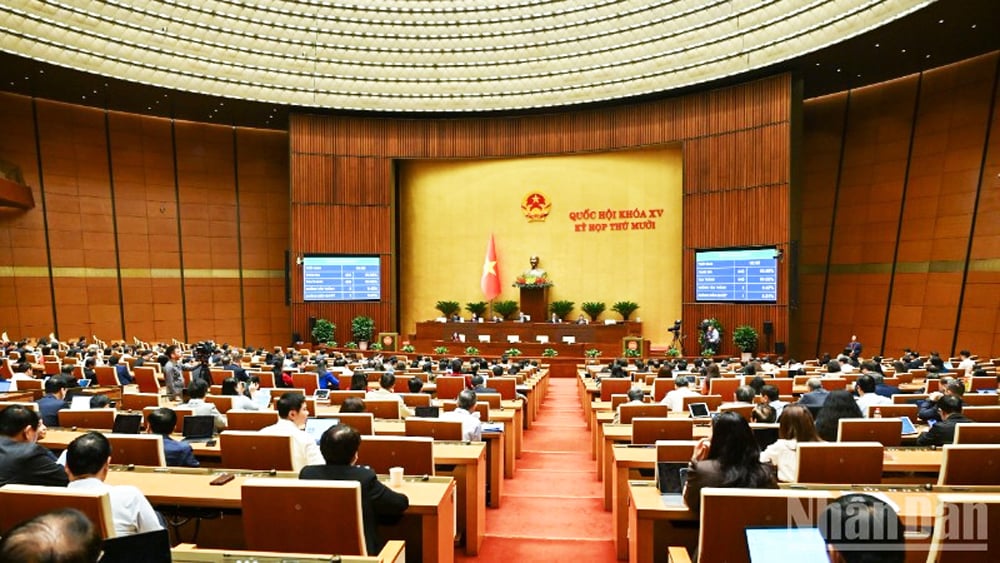 |
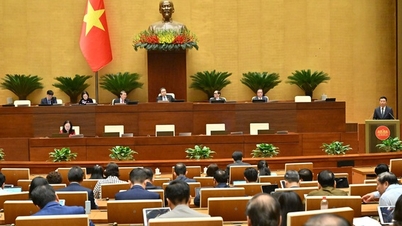
A view of the National Assembly session on the morning of December 10th. |
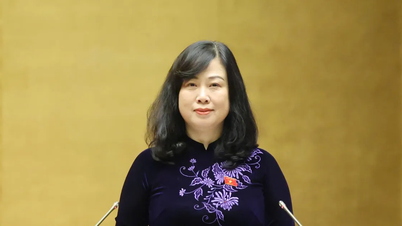
Before the National Assembly proceeded with the voting process, Minister of Health Dao Hong Lan, on behalf of the drafting agency, presented a summary of the draft law after it had been revised and amended.
According to Minister Dao Hong Lan, this draft Population Law marks a fundamental change, shifting the focus of population policy from family planning to population and development. These changes are reflected in the comprehensive resolution of issues related to population size, structure, adaptation to population aging, and improving population quality in relation to socio-economic development.
Regarding the scope of the law, to accurately reflect the nature of the law on population, the draft has been reviewed and supplemented with provisions related to the definition of terms. The Government has incorporated the opinions of delegates, focusing on regulations concerning maintaining the replacement fertility rate, minimizing gender imbalance at birth, adapting to population aging, improving the quality of the population, communication, advocacy, and education on population issues, and the conditions for ensuring the implementation of population work.
Regarding the State's population policy, the Government has incorporated and refined the draft, adding Article 7, "State Policy on Population." These are regulations of a principled and general orientation, reflecting a comprehensive set of policies that closely adhere to the Party and State's guidelines.
In addition, the draft also stipulates maintaining replacement fertility levels, adapting to population aging, improving population quality, adopting a life-cycle approach, and ensuring long-term, fundamental, and feasible measures based on practical assessments and international experience.
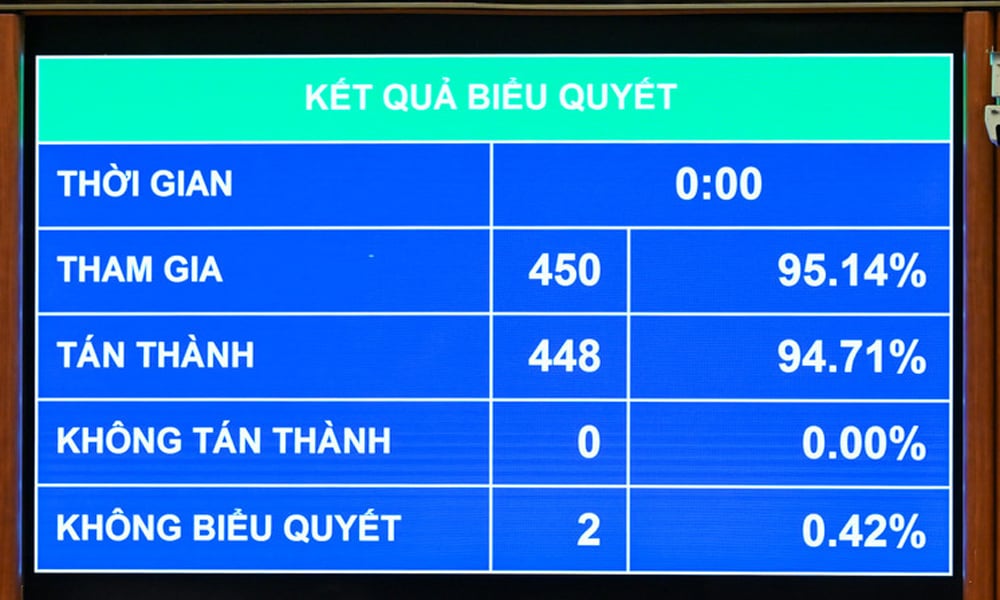 |
The results of the vote on the Population Law. |
Regarding policies to maintain replacement fertility levels, the draft has added Clause 4 to Article 7, stipulating a comprehensive policy framework encompassing education, healthcare, housing, and other policies aimed at increasing the birth rate and achieving sustainable replacement fertility levels.
Maternity leave support and financial assistance for childbirth are categorized by target group and locality; priority is given to renting, buying, and lease-purchasing social housing in accordance with housing laws.
Specifically, the law stipulates measures to maintain the replacement fertility rate, including increasing maternity leave for female workers giving birth to their second child to 7 months; and for male workers to 10 working days when their wives give birth. Financial support is provided for childbirth to women from ethnic minority groups with very small populations; women in provinces and cities with birth rates below the replacement level; and women who have two children before the age of 35. Individuals with two or more children are given priority to purchase, lease-purchase, or rent social housing as stipulated by housing laws.
Regarding policies to adapt to population aging, the draft has revised and supplemented regulations on proactive measures for old age, such as preparing for health, finances, and psychology; participating in social insurance and health insurance; learning to improve knowledge and skills to maintain physical and mental health and social functioning; and participating in activities to support the care of the elderly.
The draft also adds regulations on elderly care, developing diverse forms of care at home and in the community; developing human resources for elderly care, separating formal and informal care groups, and thereby establishing mechanisms to support skills training appropriate to each group.
Diversifying resources for providing routine health check-ups for the public.
Also at the session, under the chairmanship of Vice Chairwoman of the National Assembly Nguyen Thi Thanh, the National Assembly conducted the voting process to pass the Law on Disease Prevention. The results showed that 440 out of 443 National Assembly deputies present voted in favor (accounting for 93.02%), and the Law on Disease Prevention was officially passed.
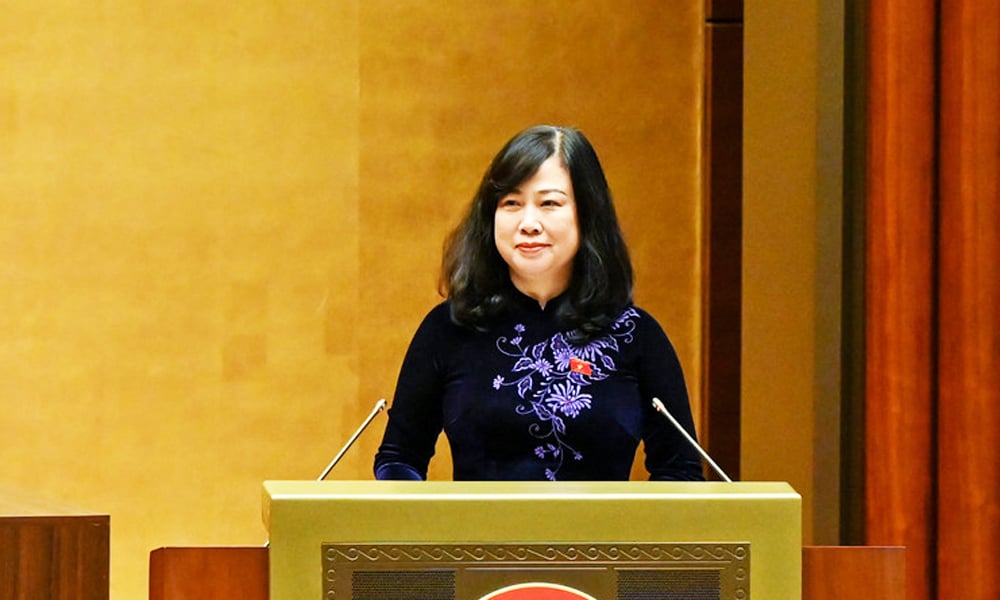 |
Minister of Health Dao Hong Lan. |
Before the National Assembly voted, the Minister of Health presented a report on the revisions and amendments to the draft law. The Minister stated that, based on the opinions of delegates during group discussions and plenary sessions; the opinions of the National Assembly's Committee on Culture and Social Affairs; and the opinions of the National Assembly Standing Committee, the Government had directed relevant agencies to review and incorporate as many suggestions as possible to finalize the draft.
Regarding free routine health check-ups and screenings, to ensure funding and feasibility, the Government has finalized regulations on diversifying resources, including the state budget, social mobilization, and especially the Health Insurance Fund.
The draft law (Article 44) amending and supplementing the Health Insurance Law stipulates that citizens will have their costs for routine health check-ups and screenings covered by the Health Insurance Fund free of charge, according to a roadmap and the fund's balancing capacity. This is a significant breakthrough in institutionalizing Resolution 20 and Resolution 72.
Regarding specialized policies, the draft law has incorporated and revised regulations on the prevention and control of non-communicable diseases; the prevention and control of mental disorders; nutrition in disease prevention; risk management; screening, early detection, and appropriate prevention and treatment.
Policies prioritizing vulnerable groups and disadvantaged areas are clearly demonstrated. At the same time, regulations on infectious disease prevention and control have been supplemented and updated based on practical experience gained during the Covid-19 pandemic.
Regarding the Disease Prevention Fund, the Government has revised the draft to separate the fund's purpose and tasks into two distinct components to ensure clarity. The draft also adds expenditure for regular health check-ups and free screenings to align with Article 27 and strengthen resources for implementing this important policy.
Regarding the technical aspects of the text and the consistency of the law, the draft law has been reviewed and revised to include provisions related to state management; the responsibilities of press agencies; terminology; prohibited acts; and to ensure consistency within the legal system in articles such as Article 5, Article 10, etc.
Source: https://baobacninhtv.vn/thong-qua-luat-dan-so-uu-tien-mua-nha-o-xa-hoi-voi-nguoi-co-tu-2-con-de-tro-len-postid432857.bbg

![[Photo] The captivating scenery of the fragrant maple forest in Quang Tri](/_next/image?url=https%3A%2F%2Fvphoto.vietnam.vn%2Fthumb%2F1200x675%2Fvietnam%2Fresource%2FIMAGE%2F2025%2F12%2F10%2F1765353233198_lan09046-jpg.webp&w=3840&q=75)
![[Photo] Explore the US Navy's USS Robert Smalls warship](/_next/image?url=https%3A%2F%2Fvphoto.vietnam.vn%2Fthumb%2F1200x675%2Fvietnam%2Fresource%2FIMAGE%2F2025%2F12%2F10%2F1765341533272_11212121-8303-jpg.webp&w=3840&q=75)


















![[Video] The craft of making Dong Ho folk paintings has been inscribed by UNESCO on the List of Crafts in Need of Urgent Safeguarding.](https://vphoto.vietnam.vn/thumb/402x226/vietnam/resource/IMAGE/2025/12/10/1765350246533_tranh-dong-ho-734-jpg.webp)




















































Comment (0)