

Strengthening decentralization and delegation of authority in planning activities
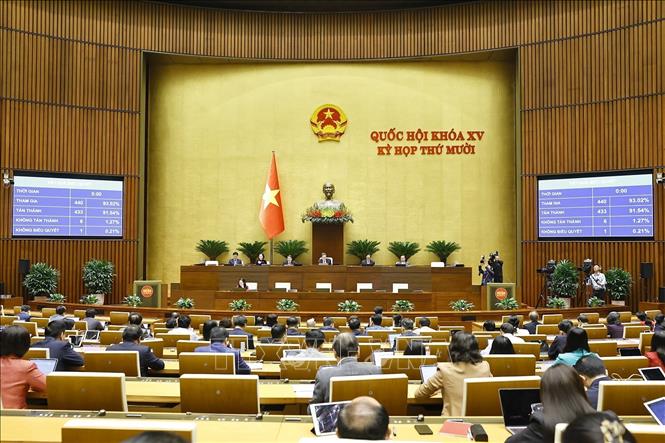
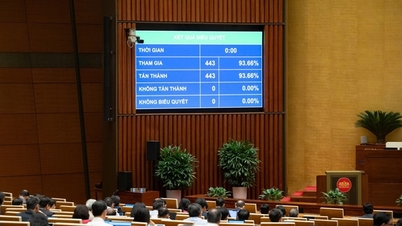
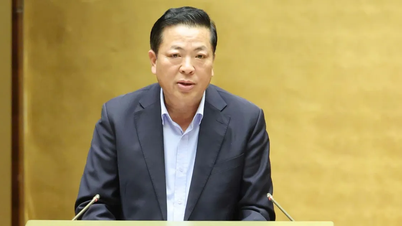
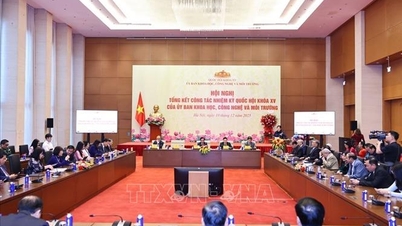
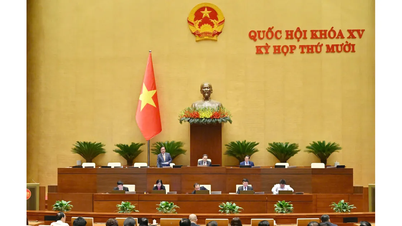
With 428 out of 445 delegates voting, representing 90.49%, the National Assembly passed the draft Law on Planning (amended). This is an important draft law aimed at removing bottlenecks, strengthening decentralization and delegation of power, and simplifying administrative procedures in planning activities.
The Law on Planning (amended) consists of 6 Chapters, 58 Articles and attached Appendices.
The law focuses on addressing key issues to overcome the problems of slow, overlapping, and inconsistent planning. The law has several new points compared to the current law. Accordingly, it improves the planning system and clarifies the concept of "Detailed sectoral planning". The planning system includes: National-level planning (overall, marine spatial, land use, sectoral); Regional planning; Provincial planning; Detailed sectoral planning; Urban and rural planning; Planning for special administrative- economic units.
A key new feature of the Law is the replacement of the concept of "technical, specialized planning" with "detailed sectoral planning". This change aims to accurately reflect the specific nature of this type of planning, clearly define the hierarchical relationship, and resolve difficulties in determining its legal role.
The Government has reviewed and streamlined the planning list, reducing it from 78 to 49 plans.
In line with the principle of "local authorities decide, local authorities act, local authorities take responsibility," the Law introduces significant changes regarding approval authority. Accordingly, the Chairman of the Provincial People's Committee approves the Provincial Planning and the Provincial Land Use Planning, instead of the Prime Minister as before. This helps reduce the burden on the central government and increases the autonomy of local authorities.
Regarding regional planning, the Prime Minister approves regional planning to ensure connectivity and resolve inter-provincial issues.
For sectoral planning, the approval authority is implemented according to Government regulations (can be delegated to the Minister for some planning).
The law also addresses obstacles in assessing the conformity of projects with planning. This is a new provision added in Article 48 to resolve practical difficulties. Specifically, the law allows for investment decisions that differ from the planning for special, urgent public investment projects or those directed by the Politburo, the Secretariat, the National Assembly, or the Government; subsequently, the planning will be updated and adjusted through a simplified procedure.
The law also reflects innovations in planning periods and vision. Accordingly, the planning period is standardized at 10 years (calculated from the year ending in 1 to the year ending in 0). The planning vision is 30 years. This ensures consistency with the socio-economic development strategy.
The law stipulates the establishment of a national information system and database on planning for unified management, serving state administration and providing information to citizens and businesses. Planning documents must be publicly disclosed (except for state secrets) to ensure easy access for citizens and organizations.
The law is expected to take effect from March 1, 2026. However, regulations on adjusting national, regional, and provincial planning for the period 2021-2030 to serve administrative unit restructuring or growth targets will take effect earlier (from the date the law is passed) to ensure implementation before December 31, 2025. The amended Planning Law is expected to create a more favorable legal framework, address current shortcomings, and provide impetus for sustainable socio-economic development.
Improving the effectiveness of depositor protection
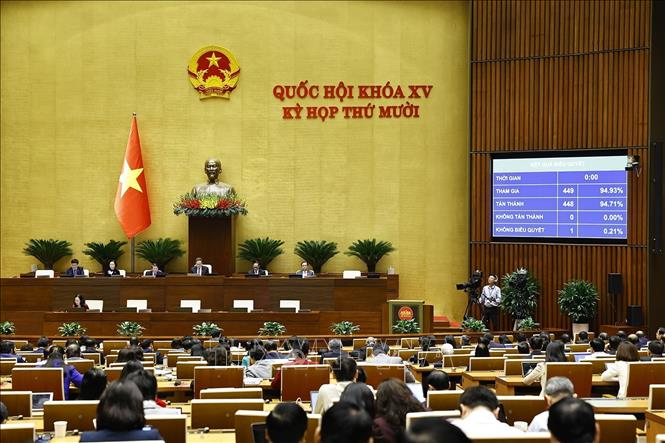
With 448 out of 449 delegates voting in favor, representing 94.71%, the National Assembly passed the draft Law on Deposit Insurance (amended). The law comprises 8 chapters and 41 articles, with the following specific structure:
The amended Law on Deposit Insurance includes several important changes aimed at improving the effectiveness of depositor protection and ensuring system safety. Accordingly, the Law promotes online information transparency by adding regulations on the form of public disclosure of deposit insurance participation. Specifically, Article 16 stipulates that, in addition to displaying copies of the Certificate at transaction points, deposit insurance participating organizations must publicly disclose this information on their websites (if any).
The law enhances the role of the deposit insurance organization in crisis management and support for credit institutions, with detailed regulations on the participation of the deposit insurance organization in early intervention, special control, and incident/crisis handling. New mechanisms include: special lending; and purchasing long-term bonds.
The law clearly stipulates the responsibility of the State Bank of Vietnam in sharing data and information about deposit insurance participating institutions with the deposit insurance organization to perform its functions and duties. Regarding state management, the law affirms that the State Bank of Vietnam is responsible for inspecting, examining, and handling violations related to deposit insurance in accordance with this law and relevant laws.
The law stipulates that within 30 days from the date a deposit insurance participating institution ceases accepting deposits or becomes insolvent, the deposit insurance organization is responsible for paying deposit insurance benefits to depositors.
After the Law is passed, the Government will direct the State Bank of Vietnam and relevant agencies to promptly issue guiding documents to implement the Law as quickly and effectively as possible.
Source: https://baotintuc.vn/thoi-su/thong-qua-luat-quy-hoach-sua-doi-va-luat-bao-hiem-tien-gui-sua-doi-20251210103827370.htm

























![[Video] The craft of making Dong Ho folk paintings has been inscribed by UNESCO on the List of Crafts in Need of Urgent Safeguarding.](https://vphoto.vietnam.vn/thumb/402x226/vietnam/resource/IMAGE/2025/12/10/1765350246533_tranh-dong-ho-734-jpg.webp)
































































Comment (0)