

The Cham community in Lac Thanh town, Tanh Linh district, holds a ceremony to worship Po Cei Khai Mâh Bingu on the mountain periodically, every 3-5 years. The worship of Po Cei Khai Mâh Bingu aims to pray for the deity's blessings for a prosperous and happy life for the villagers.
The ruins of the Po Cei Khai Mâh Bingu temple.
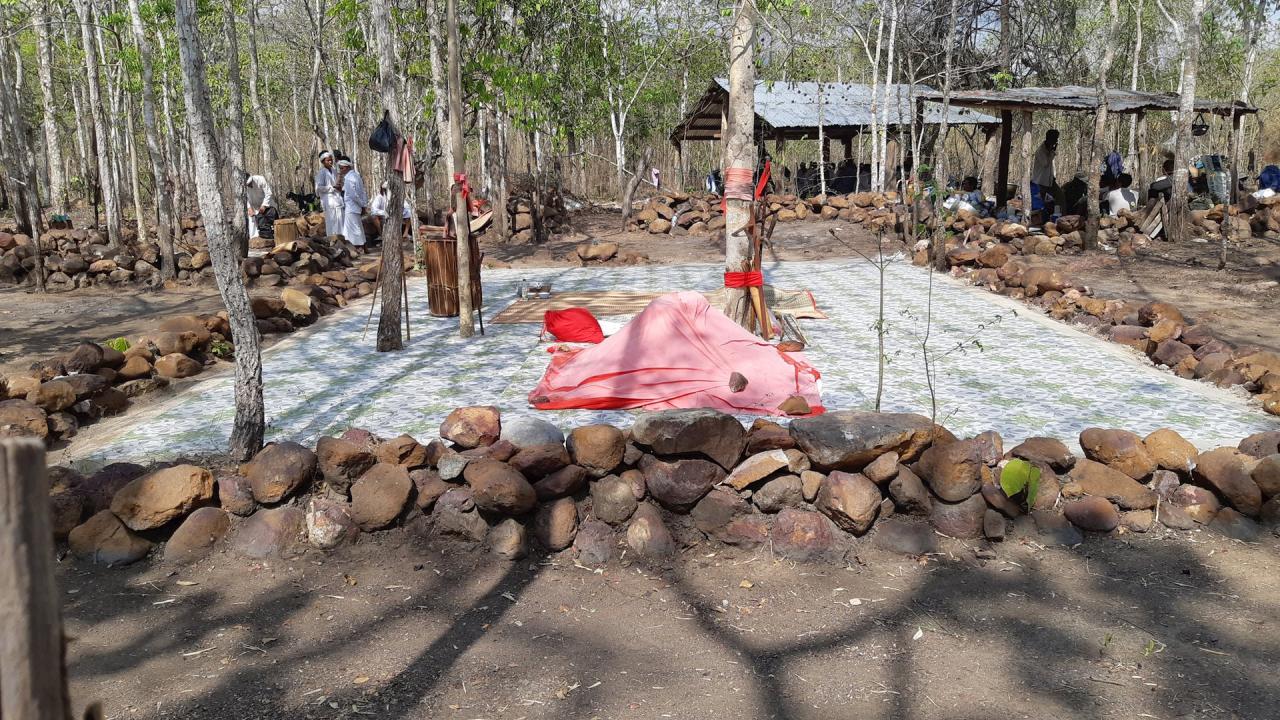
The Po Cei Khai Mâh Bingu temple site is located in the Kalong forest in Tánh Linh district, Bình Thuận province. According to Mr. Thông Dừa (35 years old), a Pajau official, Po Cei Khai Mâh Bingu was the son of Po Haniim Par. The shrine dedicated to Po Cei Khai Mâh Bingu is a sand-built tomb. Surrounding the tomb is a wall made of stacked stones, approximately 50cm high. This stone wall consists of two layers, with the interior divided into the following areas:
The kitchen area (in the southwest): Used for storing food and preparing offerings for the deities. The area for worshipping the thunder god (in the east): The temple dedicated to the thunder god is built of stacked stones. The worship of the thunder god is overseen by the officials (Halau Balang).
The area for the officials (in the southeast) is occupied by the Halau Balang, who sit together in a separate area near the entrance opposite the kitchen. Their duty is to protect and control the offerings brought by the people for the ceremony and the central area, where the sand mound and offerings to the deities are located. The central area is reserved only for the Acar, Maduen, Ka-ing, Kadhar, and Pajau officials, the ceremonial dancers, and the ceremonial band. People only enter the central area when offering their prayers and making offerings.
Besides the stone rampart system serving as the main worship space, about 1km away there are traces of a fortified wall built with stacked stones, 1-2m high and approximately 5km long. According to Mr. Dong Van Long from the Cham neighborhood, Lac Thanh town, Tanh Linh district, the function of the stone rampart was for hunting wild animals.
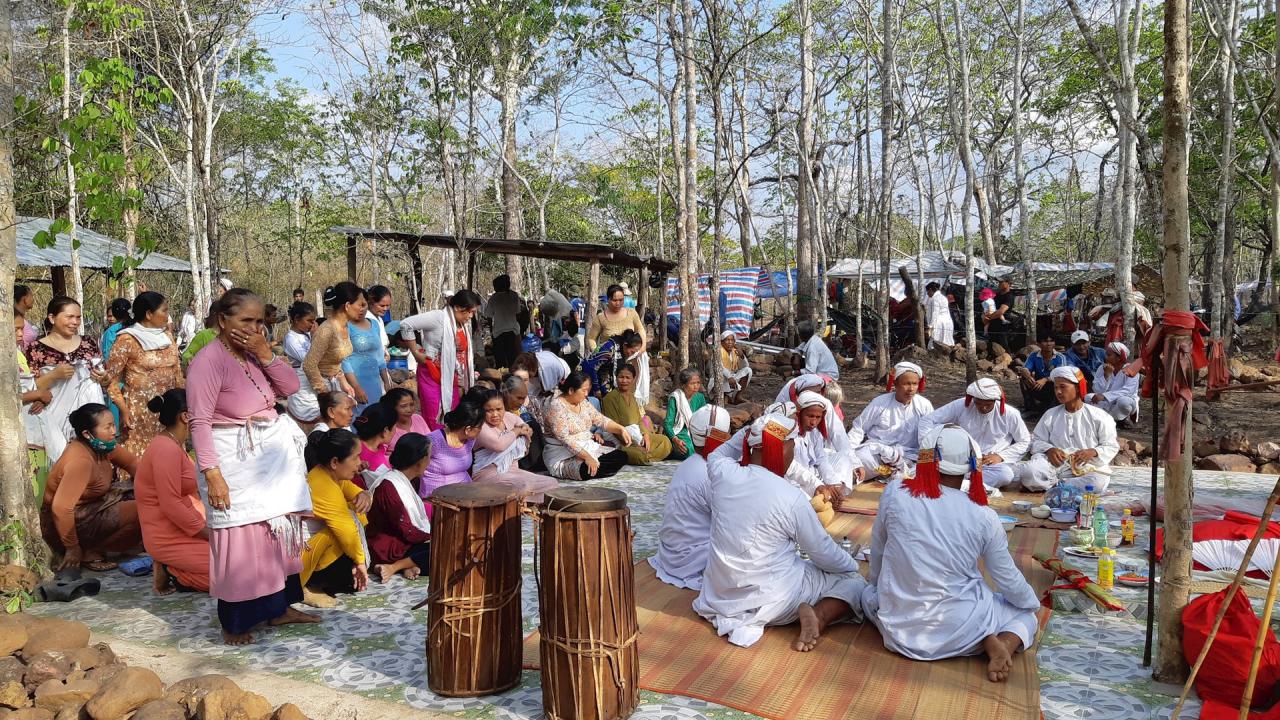
The Po Cei Khai Mâh Bingu worship ritual
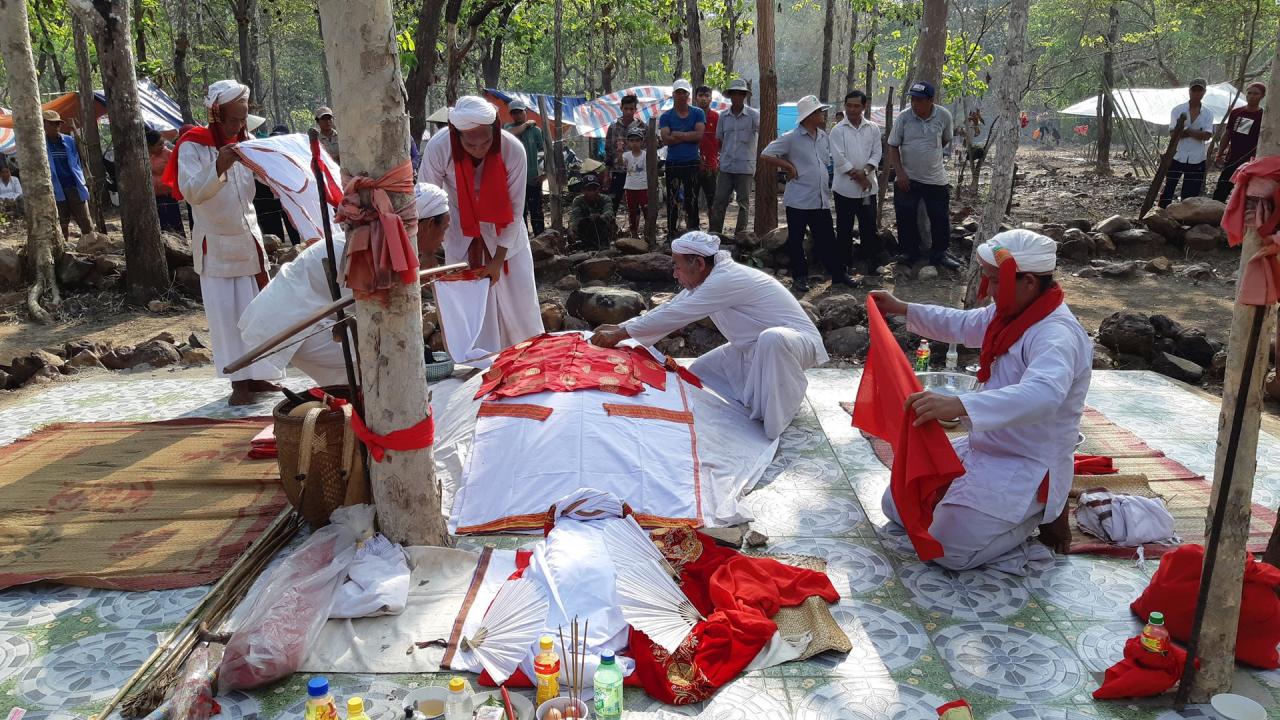
According to the ritual leader, the Po Cei Khai Mâh Bingu ceremony can be divided into three main rituals: the Pa-mruai ritual presided over by the Po Acar deity, the Rija Harei ritual performed by the Ka-ing and Maduen deities, and the Abu Rieng ritual performed by the Kadhar and Pajau deities. These rituals are conducted continuously and last from evening until early the next morning.
Pa-mruai ritual
The Acar religious leaders sit facing south towards the sand-covered tomb, with the highest-ranking leader being the Imam. In front of the Imam is a bowl of burning charcoal for incense. When the Imam begins reciting prayers in Arabic, the Acar religious leaders chant in unison. The Acar religious leaders only recite prayers and perform rituals; they do not offer sacrifices. While the Acar leaders are reciting, the people clasp their hands in prayer, hoping for good fortune in life, favorable weather, family peace, and happiness. The Acar religious leaders' only duty is to perform the Pa-mruai ritual. They have a separate altar in the Po Cei Khai Mâh Bingu worship area. On the Acar religious leader's altar, there is a bunch of bananas, a tray of betel nuts, fruit, cakes, and a teapot.
Rija Harei ritual
At the Po Cei Khai Mâh Bingu ceremony, the Maduen priest invites the spirits, beating the Baranâng drum and singing about the legends of the gods. The Ka-ing priest pours wine to offer to the gods and performs the main ceremonial dance. The ceremonial band consists of the Ginăng drum, Saranai horn, and gongs playing together to accompany the Ka-ing dance. In addition, there is a Churu ceremonial band participating, consisting of a drum (used to keep the rhythm by hand, not by a mallet like the Ginăng drum of the Cham people), rattles (grong), and Kabot horns (gourd horns).
Ka-ing's only props in the Rija Harei ritual are a red handkerchief, a paper fan, and a rattan whip. Throughout the ceremony, Ka-ing moves back and forth, his hand movements graceful, his feet light, in rhythm with the Ginang drums of the ceremonial band. However, when a spirit possesses Ka-ing, his whole body trembles, and he takes out a slingshot and a stick, burning incense smoke. These two weapons were used by Po Cei Khai Mâh Bingu for going into the forest and hunting animals.
The main offering is a boiled goat, shredded and arranged on a bamboo tray. The goat meat is divided into two trays, one for Patuei and one for Kalai. Other offerings brought by the villagers include chicken, betel nuts, eggs, wine, fruit, and dried coconuts… In addition, each family attending the ceremony brings a small container (Ciét) holding clothing for the deceased and a rattan whip.
Abu Rieng ritual
Immediately after the Ka-ing and Maduen officials finished their offerings, the Kadhar and Pajau officials continued to arrange the offerings. The main offerings consisted of a pair of boiled chickens, one rooster and one hen. In addition, there was a tray of betel nuts, two eggs, one bowl of rice (lisei hop), ten bowls of soup, four bowls of rice, and a small bottle of wine.
The ceremony begins with the Kadhar priest burning incense and invoking the spirits to witness and accept the offerings. The prayers explain the purpose of the people's offerings and the offerings themselves. Through these offerings, they ask the gods for blessings and protection, for favorable weather, and for a peaceful, prosperous, and happy life for the people. When offering sacrifices to Po Cei Khai Mâh Bingu, the Kadhar and Pajau priests sing and recount the god's life story and merits. The Kadhar priest plays the Kanyi instrument while singing hymns, with the other priests singing along. Towards the end of the song, the priests and people form a circle and dance celebratoryly around the god's tomb until the song concludes. Everyone ties scarves around their waists, clasps their hands above their heads, and prays to the god, wishing for good fortune for their families.
After the village's offering ceremony, families arrange offerings to present to the deity, either to repay debts as promised or to pray for divine blessings. The offerings for Abu Rieng include two grilled fish (usually snakehead fish), porridge, and sweet rice porridge. The grilled fish are placed on a bamboo rack lined with banana leaves, and the porridge is served in bowls on two trays. Each tray contains four bowls of porridge and one plate of sticky rice. Approximately 8-12 families participate in each offering, with Kadhar and Pajau officials assisting in arranging the offerings. Families offering chicken and packed lunches (lisei hop) also include a dried coconut. The following day, families with children who are difficult to raise or frequently ill request permission to perform the ritual of placing bracelets and anklets on the children. The officials divide the tasks among themselves to perform the ritual according to the people's wishes.
Thus, the belief in worshipping Po Cei Khai Mâh Bingu on the mountain has existed for a long time. However, due to the rugged mountainous terrain and difficult access, the people of the Cham neighborhood in Lac Thanh town, Tanh Linh district, invited the deity to the village to build a temple for easier offerings and worship. Although a new place of worship has been established in the village, the people still commemorate the deity at the old place of worship. Therefore, every 3-5 years, the people organize a ceremony on the mountain. The belief in worshipping Po Cei Khai Mâh Bingu is a synthesis of many rituals, with the participation of the dignitaries Po Acar, Ka-ing, Kadhar, and Pajau. Notably, the Churu, Kaho, and Cham ethnic groups in Tanh Linh and Ham Thuan Bac districts also practice the rituals together. This shows that the belief in worshipping Po Cei Khai Mâh Bingu has a profound influence on the ethnic minority communities in Binh Thuan province.
Source


![[Photo] Prime Minister Pham Minh Chinh holds a phone call with the CEO of Russia's Rosatom Corporation.](/_next/image?url=https%3A%2F%2Fvphoto.vietnam.vn%2Fthumb%2F1200x675%2Fvietnam%2Fresource%2FIMAGE%2F2025%2F12%2F11%2F1765464552365_dsc-5295-jpg.webp&w=3840&q=75)


![[Photo] Closing Ceremony of the 10th Session of the 15th National Assembly](/_next/image?url=https%3A%2F%2Fvphoto.vietnam.vn%2Fthumb%2F1200x675%2Fvietnam%2Fresource%2FIMAGE%2F2025%2F12%2F11%2F1765448959967_image-1437-jpg.webp&w=3840&q=75)
































![[OFFICIAL] MISA GROUP ANNOUNCES ITS PIONEERING BRAND POSITIONING IN BUILDING AGENTIC AI FOR BUSINESSES, HOUSEHOLDS, AND THE GOVERNMENT](https://vphoto.vietnam.vn/thumb/402x226/vietnam/resource/IMAGE/2025/12/11/1765444754256_agentic-ai_postfb-scaled.png)


















![[Infographic] Preventing students from making their own firecrackers: 7 things parents need to know](https://vphoto.vietnam.vn/thumb/402x226/vietnam/resource/IMAGE/2025/12/11/1765466656703_img_0320_20251211183542.jpeg)















Comment (0)