

China is accelerating the completion of the Type 076, the next generation of the Type 075, to enhance its amphibious assault capabilities – which it is using as a deterrent in its maritime sovereignty disputes.
The South China Morning Post reported that China launched its first Type 076 submarine yesterday (December 27).
New power
Compared to its predecessor, the Type 075, which had a full-load displacement of 40,000 tons, the Type 076 not only increased the full-load displacement to 50,000 tons but was also equipped with an electromagnetic catapult to enhance its combat capabilities by launching unmanned aerial vehicles (UAVs) more quickly. This allows the Type 076 amphibious assault ship to accelerate its amphibious landing capabilities (both at sea and on land) and increase its attack intensity. Many analyses suggest that China is aiming to develop the Type 076 into an aircraft carrier specifically designed for UAVs.
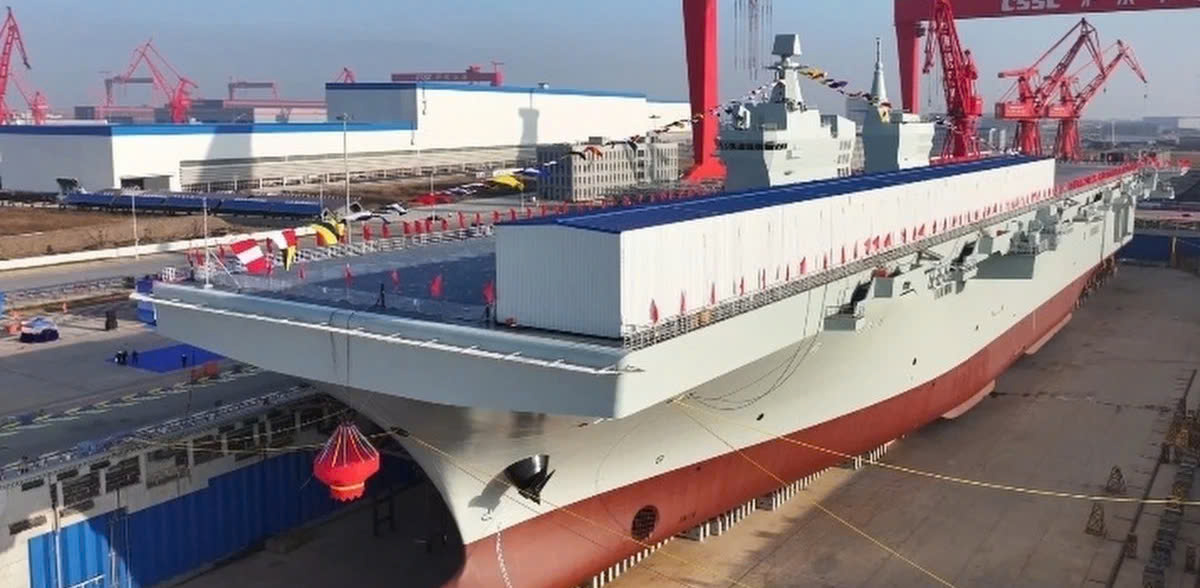
Type 076 ship
In addition, the Type 076 retains all the characteristics of previous generations of amphibious assault ships. These include the ability to carry 1,000 soldiers, dozens of helicopters of various types, including the Z-8 and Z-9 multi-role combat helicopters, and two hovercraft landing craft.
Recently, there have been many indications that China is seeking to upgrade its Type 075 and 076 ships in a manner similar to what the US has done with the Wasp and America-class amphibious assault ships, or how Japan operates its Izumo-class amphibious assault ships. The US and Japan have deployed the F-35 stealth fighter jet (short takeoff and vertical landing version) on the Wasp, America, and Izumo classes. These amphibious assault ships can then function as light aircraft carriers. China, meanwhile, is striving to develop the J-35 with similar capabilities for deployment on its Type 075 and Type 076 ships.
Serving ambitions to control the seas.
In recent times, even during peacetime, amphibious assault ships have been deployed to serve China's ambitions for maritime sovereignty.
In the middle of this year, amidst serious tensions with the Philippines in the South China Sea, the Global Times reported that Beijing had deployed a Type 075 warship to the Subi Reef area in the Spratly Islands, which is under Vietnamese sovereignty but illegally occupied by China. Prior to this, China announced that one of its Type 071 landing ships had conducted amphibious landing exercises involving hovercraft at Subi Reef.
In an interview with Thanh Nien newspaper, Dr. Satoru Nagao (Hudson Institute, USA) pointed out that amphibious assault ships are amphibious vessels and also the largest warships to meet control objectives in peacetime. In wartime, military operations require eliminating enemy resistance. However, in peacetime, it is impossible to sink other countries' ships, so the comprehensive service capabilities of amphibious assault ships are highly significant.
China intends to build and renovate artificial islands. This requires amphibious landing capabilities. Therefore, using amphibious assault ships demonstrates greater confidence in continuing operations. Through amphibious assault ships, China can land a large number of military personnel or construction workers. That is why China's deployment of Type 075 ships in the South China Sea is a cause for concern.
Therefore, by strengthening its amphibious assault ship fleet, China can further intensify its activities in the South China Sea as well as other maritime regions.
Is China developing a 6th-generation fighter jet?
Yesterday (December 27), the South China Morning Post cited a clip on Chinese social media showing a new type of fighter jet being test-flown (photo) .
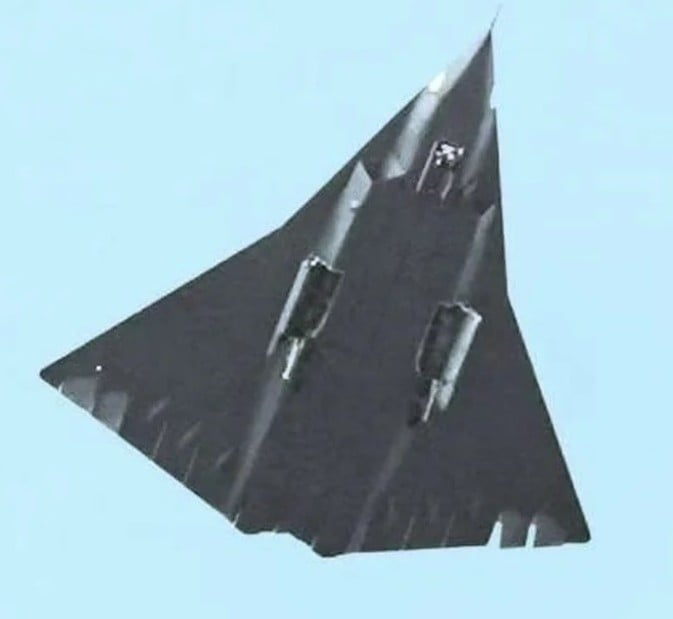
Subsequently, several official military channels "hinted" at confirming the information. This is believed to be a sixth-generation stealth fighter jet. To date, China has developed two fifth-generation stealth fighter jets, the J-35 and J-20, which have designs quite similar to the US F-35 and F-22, respectively. Both the J-35 and J-20 have already been deployed to the Chinese armed forces.
Source: https://thanhnien.vn/trung-quoc-tang-cuong-thuc-luc-do-bo-tan-cong-tren-bien-185241227231043763.htm

















































































Comment (0)