

In December, in Zhangye, a city in Gansu province, the chimneys of waste-to-energy plants still belched white smoke, but behind them was a quiet but drastic shift in an entire industry. As the domestic economic growth rate slowed, causing the amount of waste - an important input "raw material" - to be less abundant than predicted, Chinese businesses realized they could no longer stay at home.
The latest statistics paint a vibrant picture of this “going abroad” wave. In just six months to the end of November, the number of overseas incinerator projects involving Chinese companies has skyrocketed from 79 to 101. The footprint of this country’s environmental corporations has now spread from neighboring Asian countries to Europe, Africa and even the Americas.
Mr. Guo Yungao, Secretary General of the Energy and Environment Committee of the All-China Environmental Federation, commented that the industry is making a qualitative leap. No longer simply exporting individual machinery and equipment, Chinese enterprises now provide complete solutions, from technology, operating standards, management to direct capital injection into international projects.
However, the driving force behind this aggressive expansion is not simply the ambition to dominate the market, but also a necessary escape route from the "overabundance" crisis at home.
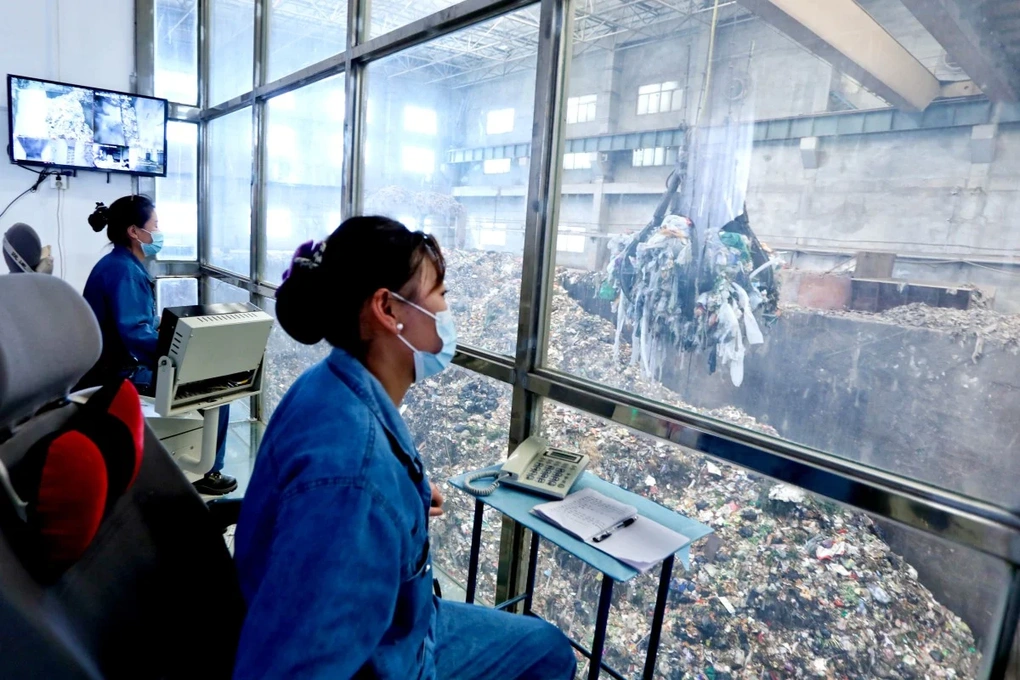
Slowing economic growth has left the domestic “waste-to-energy” industry short of fuel. Chinese companies are increasingly looking abroad for waste and profits (Photo: SCMP).
When "miracle drug" becomes "poison"
To understand the origins of the current crisis, it’s worth looking back to the heyday of China’s waste-to-energy industry a decade ago. In the early 2000s, as landfills ran low and pollution concerns mounted, Beijing bet big on waste-to-energy technology. Backed by public-private partnerships and generous subsidies, thousands of plants sprang up.
In less than a decade, China has undergone a rapid revolution, increasing its processing capacity from 102 million tons/year in 2018 to a whopping 206 million tons in 2024. Currently, the country holds two-thirds of the world's waste-to-energy capacity, processing nearly 80% of urban household waste.
But the hasty development has had an unintended consequence: a surplus crisis. Planners were too optimistic when they predicted that waste would grow linearly with the economy. The reality is much harsher. Large cities have so many incinerators that factories are competing fiercely for resources, while rural areas – where the real need is – are left behind due to high collection costs and low population density.
Ironically, the government ’s environmental protection efforts have been a fatal blow to the incineration industry. The “Zero Waste Cities” campaign and strict waste sorting regulations that have been widely applied have caused the amount of waste entering the incinerator to decrease in both quantity and calorific value.
Many factories are currently operating at only 60% capacity, and some have even resorted to the extreme option of digging up trash from old, closed landfills to burn.
Financial shock and wake-up call
The business picture of China’s waste-to-energy industry is shifting from bright to gray. The three main revenue pillars that once helped businesses make money: state subsidies, electricity sales and carbon credits are all shaking violently.
First is the subsidy shock. Since 2023, the central budget has stopped supporting new projects, shifting the entire financial burden to local governments. In the difficult economic context, many localities have fallen into a state of prolonged payment delays. As of mid-2024, listed environmental enterprises were in arrears of up to 350 billion yuan (equivalent to 49 billion USD), a staggering figure that exceeded their total operating revenue.
Next is the disappearance of carbon credits. Incineration used to reduce methane emissions from landfills, generating significant revenue from the sale of certified emission reductions (CCERs). However, with new, more stringent environmental accounting methods in place from 2024, this cash flow has almost completely disappeared, wiping out around 10% of the net profits of well-run businesses.
Even revenue from electricity sales is no longer attractive as the price of green electricity certificates (RECs) has plummeted due to oversupply. These factors combined to create a “perfect storm”, wiping out the lucrative profit margins that the industry once enjoyed.

The large-scale implementation of waste sorting since 2020 has caused incinerators to lose their previously abundant source of waste. (Photo: Flickr).
Expensive lessons in planning and adaptation
The story of China's waste-to-energy industry is a typical "case study" of ESG (Environmental - Social - Governance) risks in investment.
Environmentally, while incineration is better than landfill, it is still a “end-of-the-pipe” solution. The overabundance of incinerators goes against the principles of the circular economy (Reduce – Reuse – Recycle). In fact, the pressure to feed incinerators can actually encourage the creation of more waste rather than reduce it.
On the social front, the "Not In My Backyard" movement is spreading. Urban residents are increasingly concerned about dioxin emissions and health risks, making it impossible to find sites for new projects.
Faced with the harsh reality, industry giants like Everbright Environment are being forced to restructure their survival strategies. The days of sitting back and enjoying the benefits of the beg-and-give mechanism are over. The company’s 2024 annual report shows a clear shift towards diversifying its revenue sources.
They no longer rely solely on municipal waste but have begun to expand into industrial waste treatment, while shifting their customer base from the government to private businesses and households.
But more importantly, going offshore is becoming the only way to solve the problem of excess capacity. By bringing technology, capital and management experience to emerging markets - where the thirst for waste treatment is as hot as China's 10 years ago - these businesses hope to find the lost "golden age".
However, this journey is also full of thorns as they have to face legal challenges and a complex business environment in a foreign country. Whether the strategy of exporting the "turning trash into gold" model will be successful or not is still an open question, but one thing is certain: the era of massive waste incineration in China has officially ended, giving way to a more substantial and sustainable development phase.
Source: https://dantri.com.vn/kinh-doanh/trung-quoc-xuat-khau-lo-dot-rac-cu-quay-xe-tim-vang-tu-phe-lieu-20251206090106634.htm
![[Photo] National Assembly Chairman Tran Thanh Man attends the VinFuture 2025 Award Ceremony](/_next/image?url=https%3A%2F%2Fvphoto.vietnam.vn%2Fthumb%2F1200x675%2Fvietnam%2Fresource%2FIMAGE%2F2025%2F12%2F05%2F1764951162416_2628509768338816493-6995-jpg.webp&w=3840&q=75)



![[Photo] 60th Anniversary of the Founding of the Vietnam Association of Photographic Artists](/_next/image?url=https%3A%2F%2Fvphoto.vietnam.vn%2Fthumb%2F1200x675%2Fvietnam%2Fresource%2FIMAGE%2F2025%2F12%2F05%2F1764935864512_a1-bnd-0841-9740-jpg.webp&w=3840&q=75)



















































































Comment (0)