


General Secretary To Lam inspects the activities of two-level local governments in Hanoi , July 1, 2025_Photo: tienphong.vn
Systems thinking is a method of perceiving problems in overall relationships, determining the structure, function and interaction between constituent elements (1) . Systems thinking helps to see administrative reform not only as restructuring the organization, but also as reshaping relationships, information flows, functions and responsibilities in a unified management ecosystem. At that time, the administrative apparatus is viewed as a whole consisting of many subsystems: institutions, human resources, technology, finance, law and public service culture. Each change in an element will create a reaction in the entire system. If administrative reform is only "cutting off the top" without adjusting the flow of information, staff capacity or digital technology , the system will be unbalanced.
Systems thinking in organizational structure and practical requirements
In recent years, administrative reform has become a focus in the strategy of building and perfecting the socialist rule-of-law state of Vietnam. The administrative reform has achieved many positive results, such as simplifying administrative procedures, applying information technology to public services, and gradually streamlining the state administrative apparatus at all levels. However, when viewed through the lens of systemic thinking, these reforms still tend to handle parts, lacking synchronization in institutions, technology, resources and organizational structure. For a long period of the country's history, the three-level local government model (commune, district, province) has played a very important role, especially the district level, which was once identified as a "fortress" in socio -economic development, maintaining national defense and security. However, entering a new stage of development, this model has revealed "bottlenecks" in system operation, such as:
The hierarchical structure causes overlap and congestion. In the three-level model, the division of tasks between the province, district and commune in reality still has many shortcomings. Most areas such as basic construction, environmental resources, population management, education, health, etc. have a three-level approval process. This not only slows down the processing time but also makes it difficult to assign specific responsibilities if violations occur.
The intermediate level operates in a formal and ineffective manner. The district level is considered a "transfer link" between the province and the commune, but its decision-making authority is actually limited. Most important decisions are still issued by the province, while the commune level is responsible for implementation. Therefore, in many places, the district level government exists as a formal administrative level, causing waste of human resources and budget. Practice also shows that in many localities, when an emergency situation occurs (natural disasters, land disputes, protests, etc.), the district level government often reacts slowly, cannot make immediate decisions, and must wait for instructions from the provincial level. This demonstrates the inflexibility of an intermediate level that lacks strong enough coordination capacity (2) .
The commune level is passive, lacking in power and capacity. The commune-level government, the unit closest to the people, is often seen as a place to "implement administrative orders" without the right to make decisions. All important issues, from small infrastructure investments, public land management, handling of construction order violations, etc., must seek opinions or wait for approval from the district and provincial levels. This causes the commune level to lose its initiative and responsibility to the people. In many places, the team of commune-level officials has not been properly trained and lacks comprehensive management capacity.
Imbalance in decentralization and delegation of power. Strong decentralization and delegation of power to localities is the Party's policy, which has been strongly implemented by Party committees at all levels to encourage dynamism, creativity and promote the positivity and initiative of all levels, sectors and localities. However, in reality, decentralization has only stopped at administrative affairs, without accompanying financial and personnel mechanisms. Although the commune level is "assigned tasks", it does not have the right to coordinate the budget, leading to the situation of "contracting out work without assigning tools". In addition, specialized agencies under districts and departments and sectors often tend to "hold power" or are afraid of responsibility, and do not proactively share data, hindering multi-level coordination and information exchange. This is a manifestation of rigid vertical management thinking, which does not reflect a flexible operating system as required by modern state governance.
The system has not been fully digitized. A fundamental “bottleneck” is that the application of information technology in administrative management is still scattered and lacks system connectivity. Each level has its own software platform, leading to “information segregation” and difficulty in synchronizing data. For example, in the field of civil status, information on birth, death, and marriage registration must be re-entered many times through the system at the commune, district, and justice departments, and is not synchronized in real time. This not only causes inconvenience to the people but also reduces the State's management capacity.
The limitations and “bottlenecks” in the operation of the three-level local government model have created an urgent need to replace it with a two-level local government to meet the country’s development requirements. This transformation is not simply a reorganization of the administrative apparatus, but a step to reform the structure of the public administration system. In that context, systemic thinking plays a key role in avoiding dysfunction, overlapping tasks or broken public service chains.
To effectively operate a two-level local government, it is necessary to review the entire flow of functions, information flows, coordination mechanisms between units and the way tasks are performed in a unified and adaptable whole. Re-establishing the flow of information and decision-making mechanisms is urgent. In the three-level model, the district level is the place to transfer instructions from the province to the commune and reflect back issues from the grassroots. Without a district level organization, this flow will be affected if there is no strong enough digital infrastructure and clear coordination regulations. Therefore, applying digital technology, data connection, and building a two-way information portal between the province and the commune are urgent requirements. Without a synchronous data platform and digital communication, information will be blocked, feedback will be slow and decisions will be unfounded, causing stagnation or contradictions in implementation (3) .
In the new model, the commune level must be repositioned in terms of role and capacity. Previously, the commune level often only performed simple administrative tasks or supported people's livelihood. In the new model, the commune level must undertake many functions that belonged to the district level, such as land management, small construction permits, natural disaster prevention and control, dispute mediation, security and order management in the area, etc. This requires comprehensive investment in infrastructure, budget, staff, legal tools and management capacity. There needs to be a mechanism of "conditional delegation" from the provincial level to the commune level, including finance and human resources, instead of just assigning additional tasks without ensuring implementation.
Administrative control and supervision in the two-tier local government system needs to be redesigned. The district level previously had the role of inspecting, checking, and supervising the commune level. When removing the district level, it is necessary to build a new supervision model, such as: Cross-supervision between communes in the cluster, vertical supervision from the province's specialized department, and at the same time apply digital supervision tools, such as scoring the quality of administrative services through data reflecting from the people.
Systems thinking must also be applied in regional - inter-commune coordination, especially with tasks that cannot be performed independently, such as waste collection, domestic water supply, border security, infectious disease management, etc. In France, the concept of the inter-commune model has become a specific organizational model, in which small communes pool resources to establish a coordination council, with the right to make decisions with their own budget, which is publicly controlled. Applying the inter-commune model with budget management and common authority for commune clusters contributes to improving the efficiency of public service provision in this country (4) . This is a way of thinking according to the "cooperative network" instead of the "subordinate, superior" model, suitable for the reality of Vietnam where many adjacent communes have the same geographical conditions, population and similar governance challenges.
Japan is one of the countries with a two-tier administrative management system at the local level. After merging small administrative units in 2005, Japan applied network management, decentralization with strict legal rules and retraining all commune-level officials (5) . The merger of grassroots administrative units is decisive in perfecting the local government system and improving the management capacity of grassroots governments in Japan. Similarly, Singapore does not maintain an intermediate level, but ensures public services thanks to a strong e-government system and centralized management capacity (6) .
Solutions to promote administrative reform based on systems thinking
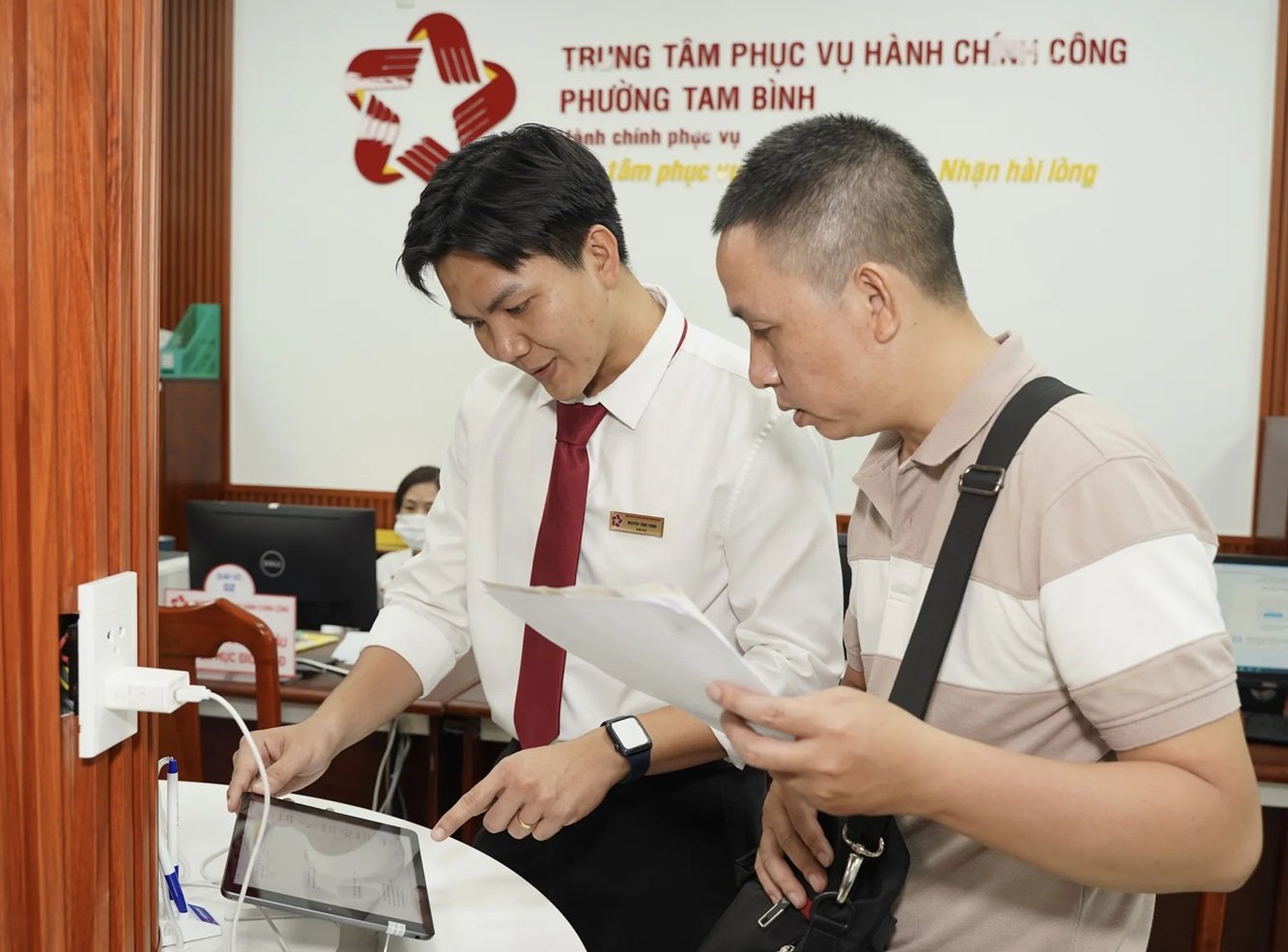
Officials of Tam Binh Ward, Ho Chi Minh City guide people to use tablets to look up information when coming to do administrative procedures at the ward_Photo: plo.vn
To continue administrative reform in the context of two-level local government, it is necessary to deploy solutions according to systemic thinking, that is, to comprehensively handle the system's constituent elements at the same time, with synchronous coordination between the apparatus organization, legal institutions, human capacity and technological platform.
First of all , it is necessary to promptly issue specific documents guiding the implementation of the Law on Organization of Local Government (Law No. 72/2025/QH15) passed by the 15th National Assembly on June 16, 2025. This is a legal document of historical significance, creating a solid legal foundation for the organization of administrative units and the two-level local government model organized for the first time in our country. In order for the implementation of the law to be synchronous and effective, the Government needs to promptly issue legal documents under its authority to redefine the tasks and powers of local governments, promptly adjust the operations of the new apparatus after the arrangement, and avoid the situation of "legal gaps". Delays in developing and completing legal documents affect the smooth operation of new agencies and units, causing confusion for officials and civil servants and potentially causing interruptions and stagnation in operations.
Second , deploy digital government and big data as the foundation for operating the new government. Each commune needs an electronic system to receive, process, and respond to requests for public services. The provincial level needs to effectively operate an intelligent operations center (IOC) to monitor the quality of implementation and evaluate performance according to specific indicators. Singapore's experience shows that, thanks to the integration of data between levels and sectors through the "Smart Nation" platform, the government can respond quickly to people's issues and evaluate the performance of officials based on practical data, not just formal reports (7) .
Third , improve the capacity of cadres in a multi-task and systematic way. Commune-level cadres need to be trained not only in expertise, but also in inter-sectoral coordination skills, financial management, technology, and emergency handling skills (natural disasters, epidemics, and local security). At the same time, provinces need to design a model of "grassroots government academy" to train commune cadres to meet new requirements. After merging localities in 2005, Japan implemented a policy of "comprehensive retraining of commune cadres" through regional academies, thereby improving the quality of governance and public trust (8) .
Fourth , establish inter-commune coordination centers in commune clusters with large populations, special conditions or expanding urban areas. These centers operate as a unit to manage common resources (health, transportation, electricity, water, epidemic prevention and control, etc.), which can be designated by the province or established by the communes themselves, creating a flexible, effective, and autonomous mechanism instead of being completely dependent on the province. This model can be learned from federal cooperation zones in Germany - where grassroots units maintain relative independence but coordinate together for more effective management (9) .
Fifth , build a set of indicators to evaluate the system of administrative reform including: time to process documents, level of people's satisfaction, rate of application of online public services, work performance of commune officials, level of coordination between the province, commune, department and branch. Publicize the evaluation results to promote active competition and enhance accountability.
The transition to a two-tier local government model is a major revolution aimed at streamlining the apparatus, improving administrative efficiency and creating new spaces for socio-economic development. In the process of operating the new model, if there is a lack of systemic thinking, it will easily lead to congestion, dispersion and reduced efficiency, requiring reform to be accompanied by a comprehensive restructuring of the apparatus, institutions, technology and people in a systemic, interactive and responsive relationship. The administrative structure is only effective when designed as a continuously operating ecosystem, flexibly connected and coordinated by data, law and accountability./.
-------------------------
(1), (3) See: Nguyen Dinh Cu: Systems thinking in state administration , Political Theory Publishing House, Hanoi, 2021
(2) See: Nguyen Thi Thu Hien: "Reducing intermediate administrative levels: Theory and practice", Journal of State Management , Hanoi, 2024, No. 2
(4) See: Organization for Economic Cooperation and Development: Territorial Reform in France: Trends and Challenges, OECD Publishing House, 2020
(5), (8) See: Nakamura, K.: Post-merger Governance in Japan: Challenges of System Integration, Japanese Journal of Management Studies , 2017
(6), (7) Tan, K.: Governance and Public Service Delivery in Singapore, Asian Journal of Public Administration, 2018
(9) German Corporation for International Cooperation (GIZ): Public Administration Reform in Germany, 2021
Source: https://tapchicongsan.org.vn/web/guest/chinh-tri-xay-dung-dang/-/2018/1113302/tu-duy-he-thong-ve-cai-cach-hanh-chinh-trong-boi-canh-chinh-quyen-dia-phuong-hai-cap-o-viet-nam.aspx



![[Photo] Closing Ceremony of the 10th Session of the 15th National Assembly](/_next/image?url=https%3A%2F%2Fvphoto.vietnam.vn%2Fthumb%2F1200x675%2Fvietnam%2Fresource%2FIMAGE%2F2025%2F12%2F11%2F1765448959967_image-1437-jpg.webp&w=3840&q=75)













































![[OFFICIAL] MISA GROUP ANNOUNCES ITS PIONEERING BRAND POSITIONING IN BUILDING AGENTIC AI FOR BUSINESSES, HOUSEHOLDS, AND THE GOVERNMENT](https://vphoto.vietnam.vn/thumb/402x226/vietnam/resource/IMAGE/2025/12/11/1765444754256_agentic-ai_postfb-scaled.png)














































Comment (0)