

Based on the traditional human dignity of "people are the flowers of the earth" and "respect for the people," Ho Chi Minh creatively applied and developed Lenin's (1870-1924) thought on the right to national self-determination under socialism; the ideas of freedom, equality, and fraternity of the French bourgeois revolution of 1789; Sun Yat-sen's (1866-1925) "Three Principles of the People" (national independence, civil liberties, and people's well-being); and the idea of the natural rights of each individual in international human rights law – transforming them into the independent, free, and happy rights of each individual and the Vietnamese nation, based on Marxism-Leninism. This is the ideology and theory that the Party, State, and people of Vietnam have applied and creatively developed during the period of reform.
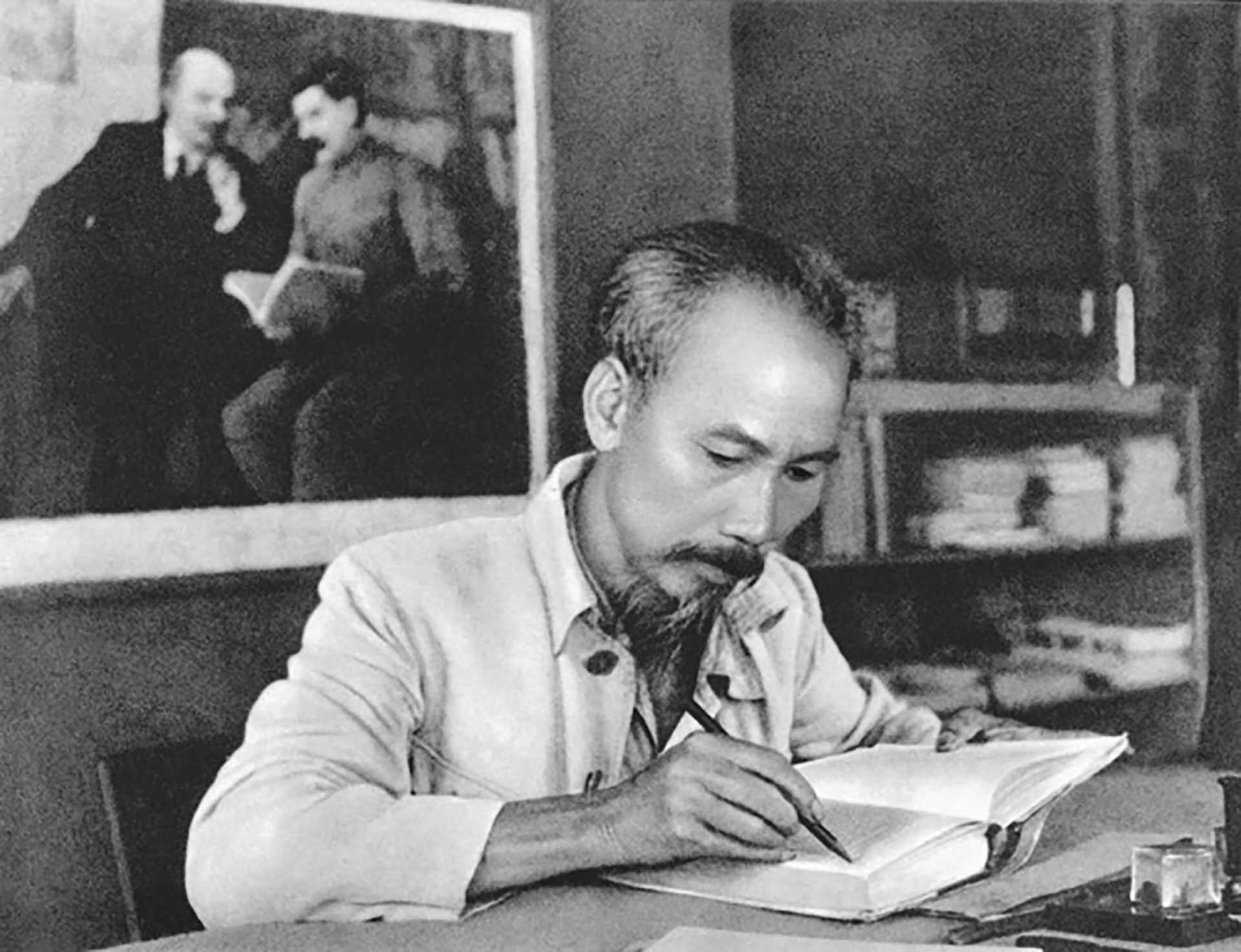 |
| President Ho Chi Minh in his office at the Viet Bac base (1951). (Source: hochiminh.vn) |
Ho Chi Minh's thought on human dignity and human rights
Regarding human dignity. President Ho Chi Minh considered human dignity from the perspective of the inherent human nature of man. He once borrowed the saying "At birth, human nature is inherently good" to explain the issue of Good and Evil in a simple way: "On Earth, there are millions of people. But these people can be divided into two categories: good people and evil people. In society, although there are hundreds of tasks and thousands of jobs, these jobs can be divided into two kinds: righteous and evil. Doing righteous work makes one a good person. Doing evil makes one an evil person."1 For President Ho Chi Minh, "good and evil are not inherent natures. They are mostly shaped by education."2 A person with human dignity will do good deeds, no matter how small, and avoid evil deeds, no matter how small.
It is argued that the traditional understanding of good and evil, and human dignity, is fundamentally expressed in benevolence and morality. Morality and human rights are different manifestations of human nature whenever individuals are present in the community and society, in various aspects and roles.
When approaching Marxism-Leninism, President Ho Chi Minh considered morality and human dignity to be the factors that had a profound influence on people's perceptions and feelings, rather than just intellectual genius.
Indeed, in his article "Lenin and the Peoples of the East" (1924), he wrote: "It was not only his genius but also his disdain for luxury, his love of work, his pure private life, his simple lifestyle, in short, the great and noble morality of the teacher that greatly influenced the peoples of Asia and made their hearts turn towards him unstoppable."3
Human dignity is linked to progressive humanistic values, as well as those "ahead-of-the-line" humanistic values of the nation and humanity.
In the light of Marxism-Leninism, these qualities were elevated to a new level by him, such as: integrating the rational "thinking human being" of the West and the "heart" or compassion of the Eastern people into "living with compassion and righteousness," "learning linked to practice," and "saying and doing in harmony" to achieve a balance between talent and virtue; elevating the humane love of humanity to communist humanism, bearing a Vietnamese identity; elevating traditional patriotism to Vietnamese patriotism in the era of the socialist revolution; elevating the tradition of national solidarity and solidarity to a tradition of national unity linked with international solidarity;...
Thus, according to Soviet journalist Osip Mandelstam (1923): "From Nguyen Ai Quoc emanated a kind of culture, not European culture, but perhaps the culture of the future."
Regarding human rights: The preamble of the 1948 Universal Declaration of Human Rights acknowledges the dignity and inalienable equal rights of all members of the human family. Human rights are the legal expression of human dignity in society. President Ho Chi Minh, through the Declaration of Independence on September 2, 1945, linked individual rights with the rights to independence, freedom, and happiness of all nations.
Thus, he expanded human rights to include the right to national self-determination. It is important to emphasize that it was not until 1966 that the International Covenant on Civil and Political Rights (ICCPR) and the International Covenant on Economic, Social and Cultural Rights (ICESCR) linked the right to national self-determination with human rights.
This is because Ho Chi Minh truly valued the practice of the dialectical relationship between individual rights and the rights of communities (ethnic groups, religions, genders, etc.) with the independence, freedom, and happiness of the nation, in accordance with Article 55 of the 1945 UN Charter. The decisions of a nation-state belong only to all the permanent inhabitants of the territory of that new nation-state, because they are subjects of international law.
Human rights encompass the totality of socio-legal relations of human dignity and are manifested in cultural personality. Those who consider human rights primarily view them as a tangible product achieved by individuals in their struggle with the natural world, society, and themselves, especially in the struggle against oppression and exploitation, and link them to the level of economic and cultural development in each historical period of a nation and humanity.
Therefore, human rights always bear national and class characteristics and depend on each socio-political regime and each national culture. Thus, human rights are not limited to the natural-social aspects, but are essentially the “total of social relations” 4 (Karl Marx), primarily legal relations, human dignity, and are expressed in cultural personality. Therefore, we must find ways to deeply instill culture into the national psyche..., we must find ways for everyone to have the ideals of self-reliance, independence, and freedom... everyone to understand their responsibilities and know how to enjoy the happiness they deserve.5
Human rights are recognized in both civil rights and human rights through laws and self-governing cultural institutions in society. Inheriting this idea of Karl Marx, President Ho Chi Minh used both terms human rights and civil rights (citizen rights) and always emphasized the unified relationship between them in order to realize the independence, freedom, and happiness of the nation and state on the basis of respecting, protecting, and implementing the right to life, freedom, and the pursuit of happiness of every Vietnamese person.
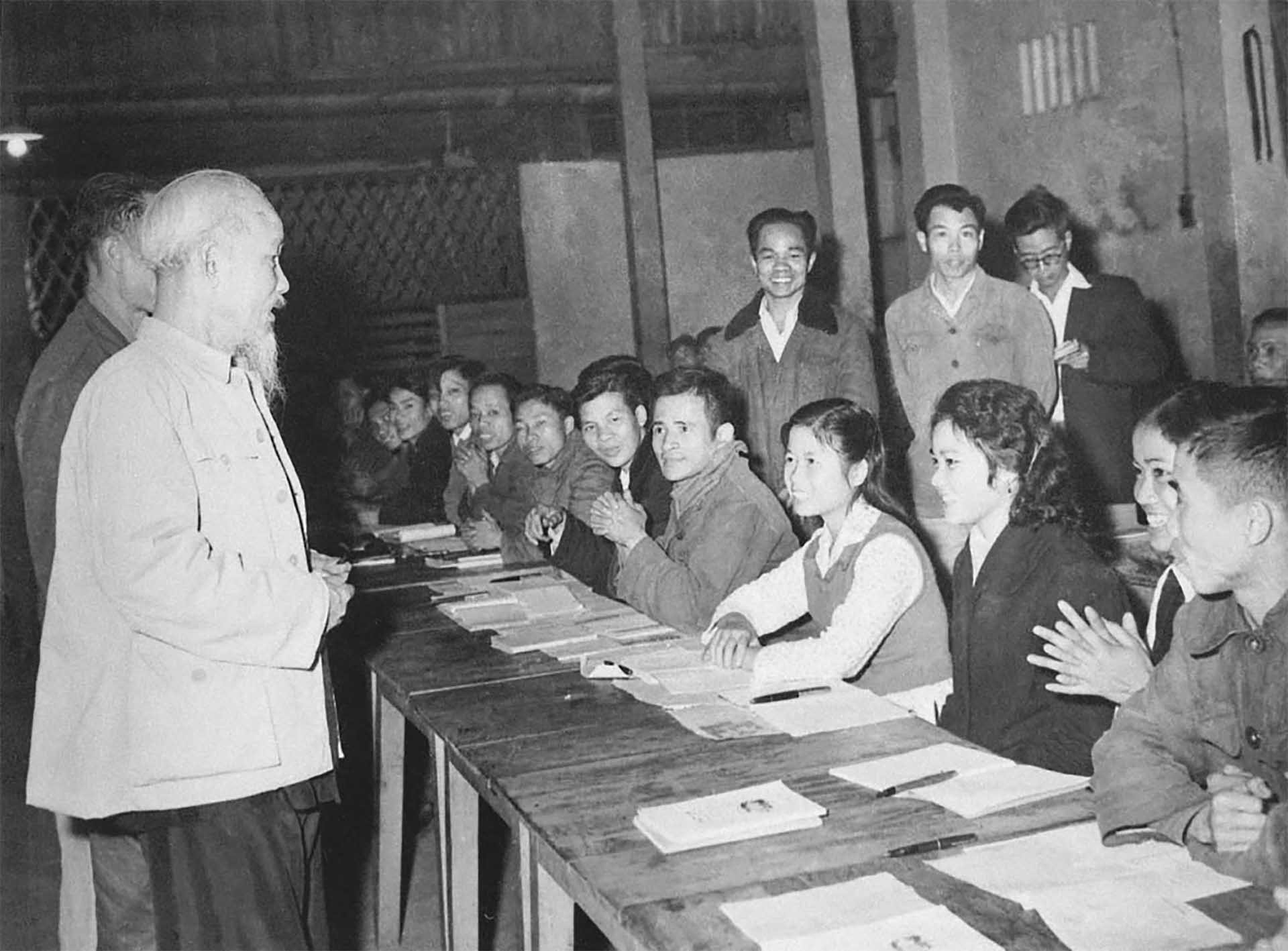 |
| President Ho Chi Minh visits the evening cultural and technical enrichment class for workers at the 1-5 Automobile Factory, a leading example of the cultural enrichment movement in Hanoi's industrial sector (1963). (Source: hochiminh.vn) |
Applying Ho Chi Minh's ideas on human dignity and human rights in the present day.
Firstly, applying President Ho Chi Minh's ideas on the relationship between human dignity and human rights in the following way: human rights possess both the universal nature of human dignity and the specific characteristics of the social conditions that create it. Human rights are not limited solely to the natural-social aspects, but are essentially the "total of social relations" (Karl Marx), primarily legal relations, of human dignity, and are expressed in cultural personality.
Secondly, we need to apply the idea of the reciprocal relationship between ensuring national rights and respecting, protecting, and realizing the rights and interests of individuals and communities within the country. In reality, the reform process has addressed this quite well, but the full value of this dialectical relationship has not yet been recognized.
Therefore, in the current period, it is necessary to recognize and constantly be aware of the importance of practicing and effectively resolving that dialectical relationship; in which respecting, protecting, and implementing the rights of the people and communities of all sizes is the basis for ensuring the independence, freedom, and happiness of the country.
Thirdly, applying the idea of "a hundred things must be governed by divine and legal principles" to "reform the moral order and cultivate human rights" (social transformation to implement human rights). The result of this application is the building and perfecting of the socialist rule of law state.
However, there are still limitations in building and perfecting the institutions for implementing the people-rule-of-the-people, people-for-the-people system. For example, there has only been attention paid to building the rule-of-law system of the state apparatus, without simultaneously focusing on building and developing the rule-of-law system of citizens in their relationship with the State and society, as the foundation and purpose of the socialist rule-of-law state where the people are the masters.
Therefore, it is necessary to continue institutionalizing the State's responsibility in ensuring human rights and civil rights in all three aspects: the responsibility of agencies and organizations; the responsibility of state officials and employees; and the responsibility of state administrative management documents.
Simultaneously, it is important to prioritize the implementation of the Law on Grassroots Democracy in 2022, primarily to promote the guarantee of human rights and civil rights at the grassroots level and to enhance the capacity for social critique and supervision by social organizations, especially the press and the Internet. Currently, many agencies and businesses have not paid adequate attention to the implementation of this Law in their localities and fields of operation. This leads to a lack of unified and coordinated implementation of democracy between officials and citizens at the commune level and officials and employees in agencies and businesses.
Particularly in the context of the country entering a new stage of development, with new strength and momentum, it is necessary to immediately overcome the limitations in applying Ho Chi Minh's thought on human dignity and human rights.
These are: (i) avoiding confusion between Ho Chi Minh's thought on criticizing human rights under bourgeois, colonial, and feudal regimes during the national liberation revolution and the right to be masters and rulers during the socialist transition period; (ii) paying due attention to creativity in ensuring human rights in accordance with the country's conditions; (iii) giving due importance to ensuring "financial rights" linked with human rights and civil rights as defined in the Resolution of the Tan Trao National Congress (August 16-17, 1945).
Although Vietnam has done quite well in implementing rights related to poverty reduction, production, business, and entrepreneurship, it has not yet paid adequate attention to effectively and efficiently addressing issues of ownership rights associated with the possession, use, and management of land, housing, and other real estate, which serve as the foundation of economic rights. As a result, many economic issues, especially those concerning land, housing, and other real estate, often lead to repercussions on human rights and civil rights, causing economic losses for the State and the people.
Furthermore, there is still a lack of attention to clarifying, applying, and creatively developing the relationship between building a new morality and culture and ensuring human rights (while President Ho Chi Minh considered morality as the foundation and root of a revolutionary); and insufficient emphasis has been placed on concretizing the respect for, protection of, and implementation of institutions that guarantee the rights of each social stratum (workers, farmers, intellectuals, entrepreneurs, etc.) to suit the situation of wealth inequality and social stratification under the socialist-oriented market mechanism.
In the context of increasing awareness of human rights, ensuring and promoting civil rights must be linked to human rights in accordance with the Party's viewpoint and policies and the spirit of the 2013 Constitution: "In the Socialist Republic of Vietnam, human rights and civil rights in political, civil, economic, cultural, and social spheres are recognized, respected, protected, and guaranteed according to the Constitution and laws."1. Ho Chi Minh: Complete Works, National Political Publishing House, Hanoi, 2011, Vol. 6, p. 129.
2. Ho Chi Minh: Complete Works, op. cit., vol. 3, p. 413.
3. Ho Chi Minh: Complete Works, op. cit., Vol. 1, p. 317.
4. C. Marx - F. Engels: Complete Works, National Political Publishing House, Hanoi, 1995, Vol. 3, p. 11.
5. Ho Chi Minh: Complete Works, op. cit., Vol. 1, p. 26
6 See: Communist Party of Vietnam: Complete Party Documents, National Political Publishing House, Hanoi, 2000, volume 7, p. 559.
Source


![[Image] Close-up of the newly discovered "sacred road" at My Son Sanctuary](/_next/image?url=https%3A%2F%2Fvphoto.vietnam.vn%2Fthumb%2F1200x675%2Fvietnam%2Fresource%2FIMAGE%2F2025%2F12%2F13%2F1765587881240_ndo_br_ms5-jpg.webp&w=3840&q=75)








































































Comment (0)