

But amidst the towering skyscrapers and bustling activity, Hong Kong still boasts many tranquil temples and monasteries that offer a sense of peace and serenity. One such place is Tsz Shan Monastery, located in the Huishan area (Taipou District, Hong Kong).
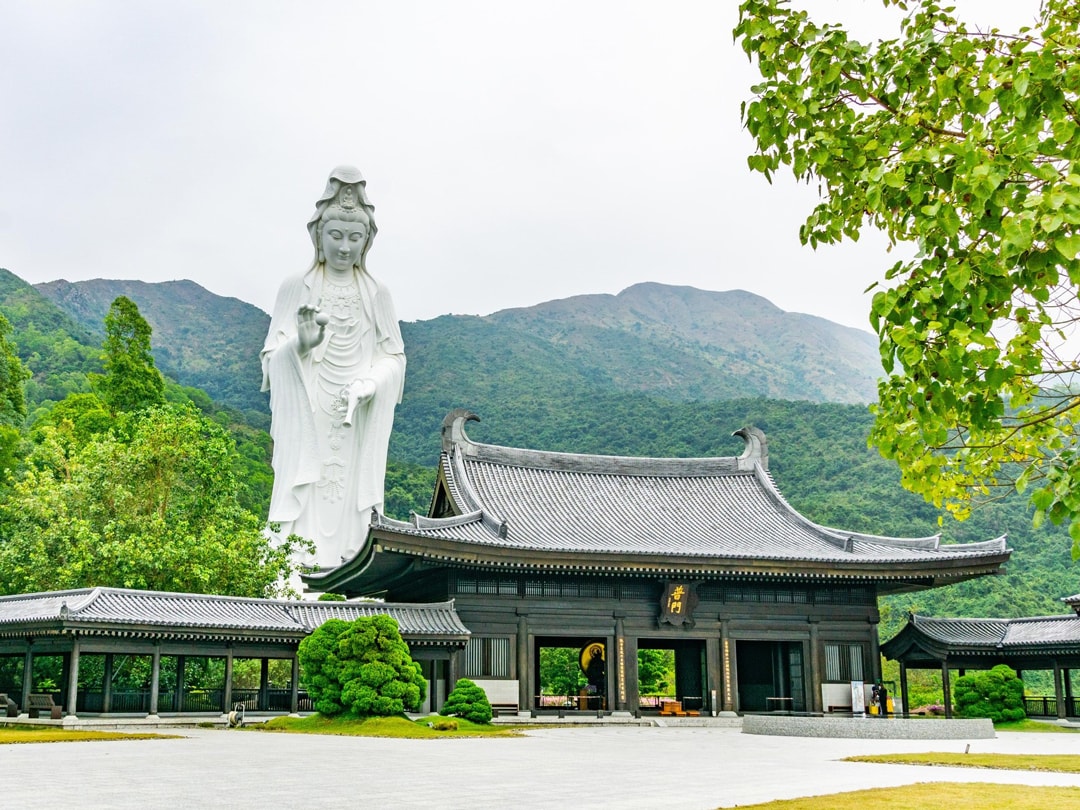
Tsz Shan Monastery features architecture from the Tang Dynasty.
Construction process
Tsz Shan Monastery (or Tsz Shan Temple) is a Buddhist monastery with architecture from the Tang Dynasty combined with the Northern Song, Liao, and Jin Dynasties, sponsored by billionaire Li Ka-shing. Li Ka-shing is the richest billionaire in Hong Kong with an estimated net worth of $37 billion.
From a young age, billionaire Li Ka-shing was influenced by and closely associated with Buddhism. With the spirit of enlightenment and the desire to create a place for meditation, he built the Tsz Shan Monastery as a Buddhist academy.
The construction of the monastery, funded by the Li Ka-shing Foundation, began in 2003 and was completed more than ten years later. To date, the foundation has contributed over HK$3.3 billion to purchase land, construct the monastery, and cover its operating costs. The monastery opened to visitors in April 2015.
The Tsz Shan complex covers an area of over 5,000 square meters with a total construction cost of nearly 200 million USD. It houses a statue of the Goddess of Mercy (Guan Yin) that is considered the second tallest in the world today, standing at 76 meters high.
Tsz Shan Monastery is secluded from the hustle and bustle of city life, nestled against the mountains, surrounded by lush green forests, and overlooking the sea. Notably, Tsz Shan makes maximum use of natural elements in its architecture. Many native and exotic trees and plants are meticulously trimmed and neatly arranged within the monastery grounds. Dark padauk wood, white granite, marble, and copper are the main materials used in its construction. The buildings blend seamlessly with nature, creating an ideal space for meditation.
Notably, at Tsz Shan Monastery, no incense, alcohol, meat, or other offerings are used; only water is offered. Visitors scoop water from pre-built reservoirs, pour it into bowls, and then offer it to the Buddhas as a sign of respect.
Unique architecture
Each day, Tsz Shan Monastery only allows 400 visitors, so advance registration is required. From the main gate, visitors will arrive at the Maitreya Hall and the Great Buddha Hall, located on the central axis of the monastery. On either side of the Maitreya Hall are the Drum Tower and the Bell Tower. The library is located to the west of the main hall, followed by a large Buddha hall. In the center is a six-armed statue of Avalokiteshvara. The walls on either side are carved with calligraphy inscribed with the vows of Samantabhadra Bodhisattva and Avalokiteshvara Bodhisattva to save sentient beings. Outside is an 8-meter-diameter pond shaped like two concentric circles, resembling a mirror from afar.
The highlight of Tsz Shan Monastery is a bronze statue of Avalokiteshvara Bodhisattva, seated on a three-tiered lotus pedestal built on a 6-meter-high granite base. The statue is covered in white paint and modeled after sculptures from the Song Dynasty. A small statue of Amitabha Buddha sits atop Avalokiteshvara's hair. In her right hand she holds a wisdom mani jewel, while in her left hand she holds a vase. Legend says that the pure water from the vase can cleanse away the evils of the world.
At the foot of the statue of Bodhisattva Avalokiteshvara is the Compassionate Path, lined with 18 pine trees on either side. In the center is a large bronze cauldron called the "Thousand Wishes Pond," where tourists offer water as a tribute to Bodhisattva Avalokiteshvara.
Right at the foot of the Guanyin statue is a museum displaying over 100 Buddhist statues related to the history of Buddhism in Asia. Buddhism originated in India, founded by Siddhartha Gautama Buddha in the 6th century BC. Through the Silk Road and maritime routes, Buddhism spread to China, Nepal, Tibet, Myanmar, Korea, and Japan.
The museum's artworks, spanning from Gandhara to Dunhuang, Myanmar, offer viewers a glimpse into various historical periods. The exquisite sculptures and preserved colors highlight the beauty and elegance of Asian Buddhist art.
The ancient statue of Shakyamuni Buddha, standing in the museum, has an oval face, wavy hair, and a thin string tied around its bun. This ancient artifact is typical of the Buddha's face, embodying the strong Greek-Roman style, with a high, straight nose, relatively low eyebrows, and large, bright, slightly downcast eyes. The Buddha wears a thick robe with characteristic Greek folds. With its life-size dimensions, well-proportioned body, vivid expression, and realistic details, the statue has become a masterpiece of the late Kushan Dynasty (the Kushan Empire, which existed from approximately the 1st to 3rd centuries). Billionaire Li Ka-shing commissioned the construction of the museum, combining both ancient and modern artifacts, with the desire to tell the story of Buddhism and its survival throughout history.
With its vast space nestled amidst mountains and hills, isolated from the hustle and bustle of the world, Tsz Shan Monastery is a place where you can feel tranquility with every step. Tsz Shan is a must-see destination for visitors to Hong Kong.
Source: https://hanoimoi.vn/tu-vien-tsz-shan-chon-thien-tinh-giua-nui-rung-685463.html

![[Photo] Closing Ceremony of the 10th Session of the 15th National Assembly](/_next/image?url=https%3A%2F%2Fvphoto.vietnam.vn%2Fthumb%2F1200x675%2Fvietnam%2Fresource%2FIMAGE%2F2025%2F12%2F11%2F1765448959967_image-1437-jpg.webp&w=3840&q=75)


![[Photo] Prime Minister Pham Minh Chinh holds a phone call with the CEO of Russia's Rosatom Corporation.](/_next/image?url=https%3A%2F%2Fvphoto.vietnam.vn%2Fthumb%2F1200x675%2Fvietnam%2Fresource%2FIMAGE%2F2025%2F12%2F11%2F1765464552365_dsc-5295-jpg.webp&w=3840&q=75)































![[OFFICIAL] MISA GROUP ANNOUNCES ITS PIONEERING BRAND POSITIONING IN BUILDING AGENTIC AI FOR BUSINESSES, HOUSEHOLDS, AND THE GOVERNMENT](https://vphoto.vietnam.vn/thumb/402x226/vietnam/resource/IMAGE/2025/12/11/1765444754256_agentic-ai_postfb-scaled.png)





































Comment (0)