

While the Lam Son rebels fought arduously for 10 years to achieve victory, General Le Thanh spent over 9 years alongside their leader, Le Loi. He was one of the 94 people granted the royal surname by King Le Loi of Binh Dinh.
Joining the Lam Son Rebellion in 1418, Le Thanh (originally from the Do family) quickly demonstrated his loyalty. Le Thanh's contributions to the Lam Son Uprising began with the event where Le Lai selflessly saved his leader at Pu Rinh Mountain (present-day Lang Chanh). Taking advantage of the enemy's weakened encirclement, Le Thanh, along with other generals, escorted Le Loi to Muong Khao cave, then attacked Muong Yen (west of Chi Linh Mountain) and Muong Mot (Thuong Xuan). Thanks to this, the rebel army not only preserved their forces and ensured Le Loi's safety but also killed many enemy soldiers. After this event, Le Loi personally wrote six red characters inscribed on the inscription bestowed upon General Le Thanh: "Lung Nhai Founding Hero."
In the year of Ky Hoi (1419), King Le Loi of Binh Dinh, along with his generals, including Le Thanh, attacked the Ming army at Nga Lac fort (near Lam Son commune, in present-day Bai Thuong district). They captured the local commander, General Nguyen Sao, and beheaded more than three hundred people. General Le Thanh was rewarded and appointed "Trung Nghi Dai Phu, with the title of Baron".
In the year Canh Ty (1420), Le Loi and his generals ambushed the enemy at Bong Wharf (in the upper reaches of the Chu River), killing many of them. Afterwards, Le Loi withdrew his troops to Muong Nanh (in Lang Chanh), and then moved them to Muong Thoi (bordering Laos) to preserve and replenish the forces of the Lam Son rebels.
In the winter of the year Tân Sửu (1421), the enemy general Trần Trí led over 100,000 Ming troops to attack Kình Lộng Pass (now Cổ Lũng Pass, in Cẩm Thủy district) and Bá Lẫm village (in Chiềng Lâm area, Điền Lư commune, Bá Thước district). Lê Lợi personally led the army, and General Lê Thành, obeying the king's command, along with other generals, led troops to intercept the enemy at Đèo Ống Pass (Bá Thước district). The enemy suffered a great defeat, and Trần Trí fled. Upon evaluation of his merits, Lê Thành was further rewarded and promoted to "General of the Imperial Guard".
In December 1422, our rebel army was ambushed by the enemy general Ma Ky and the Lao army. Le Loi had to retreat to Khoi village, Thien Quan town (the area between Nho Quan, Ninh Binh and Thach Thanh, Thanh Hoa today). Seven days later, the Ming invaders attacked again. Le Loi personally commanded the vanguard, led by generals Le Linh, Le Van, Le Trien, Le Hao, Le No... and General Le Thanh, who fought fiercely against the enemy, killing the enemy general Phung Quy, beheading more than a thousand enemy soldiers, and capturing several hundred horses. After the victory, Le Loi led his army back to Chi Linh mountain and bestowed the title of "General of the Imperial Guard" upon Le Thanh.
In September of the year Giáp Thìn (1424), Bình Định King divided his army and launched a surprise attack on Đa-Căng citadel (on the right bank of the Chu River, Thọ Xuân district). He captured the citadel, beheading and drowning over a thousand enemy soldiers. Taking advantage of this victory, Lê Lợi ordered his troops to advance into Trà Long - Trà Lân (now Con Cuông and Tương Dương districts of Nghệ An province). At Bồ Lạp mountain (Quỳ Châu), they encountered local troops led by Sư Hựu and Cầm Bành, and Ming generals led by Trần Trung, Trần Trí, Lý An, Phương Chính, Thái Phúc, Chu Kiệt, and others. A fierce battle ensued, with our army beheading enemy generals Trần Trung and Hoàng Thành, capturing Chu Kiệt, and killing over two thousand enemy soldiers. Upon evaluation of his merits, Lê Thành was rewarded and promoted to the rank of “Tham đốc thiêm Lộc hầu”.
In January of the year Ất Tỵ (1425), King Lê Lợi of Bình Định led his army to Đa Lôi village, Thổ Du district (Thanh Chương, Nghệ An), and divided his troops to defend various provinces and districts. In July 1425, Lê Lợi ordered generals Lê Lễ, Lê Sát, Lê Bị, Lê Triện, Lê Nhân Chú... to launch a surprise attack on Tây Đô citadel (Thanh Hóa). The Lam Sơn army beheaded over five hundred Ming soldiers and captured many others. At the same time, he ordered generals Trần Nguyên Hãn, Lê Nỗ, Lê Đà Bồ, and Lê Thành... to lead 1,000 troops and one elephant to attack the Ming forces at Tân Bình citadel (Thuận Hóa). Upon reaching the Bố Chính River (now the Gianh River in Quảng Bình), they encountered Ming forces commanded by Nhân Năng. Lê Thành divided his troops and ambushed them, beheading thousands of them. Upon meritorious service, General Lê Thành was rewarded and promoted to "Câu kìm Tổng quản Thượng tướng quân" (General Commander of the Imperial Guard).
Throughout his life of warfare, Le Thanh was one of the few generals of the Lam Son rebel army who participated in all the important battles. However, like many other talented generals, he did not get to see the fruits of his labor, nor did he get to witness the ascension of the leader to the throne. In the year of Binh Ngo (1426), the Lam Son rebel army attacked the cities in Tan Binh and Thuan Hoa. The king ordered the generals to split into many groups to fight and defend against the enemy. Le Thanh was ordered by Le Loi to defend Long Chau citadel. Despite his determination to fight to the end, due to the overwhelming enemy forces, Long Chau citadel fell, and General Le Thanh perished in battle on the 20th day of the 12th lunar month of the same year.
After Le Thanh and several other generals sacrificed their lives, fueled by burning hatred, the Lam Son rebels grew stronger, driving the Ming invaders out of the country. In the year Mau Than 1428, when Binh Dinh King Le Loi ascended the throne, he recognized 221 meritorious individuals from Lung Nhai and bestowed the royal surname upon 94 of them. Le Thanh was one of them, and was promoted to the third rank: "Trung Vu Dai Phu, Cau Kiem Ve Tuong Quan, Tu Tri Tu". Furthermore, he was posthumously awarded the titles "Suy Trung Dong Duc, Hiep Muu, Bao Chinh Cong Than, Thien Loc Hau, and the additional titles of Thai Uy and Loc Quan Cong".
During the reign of King Le Thanh Tong, General Le Thanh was posthumously honored as "Founding Hero of the Pacification of the Wu, Grand Marshal and Duke of Trang Quoc, High-Ranking Deity," and a royal decree was issued for the people of Dinh Huong (Dinh Hoa) to build a solemn temple to worship him, designating the 20th day of the 12th lunar month each year as his death anniversary.
Le Thanh's life was both glorious, marked by legendary achievements, and harmonious within his family. Both of his wives and his four children were meritorious individuals who served the king and the country.
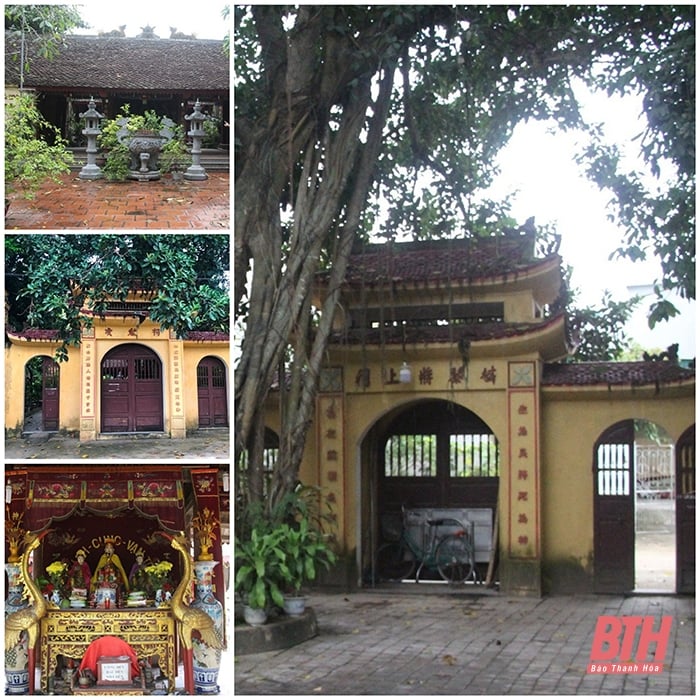
Today, while visiting the Le Thanh temple complex in Dinh Hoa (Dong Cuong ward, Thanh Hoa city), we heard many stories related to the general from the temple caretaker, Le Van Tac. In particular, he recounted the story of the theft of five royal decrees from various emperors in 2014. “I have regretted this for many years and always feel guilty towards the community. These decrees were like treasures of the village, and I failed to protect them. Currently, only three large wooden altars, painted red and gilded, remain in the temple, containing the dragon throne and ancestral tablets.”
According to Mr. Le Do Toan, Vice Chairman of the People's Committee of Dong Cuong Ward: "The people of Dinh Hoa area, including residential groups No. 4, 5, and 6, have repeatedly mobilized social contributions to repair some dilapidated parts of the temple. However, according to regulations, for classified relics, especially national-level relics, urgent repairs and renovations of relic items must be documented and approved by the Ministry of Culture, Sports and Tourism before they can be implemented. The current issue is that, in addition to some contributions from the people for the temple's repair, we earnestly hope for the attention of the province and higher levels in supporting the funding for documentation and repair costs."
Observing the actual condition, the temple, which is approximately 550 years old, now has mostly cracked walls, many wooden pillars infested with termites and requiring rudimentary bracing, and a broken and damaged roof. The national historical site of the temple dedicated to General Le Thanh needs the attention of relevant authorities and agencies for protection, restoration, and preservation.
Kieu Huyen
Source








































































Comment (0)