

In recent years, the expanded immunization program in Tuyen Quang province (including communes formerly belonging to Ha Giang province after the merger) has been maintained stably. Thanks to the close attention and guidance of local Party committees and authorities, the rate of complete immunization for children under 1 year old has consistently been high, making a significant contribution to the elimination of polio in 2000, the elimination of neonatal tetanus in 2005, and the effective control of many dangerous infectious diseases for which vaccines are available. However, after the merger of additional highland communes from the former Ha Giang province, the local immunization program has faced many new challenges.
According to statistics from the Provincial Center for Disease Control (CDC), the rate of fully vaccinated children reached 84.66%. Some vaccines, such as Japanese encephalitis and DPT4 (booster vaccine against diphtheria, pertussis, and tetanus), achieved rates above 85%. However, the vaccination rates for neonatal hepatitis B and tetanus 2+ for pregnant women remained below the target.
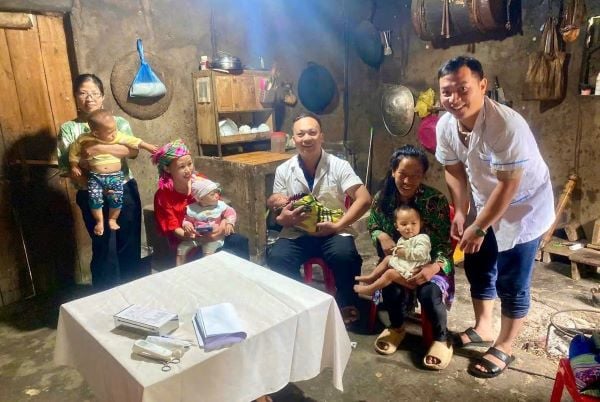
Health workers visit families to check on and remind children about vaccination schedules in Si Kha La village, Pa Vay Su commune. Photo: Tuyen Quang Provincial CDC.
Dr. Nguyen Tat Thang, Head of the Department of Infectious Disease Prevention and Control, said: "Most children do not receive the Hepatitis B vaccine on time because they are born at home. Therefore, administering the Hepatitis B vaccine within the first 24 hours after birth is very difficult. In the mountainous communes of the former Ha Giang province, the level of education is still limited, and many outdated customs, especially among the Mong ethnic group, make propaganda and mobilization efforts very difficult. In addition, language barriers and the fact that many parents work far away and leave their children with grandparents also increase the risk of children missing their vaccinations."
Transportation in the mountainous communes remains a major obstacle. Many villages are very far from the health station, such as: Si Kha La village in Pa Vay Su commune, 37 km away; Ma Pi Leng village in Dong Van commune, 22 km away; Thin Ngai village in Son Vi commune, 18 km away; Ngam Dang Vai 1 village in Hoang Su Phi commune, 19 km away; and Dan Khao village in Thuong Son commune, 17 km away. Steep mountain roads, sharp rocks, and slippery conditions during rain make travel extremely difficult. In winter, dense fog makes many sections only accessible on foot. Temperatures dropping to 3–4°C make getting children to the health station on schedule a major worry for many families.
Dr. Nong Thi Hien, Head of the Dong Van Commune Health Station, shared: "The number of people needing vaccinations has increased after the merger, but the staff remains the same. In some villages, we have to walk for almost an hour to reach them. The roads are steep and slippery when it rains, but to ensure no child is missed, the station staff still go to each village to remind them of their vaccination schedule. To date, thanks to clear explanations about post-vaccination reactions, parents have gradually become more cooperative and bring their children for vaccinations regularly."

Staff from the Vinh Tuy commune health station visit a household and advise a mother on taking her child for vaccination. Photo: Tuyen Quang Provincial CDC.
To overcome these difficulties, the Tuyen Quang provincial health sector has implemented many solutions tailored to the specific characteristics of the area. Mobile vaccination teams are maintained to deliver vaccines to villages; communication efforts are strengthened through village meetings, group activities, or bilingual materials to help parents understand the benefits of vaccination. The electronic vaccination management system supports health stations in reviewing, reminding, and monitoring children who have missed doses more effectively.
Dr. Nguyen Thi Thanh Huong, Director of the CDC of Tuyen Quang province, stated: "Vaccination is the most effective disease prevention measure. Maintaining high coverage throughout the province, especially in the highland communes of the former Ha Giang province, is a crucial task. Health stations, villages, and families need to cooperate closely. We recommend that parents give birth at healthcare facilities to ensure their children receive hepatitis B and BCG (tuberculosis prevention) vaccinations at the right time; if vaccinations have to be postponed, they should be administered as soon as the child is eligible."
In addition to the efforts of healthcare workers, local authorities are also coordinating the review and reorganization of vaccination points at health stations and off-site vaccination points; considering opening more vaccination points near residential areas to help children access vaccines more easily and reduce travel distances for parents.
In the coming period, the Tuyen Quang health sector will continue to strengthen the grassroots immunization network, enhance monitoring of each individual, and be more proactive in bringing services to difficult-to-reach villages. The main goal is to maintain high, stable, and uniform coverage across regions, ensuring that all children in the province have access to safe and complete vaccines, preventing any immunity gaps in the community.
Source: https://suckhoedoisong.vn/tuyen-quang-go-nut-that-tiem-chung-o-vung-cao-169251207071432271.htm
![[Photo] Closing Ceremony of the 10th Session of the 15th National Assembly](/_next/image?url=https%3A%2F%2Fvphoto.vietnam.vn%2Fthumb%2F1200x675%2Fvietnam%2Fresource%2FIMAGE%2F2025%2F12%2F11%2F1765448959967_image-1437-jpg.webp&w=3840&q=75)
![[Photo] Prime Minister Pham Minh Chinh holds a phone call with the CEO of Russia's Rosatom Corporation.](/_next/image?url=https%3A%2F%2Fvphoto.vietnam.vn%2Fthumb%2F1200x675%2Fvietnam%2Fresource%2FIMAGE%2F2025%2F12%2F11%2F1765464552365_dsc-5295-jpg.webp&w=3840&q=75)









































![[OFFICIAL] MISA GROUP ANNOUNCES ITS PIONEERING BRAND POSITIONING IN BUILDING AGENTIC AI FOR BUSINESSES, HOUSEHOLDS, AND THE GOVERNMENT](https://vphoto.vietnam.vn/thumb/402x226/vietnam/resource/IMAGE/2025/12/11/1765444754256_agentic-ai_postfb-scaled.png)

















































Comment (0)