

The approval rate for the recommendations was 84.7%, the highest among the four cycles under the UPR mechanism that Vietnam has participated in at the United Nations Human Rights Council.

Deputy Minister Do Hung Viet (center) at the September 27 session of the United Nations Human Rights Council - Photo: Provided by the Ministry of Foreign Affairs
271 out of 320 recommendations approved.
Responding to the press on October 1st, Deputy Minister of Foreign Affairs Do Hung Viet affirmed that this is the result of a long preparation process by the Vietnamese Government. Accordingly, immediately after the dialogue session in May at the United Nations Human Rights Council, the Ministry of Foreign Affairs , in coordination with other ministries, agencies, and organizations, actively conducted a thorough review of all 320 recommendations received from 133 countries and reported to the Prime Minister for approval. At the meeting on September 27th, Vietnam announced its decision to accept 271 out of the 320 recommendations, achieving a rate of 84.7%. "This is our highest acceptance rate in four cycles. This demonstrates Vietnam's strong commitment to the UPR process, as well as affirming Vietnam's desire and determination to protect and promote human rights," Mr. Do Hung Viet affirmed. Approximately 90 countries, international organizations, and several non-governmental organizations attended the session on September 27th. According to Mr. Viet, the vast majority of speakers highly appreciated Vietnam's efforts and the participation of the Vietnamese delegation in open and frank exchanges and dialogues, providing much useful information that helped the international community better understand the situation in Vietnam. Particularly moving at the session was when countries and international friends took advantage of the limited time allocated by the United Nations Human Rights Council for their speeches to express their solidarity and share in the pain and losses caused by Typhoon Yagi to the Vietnamese people. "Some speeches also reviewed the Vietnamese people's struggle to determine their own destiny and their path to independence, freedom, and happiness, considering this as the foundation for protecting and promoting human rights in Vietnam," Deputy Minister Do Hung Viet added.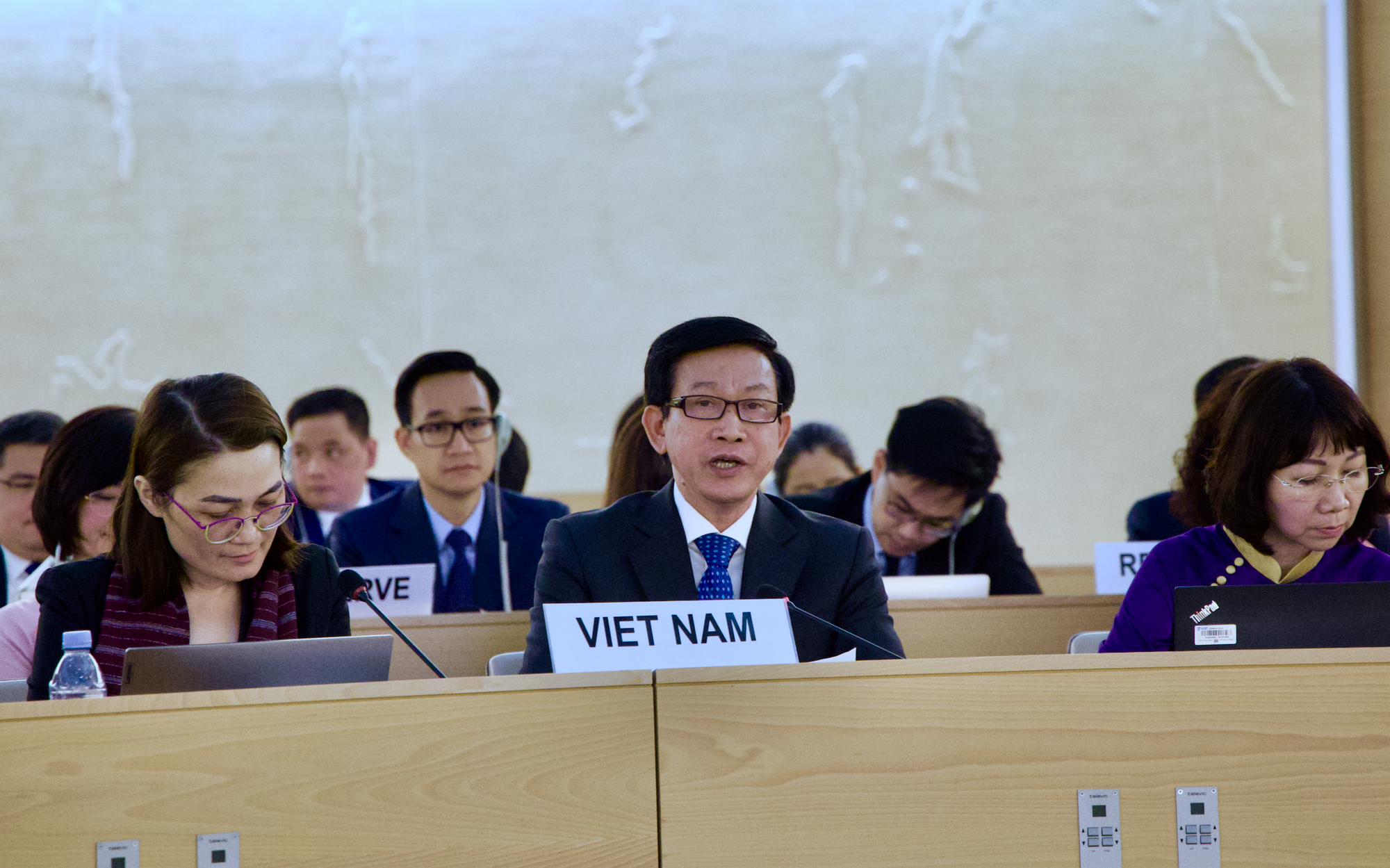
Members of the Vietnamese delegation answered questions and provided accurate information at a dialogue session at the United Nations Human Rights Council in May 2024 - Photo: VNA
Refuting misconceptions about human rights protection in Vietnam.
During the September 27th session, the Vietnamese delegation also updated information on new developments since the May dialogue session in areas such as building and perfecting legal institutions, and continuing to ensure the basic foundations for socio -economic development to better guarantee human rights in Vietnam. At the same time, the Vietnamese delegation promptly refuted the inaccurate claims and unverified information reflecting prejudice against Vietnam in the statements of a few non-governmental organizations at the session. Accordingly, Vietnam affirmed its commitment to creating a favorable environment for citizens to participate in contributing to the development of policies and laws. The implementation of human rights must also be based on the rule of law, respecting the rights and interests of individuals and communities, for the stability and prosperity of the entire country. Also at the United Nations Human Rights Council, Vietnam emphasized its uncompromising stance against actions that exploit freedoms and democracy to incite unrest and instability. Regarding the tasks to be done after the September 27th meeting, Mr. Do Hung Viet said that the Ministry of Foreign Affairs will continue to coordinate with ministries and agencies to develop and report to the Prime Minister for approval a comprehensive plan to implement the 271 approved recommendations. This comprehensive plan will specifically assign responsibilities and tasks to each ministry, agency, and organization to implement the recommendations, as well as propose a mechanism for monitoring and evaluating their implementation. Vietnam also plans to conduct a mid-term review to determine the progress of implementation and areas requiring further effort. "During this process, Vietnam will continue to cooperate with the United Nations, international partners, and friendly countries to secure additional resources to best implement the recommendations," the Deputy Minister of Foreign Affairs affirmed. Established by the United Nations Human Rights Council in 2006 and first conducted in 2008, the Universal Periodic Review (UPR) is an intergovernmental mechanism tasked with comprehensively reviewing the human rights situation in all UN member states. The mechanism operates on the principles of dialogue, cooperation, equality, objectivity, transparency, and constructive engagement. Vietnam fully participates in all UPR cycles and implements all recommendations received.
Tuoitre.vn
Source: https://tuoitre.vn/viet-nam-chap-thuan-271-khuyen-nghi-cua-133-nuoc-tai-doi-thoai-ve-quyen-con-nguoi-20241001235955638.htm![[Photo] Closing Ceremony of the 10th Session of the 15th National Assembly](/_next/image?url=https%3A%2F%2Fvphoto.vietnam.vn%2Fthumb%2F1200x675%2Fvietnam%2Fresource%2FIMAGE%2F2025%2F12%2F11%2F1765448959967_image-1437-jpg.webp&w=3840&q=75)


![[Photo] Prime Minister Pham Minh Chinh holds a phone call with the CEO of Russia's Rosatom Corporation.](/_next/image?url=https%3A%2F%2Fvphoto.vietnam.vn%2Fthumb%2F1200x675%2Fvietnam%2Fresource%2FIMAGE%2F2025%2F12%2F11%2F1765464552365_dsc-5295-jpg.webp&w=3840&q=75)


![[Photo] Prime Minister Pham Minh Chinh holds a phone call with the CEO of Russia's Rosatom Corporation.](https://vphoto.vietnam.vn/thumb/402x226/vietnam/resource/IMAGE/2025/12/11/1765464552365_dsc-5295-jpg.webp)




































![[OFFICIAL] MISA GROUP ANNOUNCES ITS PIONEERING BRAND POSITIONING IN BUILDING AGENTIC AI FOR BUSINESSES, HOUSEHOLDS, AND THE GOVERNMENT](https://vphoto.vietnam.vn/thumb/402x226/vietnam/resource/IMAGE/2025/12/11/1765444754256_agentic-ai_postfb-scaled.png)


































Comment (0)