

A 43-year-old patient from Hanoi reported having breast augmentation surgery 5 years ago at a private cosmetic clinic. After the surgery, she experienced significant pain, bruising, and stiffness in her breasts. The doctor advised her to have massages for several months before her breasts softened.
Recently, following reports that large textured breast implants had been recalled in Europe and the US due to the potential for capsular contracture or the formation of abnormal cells around the implant shell, the patient returned for a follow-up visit at the cosmetic clinic where she had her initial surgery and subsequently sought treatment at Viet Duc Friendship Hospital.
Associate Professor Dr. Nguyen Hong Ha, Head of the Department of Plastic and Reconstructive Surgery at the hospital, said that the patient had an uneven and bumpy breast implant surface and was prescribed a 3.0 Tesla MRI scan to diagnose breast pathologies. The results showed that the breast implant had ruptured previously, but the patient was unaware, therefore surgery was immediately indicated.
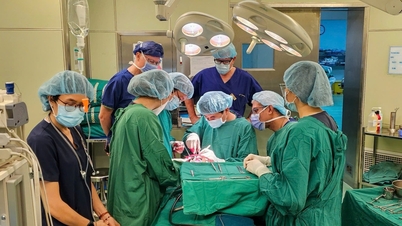
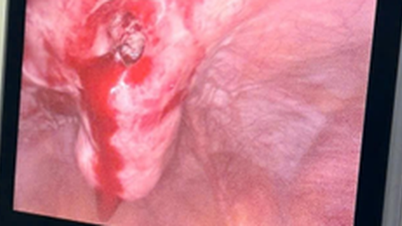
The surgery was performed through the old incision (axillary incision) but using a laparoscopic technique.
Dr. Nguyen Hong Ha stated: "The surgery was very difficult because the large, textured implant shell had firmly adhered to the surrounding tissue." The surgeons spent nearly two hours dissecting and removing the thick fibrous capsule and cleaning up the leaked liquid silicone. The rough fibrous capsule around the implant was also sent for pathological examination. Within 30 minutes, the patient's test sample was determined to be free of malignant cells. The doctors then replaced the ruptured old implant with the latest generation implant, restoring the patient's breasts to a soft, natural appearance.
According to Dr. Ha, recently, health officials in the US and Europe have simultaneously requested the recall of all these large textured breast implants from the market. “The patient was quite fortunate; she went to the hospital for examination and diagnostic imaging, the complication of implant rupture was detected, and she underwent surgery in time to remove the ruptured silicone before it spread further,” Dr. Ha said, adding that surgeons not trained in endoscopic surgery often insert breast implants using the old-style axillary incision. Currently, endoscopic axillary breast implant placement does not require additional incisions on the chest, significantly reducing complications such as bleeding, hematoma, and pain, as well as controlling the formation of capsular contracture after surgery, thus reducing post-implant complications.
“Large textured implants are always firm and have a rough surface, making it difficult for the breasts to feel soft after implantation. Over time, the textured surface can stimulate the body to form a fibrous capsule, making them prone to rupture and potentially leading to the growth of abnormal cells around the capsule. For cases where patients previously underwent surgery using large textured implants that are now subject to recall on the market, regular follow-up examinations and monitoring are necessary,” Dr. Ha noted.
Source: https://thanhnien.vn/vo-tui-nguc-sau-khi-nang-cap-vong-1-185971421.htm

![[Image] Close-up view of the interchange connecting the two expressways and Long Thanh Airport.](https://vphoto.vietnam.vn/thumb/1200x675/vietnam/resource/IMAGE/2026/05/25/1779703378210_ndo_br_z7863716673926-224453a31600126cce10622af6290afd-4549-jpg.webp)
![[Image] Hanoi's urban life under the challenge of a "scorching hot" environment](https://vphoto.vietnam.vn/thumb/1200x675/vietnam/resource/IMAGE/2026/05/25/1779706979265_nang-nong-t5-2026-minh-duy-7-4636-jpg.webp)













































































Comment (0)