

Historical vision and mission
On April 2, 2024, the Prime Minister issued Decision No. 142/QD-TTg "Approving the National Data Strategy to 2030". This decision clearly states: Data is a new resource, a key factor for national digital transformation, creating new value to promote socio -economic development, enhance national competitiveness, and serve the interests of the people.
Currently, the Ministry of Public Security is developing the Data Law, the National Data Center, and implementing Project 06 on National Digital Transformation, contributing to the realization of the historical vision and mission outlined by General Secretary and President To Lam: "Building a data-centric economic model, with digital transformation as its foundation, data becoming a means of production, forming data products, services, a data market, and a data economy, ushering the country into an era of prosperity."
In reality, all businesses need data to survive and thrive, and data is increasingly playing a dominant role in the socio-economic landscape. Therefore, the participation of the business community in building a data economy and serving national digital transformation is necessary and urgent.
 |
| The Ministry of Industry and Trade is promoting the development of electronic contracts - (Photo: Contributor). |
According to the Ministry of Public Security, many countries around the world have regulations on data, its operation, exploitation, and use (data of state agencies, organizations, businesses, and individuals), such as: the Open Data Act (South Korea); the European Data Governance Act applicable to 27 member states of the European Union; the European Data Act applicable to 27 member states of the European Union…
In Vietnam, the implementation of the Party and State's guidelines and policies on science and technology development, especially those related to data creation, connection, and sharing, has yielded some positive results, such as: the initial creation and formation of 7 national databases; the interconnection and data sharing between some national databases, contributing to the reform and simplification of administrative procedures for citizens; and the initial investment in technological infrastructure for building data centers...
However, many shortcomings and limitations remain, such as: Some ministries and agencies lack or have incomplete infrastructure to deploy core information technology systems to support their operational tasks. Many databases are collected and stored in a duplicated and overlapping manner, lacking uniformity in common data categories, causing difficulties in connecting, sharing, and exploiting data. Data centers are invested in inconsistently, lacking uniformity in technical standards and regulations, and are not regularly inspected, maintained, or upgraded, leading to risks to system security and safety.
Furthermore, some ministries, sectors, and localities that outsource IT infrastructure services pose significant risks to information security due to a lack of effective management and control over state data on these businesses' infrastructure. The workforce operating and managing these information systems is both insufficient and lacking in expertise. National databases, as stipulated in Decision No. 714/QD-TTg dated May 22, 2015, of the Prime Minister, have not been fully developed. Many information systems still have security vulnerabilities and do not meet the requirements for connecting to the National Population Database.
Difficulties exist in exploiting, linking, and providing timely data to facilitate the resolution of administrative procedures, interconnected public services, statistical analysis, and the formulation of indicators and indices to support the government's leadership and management.
The development of centralized databases is a common trend in countries around the world today. Therefore, the orientation towards building and developing a national integrated database as the main data pillar to create a foundation for the development of digital government, promote the digital economy, and form a digital society in our country is essential; it helps to establish reliable and stable state data systems, thereby deploying connectivity solutions to share, reuse, and develop advanced data analysis models/applications to create new values, new products and services, and new impetus for socio-economic development in the digital transformation period.
Investing in, upgrading, expanding, and storing information in the National Integrated Database will save significantly compared to investing in separate systems to store this information. Information stored in the National Integrated Database will also be shared for common use by ministries, sectors, and localities; data management agencies will not need to establish additional separate connection and sharing channels for information already added and stored in the National Integrated Database.
Upon review, there are currently 69 laws containing provisions on databases (including national databases and specialized databases), and draft laws with data-related provisions such as the Law on Electronic Transactions 2023, the Law on Cybersecurity, the Law on Network Information Security, the Law on Telecommunications 2023, the Law on Information Technology, and the draft Law on Digital Technology Industry…
Based on the analysis and statistics of the aforementioned legal documents, these laws have stipulated 33 national databases and 39 specialized databases, specifically:
Regarding the information fields in the database: 16 databases have clearly defined the information fields, 30 databases have defined fields but not specified them, and 26 databases do not define any information fields.
Regarding the description and definition of databases: 34 databases have clearly stated descriptions and definitions; 7 databases have regulations but not specific ones; and 31 databases are not defined.
Regarding the methods of data exploitation and sharing: 18 databases have specific regulations on the methods of data exploitation and sharing; 14 databases have regulations but not specific methods of exploitation and sharing; and 40 databases have no regulations.
 |
| The Department of E-commerce and Digital Economy (Ministry of Industry and Trade) has launched the Goods Traceability Portal - (Illustrative image). |
Currently, based on legal regulations and practical surveys conducted by the Ministry of Public Security, various ministries, sectors, and localities have implemented the construction of databases to serve state management, including 7 national databases and nearly 100 specialized databases.
Among the laws reviewed, only a few stipulate the responsibilities of the database managing agency in building, collecting, managing, operating, connecting, sharing, exploiting, and using information in the database.
However, all laws lack specific or consistent regulations on data processing and management (such as data collection, digitization, quality assurance, and storage); they do not regulate the development and application of high-tech technologies in data processing; they do not regulate the creation of databases compiled from national and specialized databases to serve the work of directing and managing, formulating policies, socio-economic development, administrative procedure reform, public services, and ensuring the interests of organizations and individuals; and they do not regulate data-related products and services that are developing worldwide, such as data exchanges, data intermediary services, and data analysis and aggregation services.
Meanwhile, establishing a data market and developing data-related products and services is now crucial. It is considered a breakthrough factor in gradually creating and promoting the opening of the data market, using the data market as a driving force for data development and stimulating and promoting digital transformation in industries and sectors, increasing competitiveness, and ensuring the progress of digital transformation in our country.
Government Resolution No. 175/NQ-CP dated October 30, 2023, approving the National Data Center Project, stipulated that by the fourth quarter of 2025, the National Data Center would become operational, serving as a place for storing, aggregating, analyzing, and coordinating data, and providing infrastructure for ministries, sectors, and localities.
Therefore, the enactment of a law called the Data Law is extremely important, necessary, and urgent to ensure comprehensive coverage of the contents and tasks identified by the Government in the digital transformation process; to enhance the effective use of information in databases to serve state management, both exploiting and applying data in socio-economic development, and tightening the management of personal and non-personal data, ensuring information security and safety.
Digital authentication has been widely implemented.
If data is key to the digital economy, then digital authentication is the high-speed train that will enable our country to participate more deeply in international trade and master the global supply chain.
Digital authentication has been and continues to be strongly implemented across all economic sectors in Vietnam. From manual authentication heavily reliant on subjective human judgment, digital authentication, built on a digital technology platform, has enabled the economic lifeline, goods circulation, and social governance to keep pace with the explosive growth of the Fourth Industrial Revolution. This not only saves billions of dollars in social costs annually but also plays a crucial role in generating hundreds of billions of dollars worth of goods for the country.
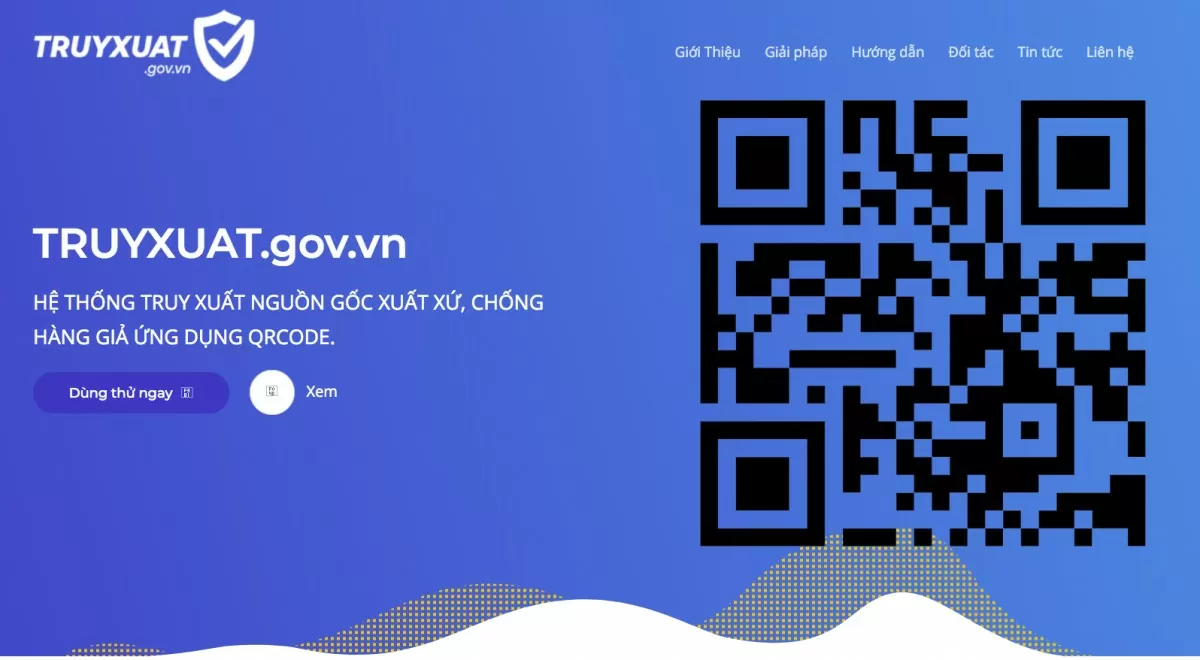 |
| The Product Traceability Portal of the Department of E-commerce and Digital Economy - Ministry of Industry and Trade. |
With the National Population Data Center, the National Goods Traceability Center, the Citizen Data Center, the Goods Data Center, and advanced application platforms, the deployment of "Digital Authentication" is rapidly being rolled out to the wider community.
On May 9, 2024, the Government issued Decree 48/2024/ND-CP amending and supplementing several articles of Decree 130/2018/ND-CP dated September 27, 2018, of the Government detailing the implementation of the Law on Electronic Transactions regarding digital signatures and digital signature authentication services. This is an updated result of the success of Project 06 on National Digital Transformation, as Vietnam has completed its citizen database early. Currently, the Research and Application Center for Citizen Data and Identity Cards (RAR Center), a unit under the National Population Data Center, has deployed many convenient "Digital Authentication" services. RAR Center researches and develops products, services, and equipment with high practical applications, minimizing paperwork-based administrative procedures, saving time and money for individuals and businesses, and innovating in operational methods while ensuring the security and reliability of all user information.
RAR Center is providing consulting services on the use of chip-embedded citizen identification cards for security control, as well as other products such as fingerprint scanners, chip readers, and data analysis. It will soon be ready to supply products that businesses need, such as biometric authentication devices for the financial and banking sectors. In addition, RAR Center is collaborating with businesses to research and invest in the development of digital identification, electronic authentication, and digital signatures, in order to keep pace with global and contemporary trends.
Thus, it can be seen that the "input" for the "Authenticity of Everything" requirement has been and is being actively improved. Big data, specifically "National Data," is the "diamond mine" for the digital economy and digital authentication, and is being exploited and further enriched during operation.
This is a once-in-a-century opportunity for businesses and entrepreneurs. In the coming years, "digital authentication" will truly become a "green industry" in Vietnam.
Nguyen Thanh Vinh - Deputy Director of the Institute for Investment Policy Research and Consulting
Source: https://congthuong.vn/xac-thuc-so-con-tau-dua-nen-thuong-mai-viet-nam-tien-vao-dai-lo-thinh-vuong-353665.html


































































































Comment (0)