

On October 23, speaking at a group discussion on the draft amended Bankruptcy Law, National Assembly representative Tran Hoang Ngan (Ho Chi Minh City) stated that the current law has many shortcomings and negative consequences.
According to Mr. Ngan, the number of businesses withdrawing annually is quite large; in 2024, approximately 197,900 businesses temporarily suspended operations or withdrew from the market; and in the first nine months of 2025, about 174,900 businesses nationwide completed procedures for temporary suspension or withdrawal from the market.
Noting that a large number of businesses have withdrawn or temporarily suspended operations, but very few have completed bankruptcy procedures, Mr. Ngan suggested that the mindset regarding bankruptcy in Vietnam is still outdated, and bankruptcy procedures are cumbersome.
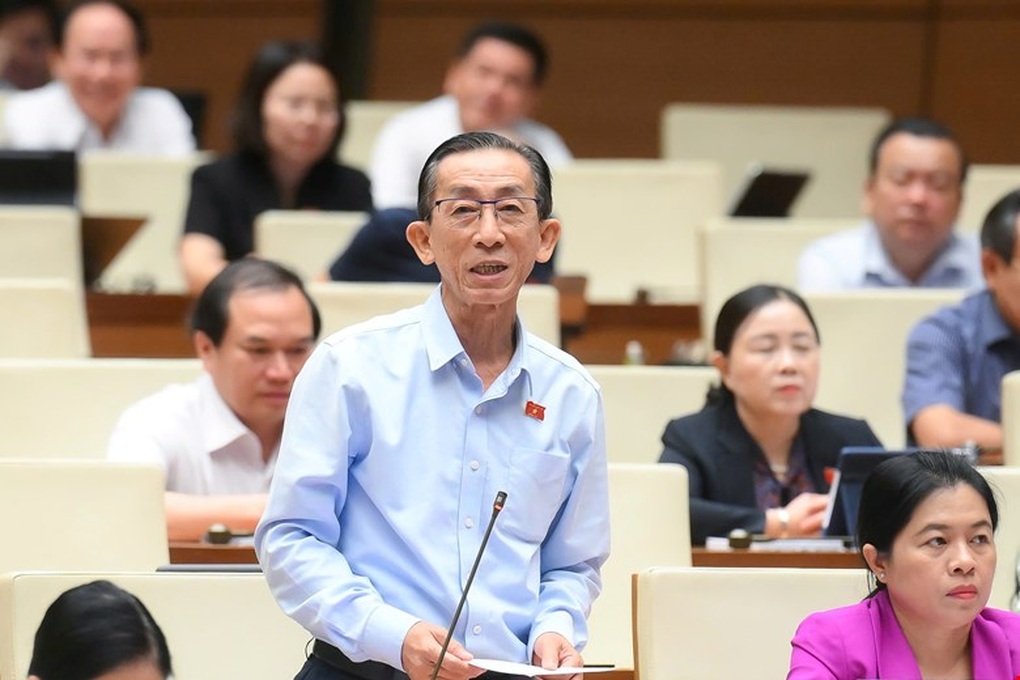
National Assembly representative Tran Hoang Ngan (Photo: Pham Thang).
According to the delegate, in Vietnam, the word "bankruptcy" is always considered very bad and negative, but in other countries or in the context of developed businesses, business losses and bankruptcies are normal occurrences.
"Bankruptcy should be viewed as an economic act, like the life cycle of 'birth, aging, illness, and death'. If we can save them, we should strive to do so; otherwise, we should resolve the issue quickly," Mr. Ngan stated, adding that Vietnam's bankruptcy procedures have remained very difficult over the past 10 years.
According to Mr. Ngan, if a business goes bankrupt without completing the necessary procedures, a series of problems will arise, such as the business becoming burdened with debt, disputes with partners, and the loss of any will to do business.
The delegate emphasized the urgent need for mechanisms and legal frameworks to resolve bankruptcy issues quickly and efficiently.
While acknowledging that this draft law adds many solutions to support and rescue businesses to help them recover, Mr. Ngan supports the option of the State budget advancing bankruptcy costs for businesses instead of the previous regulation where businesses had to advance bankruptcy costs themselves.
"When they've already reached the bankruptcy stage, why should we require them to advance funds to handle the procedures for us? In principle, businesses that survive, exist, and develop contribute significantly to the budget, but when they go bankrupt, it's perfectly reasonable for the State budget to advance funds to handle the bankruptcy procedures for them. This also speeds up the administrative process in bankruptcy," Mr. Ngan stated.
Regarding this issue, Chief Justice of the Supreme People's Court Le Minh Tri stated that the State needs to provide support, but it is necessary to consider how to provide support in a fair and reasonable manner. According to Mr. Tri, it is not possible to simply use funds as some delegates have suggested because it would not meet all the requirements.

Chief Justice of the Supreme People's Court Le Minh Tri (Photo: Pham Thang).
Mr. Tri stated that in reality, in resolving bankruptcy cases in the past, a business was influenced by many different legal relationships. "Now that the court is handling bankruptcy cases, and all the other legal relationships are being processed, consolidating them into a single point of contact will expedite the process," the Chief Justice of the Supreme People's Court said.
Mr. Tri also emphasized that "it is very difficult to take advantage of the State's support policies," because whether or not a business recovers depends on the business itself and its creditors. The State's policy to support businesses is to extend debt repayment periods, not to waive them.
"We have no right to interfere with the debt repayment responsibilities of businesses, so there's no need to worry," Mr. Tri clarified.
The Chief Justice of the Supreme People's Court also stated that the direction when amending the Bankruptcy Law is to expand the scope of the law, with the biggest goal being to resolve issues quickly, because the need for recovery, including bankruptcy, is very great, but the resolution process is still slow, affecting not only businesses but also the economy because resources are not being unlocked.
Source: https://dantri.com.vn/thoi-su/xem-pha-san-nhu-mot-hanh-vi-kinh-te-giong-vong-doi-sinh-lao-benh-tu-20251023141811930.htm















































































Comment (0)