

This 416-page work, comprising 17 monographs, is the result of nearly 10 years of research, reflecting an interdisciplinary, modern, and innovative approach to Vietnamese historical and cultural issues.
The book comprises 17 essays, focusing on three main groups presenting the author's new discoveries about Vietnamese culture. Specifically, the first group focuses on two outstanding figures in Vietnamese and modern world history: President Ho Chi Minh and General Vo Nguyen Giap. Using a new approach, the author affirms that Ho Chi Minh was "a pioneering global citizen," who practiced the motto "think globally, act locally" from a very early age, seamlessly combining national strength with the strength of the times. The essays on General Vo Nguyen Giap continue to shed light on new aspects of the personality and intellect of this renowned general, thereby contributing to a deeper understanding of Vietnam's character in the 20th century.
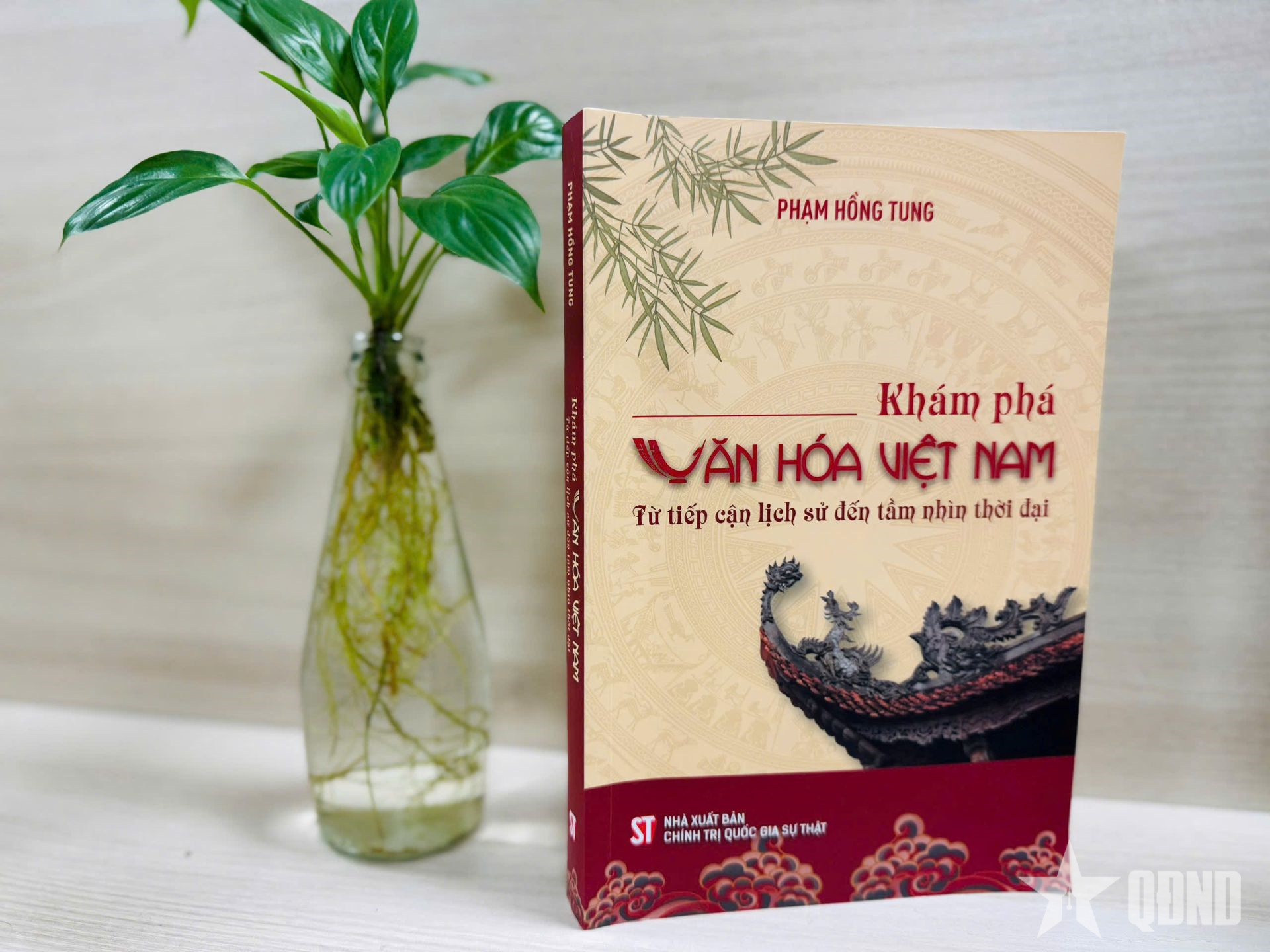 |
| The book " Exploring Vietnamese Culture: From a Historical Approach to a Contemporary Perspective". |
The second group focuses on core issues of Vietnamese political culture – from national aspirations, the desire for development, the role of the ruling party, to national consciousness and cultural welfare. In light of Ho Chi Minh's thought, the authors emphasize the role of education as a key driving force to help the nation avoid falling behind in the technological age, affirming that "education not only makes people better, but also helps the country escape weakness and achieve self-reliance."
The third section is a rich body of content on modern culture, where the author presents many fresh messages about urban culture, creative industries, cultural security, and intercultural dialogue. The author emphasizes that in the context of accelerating globalization, cultural security should be considered a crucial component of national security, because "as long as culture exists, the nation exists." In addition, studies on urban area studies are presented as a potential academic approach that can contribute to building a foundation for Vietnam's sustainable development strategy.
Notably, the work also expands its analysis to the field of intercultural dialogue, from intergenerational exchanges in modern society to the subtle dialogues hidden within Nguyen Du's *Truyen Kieu* or Ho Xuan Huong's *Nôm* poetry. Through this, the author not only clarifies the vitality of Vietnamese culture in the past but also affirms the adaptability and innovation of national culture in the modern world.
This book is also one of the first scientific products of the National Science and Technology Program QGCT.25.0 of Hanoi National University, focusing on research and development of the cultural industry in Hanoi and several other localities. The support of institutes and universities both domestically and internationally, along with feedback from colleagues, students, and researchers, has helped the work achieve academic maturity and practical depth.
HOANG HOANG
Source: https://www.qdnd.vn/van-hoa/sach/xuat-ban-sach-kham-pha-van-hoa-viet-nam-tu-tiep-can-lich-su-den-tam-nhin-thoi-dai-887796



































































Comment (0)