

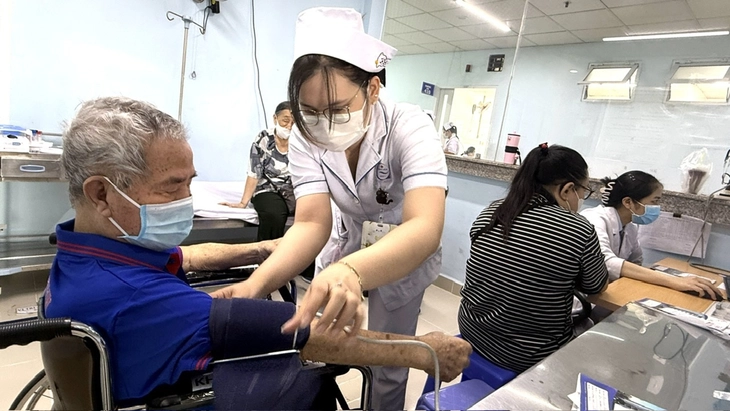
Medical staff examine the elderly at Nguyen Thi Thap Hospital, Ho Chi Minh City - Photo: TU TRUNG
The Ministry of Health has just explained the opinions raised at the National Assembly's discussion session, stating that the ministry has proposed to issue a resolution "Some breakthrough mechanisms and policies for the work of protecting, caring for and improving people's health", in which doctors (including preventive medicine doctors) and pharmacists will be ranked at level 2 in the salary scale (with a coefficient of 2.67) instead of level 1 (2.34) as present.
However, many National Assembly delegates believe that immediately assigning level 2 salaries for doctors and pharmacists is not far from level 1, so it is possible to immediately raise and assign levels 3 and 4 for newly recruited doctors to solve the "problem" of low income for medical staff over the past many years.
The doctor said it increased but still not enough.
Currently, newly graduated doctors receive a salary coefficient of 2.34 x the current base salary of 2.34 million VND. With this salary, the total income a newly employed doctor actually receives is about 7 million VND/month, including a 40% professional incentive allowance and excluding insurance payments.
Speaking to Tuoi Tre, Dr. Ma Thanh Tung - Deputy Head of the Anesthesia and Resuscitation Department of Tu Du Hospital (HCMC) - commented that increasing the salary coefficient for medical staff is a recognition of the reality, a positive signal but still not enough. According to him, a reasonable starting salary for doctors with a practicing certificate or license must be from a coefficient of 3.0 or higher.
Doctor Tung analyzed that a doctor trained to be able to "listen to the heart and lungs, hold a scalpel, issue treatment orders in medical records, and sign to take professional responsibility" must undergo at least eight years of training, including six years of university and
18-24 months after college if everything goes well (specialty 1 or master's), not to mention having to work nights and study and practice to get a practice certificate.
While students in other majors can start working at the age of 22-23, doctors have to wait until they are 26-27 to officially start practicing and earn their first income. Even after starting work, doctors still have to participate in continuing education (CME) for at least 24 hours/year (120 hours/year), and complete many mandatory certificates such as ultrasound, electrocardiogram, cardiopulmonary resuscitation, endoscopy...
According to Dr. Tung, applying the starting salary to almost the same level for all professions, while the training time and experience and certification requirements for independent practice are very different, is not appropriate.
While society always expects medical staff to be dedicated, devoted, and humble "like a gentle mother", the protection mechanism against medical violence and the treatment policy are not commensurate. When conflicts occur with patients and their families, medical staff are easily labeled as "violating medical ethics" or unworthy of being doctors.
"In our medical field, we study longer, pay higher tuition fees, spend more mental and physical effort working under stress, have more night shifts, and save many critically ill patients, but such an equal salary coefficient is not reasonable," Dr. Tung shared.
Working at a tertiary hospital in Ho Chi Minh City for decades, Dr. NT said he was heartbroken to see many young doctors working at the hospital but only working for a short time before transferring to private hospitals.
Most of the reasons for quitting their jobs are mainly due to the salary not being enough to live on with outdated allowances, salary level 1, if calculating the total income after deducting other expenses, each newly graduated doctor only gets about 7-8 million VND.
With six years of university, high tuition fees, and expensive living costs in the city, many night shifts, and low salaries, many doctors cannot survive in public hospitals.
"Many young doctors have to work part-time jobs in their spare time to make ends meet. Only when their income is good enough and they don't have to worry about making ends meet can they feel secure in their dedication," he said.
According to this person, the salary level 2 for doctors is completely appropriate, it can be raised to level 3, 4 to retain medical staff. This proposal has been talked about for many years and until now it is too late to implement, however, in order for medical staff to stick with the profession for a long time, in addition to salary, many other preferential policies are needed.
Preventing the "brain drain" in the medical industry
Dr. Truong Vinh Long - Vice Chairman of the Strategic Committee of Hoa Lam Shangri-La High-Tech Medical Zone, Hoa Lam Vietnam Group - admitted that there is currently a "brain drain" in the medical industry.
When private hospitals are established and need highly skilled medical staff, these units are forced to offer preferential salaries to compete with other units in order to find qualified professional resources and attract patients.
If there is no early policy mechanism and specific regime for medical staff, there will continue to be a wave of public medical human resources shifting to the private sector, affecting the quality of medical examination and treatment in the public health sector, where many patients are concentrated.
According to Dr. Tung, the issue of medical treatment is not only about the monthly allowance but is a long-standing concern of medical staff, especially frontline medical staff in remote areas.
Therefore, adjusting starting salary and allowances is not only a matter of income but also a proper recognition of a profession that requires a lot of responsibility and high requirements for professional quality in society.
"The medical profession, as well as the education sector, always has high expectations for ethics and dedication, but the medical profession is at a disadvantage in terms of remuneration policies. The current increase is a motivation but is still low compared to actual requirements, and does not accurately reflect the long training time and the specific nature of the profession," Dr. Tung emphasized.
A doctor working at a district hospital in Ho Chi Minh City also said that currently, at many schools training in specialties such as emergency resuscitation, infectious diseases, tuberculosis... the number of medical students studying is very small.
The reason is that these majors have the characteristics of high pressure and dangerous work, just one mistake in treatment or wrong use of medicine can affect the patient's life. Therefore, it is necessary to add preferential allowances so that they can work with peace of mind, stick with the profession, and feel secure in their work.
Increase the level of preferential allowances for occupations
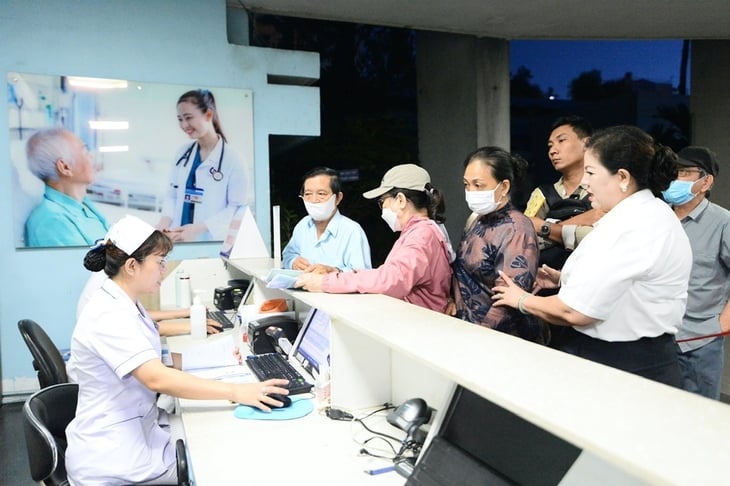
The salary of doctors and nurses is still low, the medical profession has a long study time but the starting salary is ranked the same as other professions and this is considered unreasonable. Photo taken at Nguyen Thi Thap Hospital, Ho Chi Minh City - Photo: TU TRUNG
Minister of Health Dao Hong Lan said that the salary and allowance policy for health workers in the past has been "very difficult". When drafting Resolution 72, the Politburo allowed the selection of a number of groups and levels to gradually increase allowances. The Ministry of Health is also submitting to the Government to develop special regimes such as on-duty allowances and other allowances for health workers.
In the draft decree last October, the Ministry of Health proposed to increase a series of allowances. For special surgeries, the allowance for the main surgeon, anesthesiologist or main anesthetist was proposed to increase nearly three times, from 280,000 to 790,000 VND; the allowances for surgeries of type I, II, III are 355,000, 185,000 and 140,000 VND respectively.
Surgical assistants and anesthesiologists can receive 565,000 VND per case; housekeepers 340,000 VND. For medical procedures, the allowance is 30% of the same type of surgical allowance.
Source: https://tuoitre.vn/26-27-tuoi-moi-hanh-nghe-thu-nhap-7-trieu-dong-khong-du-song-phai-xep-bac-luong-bac-si-cao-hon-20251204223942237.htm

































![[Photo] National Assembly Chairman Tran Thanh Man attends the VinFuture 2025 Award Ceremony](/_next/image?url=https%3A%2F%2Fvphoto.vietnam.vn%2Fthumb%2F1200x675%2Fvietnam%2Fresource%2FIMAGE%2F2025%2F12%2F05%2F1764951162416_2628509768338816493-6995-jpg.webp&w=3840&q=75)



































































Comment (0)