

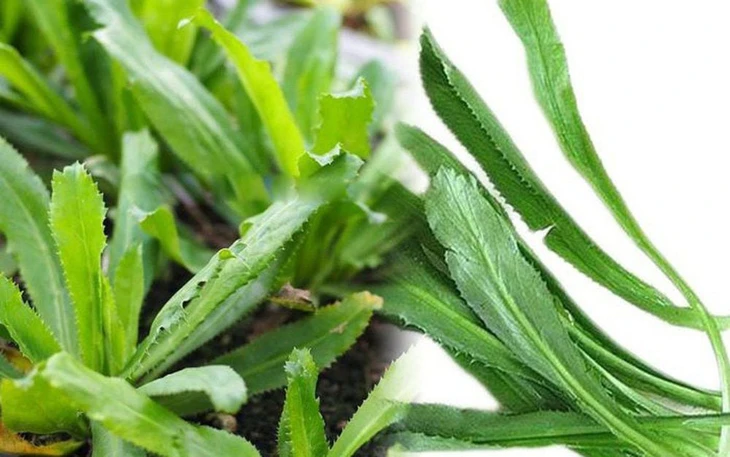
Coriander leaves, also known as spiny coriander, have many health benefits - Illustration photo
Physician Bui Dac Sang (Vietnam Academy of Science and Technology, Vietnam Oriental Medicine Association) said that coriander is easy to recognize and less likely to be confused with other vegetables.
The plant is common in moist soil in the midland and mountainous areas of the North and is also often grown in family gardens as a spice vegetable. This is an annual or perennial herb, with an upright stem, branching at the top, 15-30cm high.
Coriander leaves grow close to the ground in a rosette at the base, with thin, oblong, lanceolate blades, tapering at the base, serrated edges, and slightly thorny. The leaves on the stem become shorter and smaller as they grow up, with more serrated edges and sharper thorns. The flowers are greenish-white, growing in clusters. The fruit is spherical, slightly flat, and scaly. The whole plant contains essential oils, so it smells like coriander.
The plant is widely grown as a spice. "The whole plant, from roots, leaves, fruits to seeds, can be used as medicine. The plant is harvested year-round and can be used fresh or dried for later use," said physician Bui Dac Sang.
In traditional medicine, coriander has a spicy, slightly bitter, aromatic, warm taste, has the effect of clearing wind and heat, strengthening the spleen, promoting qi circulation, reducing swelling, relieving pain, and dissolving mucus to help loosen phlegm.
This physician also said that in modern medicine, studies have shown that the roots and leaves of eryngium have high essential oil content and are rich in nutrients such as calcium, iron, phosphorus, carotene and riboflavin, vitamins A, B1, B2 and C.
With the above analysis, coriander helps to make rice delicious, digest food, cool down, calm the nerves, dispel wind, eliminate dampness, eliminate impurities and bad odors. Coriander is also used to treat runny nose, chest tightness, digestive disorders, enteritis, and diarrhea with a dosage of 10-15g/day.
In the parts of coriander, the seeds are rich in fiber, so they have the effect of cleaning and lowering cholesterol in the blood. People with high blood fat can use coriander seeds to boil water and drink regularly to help lower cholesterol and clean the blood.
Physician Bui Dac Sang instructs: "You can use coriander seeds to help reduce cholesterol and purify the blood by washing 5g of seeds, then grinding or crushing them and adding 300ml of water to filter out the residue. Boil the filtered water and simmer for 3 minutes, let it cool and drink."
According to Mr. Sang, in addition to the effect of supporting blood fat reduction, coriander is also good for the kidneys. Accordingly, coriander can support the treatment of kidney stones by heating the leaves over a fire until wilted and put them in a pot, pour 3 bowls of water until there is 1 bowl of water left, then divide into 3 times to drink during the day. The time to take the medicine is from 7-9 days. It is best to drink before meals.
In addition to the two remedies above, people with urinary retention and fever should use 20g of coriander root to make a decoction. In case of difficulty urinating or painful urination, use 12g of coriander leaves and seeds, 12g of corn silk to make a decoction to help the disease recede quickly.
"With prescription drugs, it is best for people to consult a specialist before using them, because specific examinations and imaging are needed to specifically assess the medical condition," Mr. Sang noted.
The physician also added that pregnant women should avoid using this vegetable. People with bronchial asthma or chronic obstructive pulmonary disease should also limit the use of coriander.
Source: https://tuoitre.vn/nhung-bai-thuoc-huu-ich-tu-cay-ngo-gai-2025120516182931.htm


![[Photo] 60th Anniversary of the Founding of the Vietnam Association of Photographic Artists](/_next/image?url=https%3A%2F%2Fvphoto.vietnam.vn%2Fthumb%2F1200x675%2Fvietnam%2Fresource%2FIMAGE%2F2025%2F12%2F05%2F1764935864512_a1-bnd-0841-9740-jpg.webp&w=3840&q=75)


![[Photo] National Assembly Chairman Tran Thanh Man attends the VinFuture 2025 Award Ceremony](/_next/image?url=https%3A%2F%2Fvphoto.vietnam.vn%2Fthumb%2F1200x675%2Fvietnam%2Fresource%2FIMAGE%2F2025%2F12%2F05%2F1764951162416_2628509768338816493-6995-jpg.webp&w=3840&q=75)






![[Video] Dong Do Hospital celebrates 15 years of operation](https://vphoto.vietnam.vn/thumb/402x226/vietnam/resource/IMAGE/2025/12/06/1764980267666_img-2287-5359-png.webp)








































































Comment (0)