

VietNamNet newspaper quoted the book Vietnamese medicinal plants and herbs by Professor Do Tat Loi, which provides a lot of interesting information about the effects of plants around us. Below are 5 types of wild vegetables or very easy to grow that can be used as medicine. Note that you need to consult a doctor of Oriental medicine before using.
Purslane
According to the Health & Life newspaper, Dr. Phuong Thao said that purslane is a common and familiar vegetable in Vietnamese life, but not everyone knows that it is also a valuable medicinal herb that can help treat many diseases. The entire plant is used.
100g of the vegetable contains 92g of water; 1.7g of protein; 0.4g of fat; 3.8g of carbohydrates; 103mg of Ca; 39mg of P; 3.6mg of Fe; 0.03mg of vitamin B1; 25mg of vitamin C; and 2,550 international units of vitamin A. The whole plant contains coumarin (betacyanidin pigments), flavonoids, glucosides... and mucilage. Plants grown in different soil types have varying amounts of calcium oxalate or nitrate.
According to Traditional Chinese Medicine, purslane has a sour taste and a cooling nature, acting on the large intestine, liver, and kidneys. Its effects include clearing heat and detoxifying, cooling the blood, dispersing blood clots, and reducing swelling. It treats dysentery, urinary tract infections, urinary tract stones (painful urination, blood in urine, and stone deposits), and boils and itchy sores. The recommended daily dose is 60-200g of fresh purslane (or 15-40g of dried purslane), prepared by cooking, boiling, or juicing.
Houttuynia cordata
According to the Health & Life newspaper, Dr. Huynh Tan Vu, Head of the Day Treatment Unit at the University Medical Center of Ho Chi Minh City, said that Houttuynia cordata, also known as fish mint, is a plant with the scientific name Houttuynia cordata. It belongs to the Saururaceae family. Houttuynia cordata is cultivated or grows wild in many places. It is very easy to find and inexpensive.
Chemical composition of Houttuynia cordata: The entire Houttuynia cordata plant contains essential oils. The main component is aldehyde. In addition, Houttuynia cordata also contains caprinic acid, laurinaldehyde, benzamide, decanoic acid, lipids, and vitamin K… The leaves of Houttuynia cordata contain β-sitosterol and alkaloids.
Uses of Houttuynia cordata: Houttuynia cordata has diuretic, cooling, detoxifying, anti-inflammatory, and antiseptic effects. It is used to treat hemorrhoids, boils, measles in children, pneumonia or lung abscesses, conjunctivitis or eye infections caused by Pseudomonas aeruginosa, enteritis, urinary retention, and irregular menstruation. It is also used to treat malaria, convulsions in children, and toothaches.
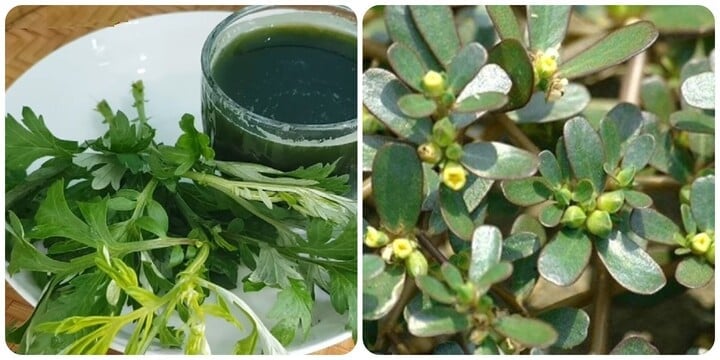
Mugwort, purslane... are common herbs used by traditional healers as medicine.
Amaranth
Amaranth contains many nutrients, such as vitamin C, B1, B2, vitamin PP, carotene, ethylcholesterol compounds, dehydrocholesterol... Amaranth leaves and young branches cooked in soup have anti-inflammatory and detoxifying effects; treat acne and dysentery. Amaranth seeds have a sweet taste, cold properties, and have the effect of cooling the liver, clearing heat, benefiting qi, and brightening the eyes. Medicines often use amaranth seeds to make a drink.
The bark of the red amaranth plant is used to make a decoction to treat irregular menstruation and anemia, while the leaves are used to treat aches, pains, and rheumatism. The powdered bark, or bark soaked in alcohol, is used as a tonic and to treat malaria.
Centella asiatica
Centella asiatica, also known as Gotu Kola or Centella asiatica, belongs to the Apiaceae family. It grows wild in tropical countries, including Vietnam. When fresh, the plant has a bitter, slightly irritating taste and can be harvested year-round. According to Traditional Chinese Medicine, Centella asiatica is neutral in nature, non-toxic, and has antipyretic, detoxifying, and diuretic properties. It is used to treat hemoptysis, dysentery, vaginal discharge, and lactation-promoting effects. It can also be combined with Eclipta prostrata to stop bleeding. Common remedies involve crushing fresh leaves and drinking the juice.
Mugwort
Mugwort is also known as moxibustion, ointment, mugwort, and belongs to the daisy family. The plant grows wild in many places.
Mugwort contains essential oils, tannins, adenine, and choline. According to Traditional Chinese Medicine, it is a warm herb with a pungent taste, used to warm the blood and qi, regulate menstruation, stabilize pregnancy, treat abdominal pain due to cold, irregular menstruation, restless pregnancy, hemoptysis, and nosebleeds. In addition, mugwort is also used to treat digestive disorders, abdominal pain, vomiting, worms, and malaria. People can decoct mugwort with water, steep it in boiling water, or consume it in powder or concentrated extract form.
Above are 5 types of wild vegetables that traditional healers use as medicine. These vegetables are all very good for health. However, if you want to use these vegetables to treat illnesses, you should consult your doctor before using them.
Source: https://vtcnews.vn/5-loai-rau-moc-dai-duoc-luong-y-dung-lam-thuoc-ar907460.html


















































































Comment (0)