

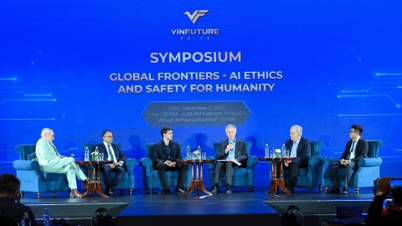
Within the framework of VinFuture 2025 Science and Technology Week, the panel discussion " AI for humanity: AI ethics and safety in the new era " discussed one of the most urgent topics today: Responsible AI development, towards humanistic values and for the common good of humanity.
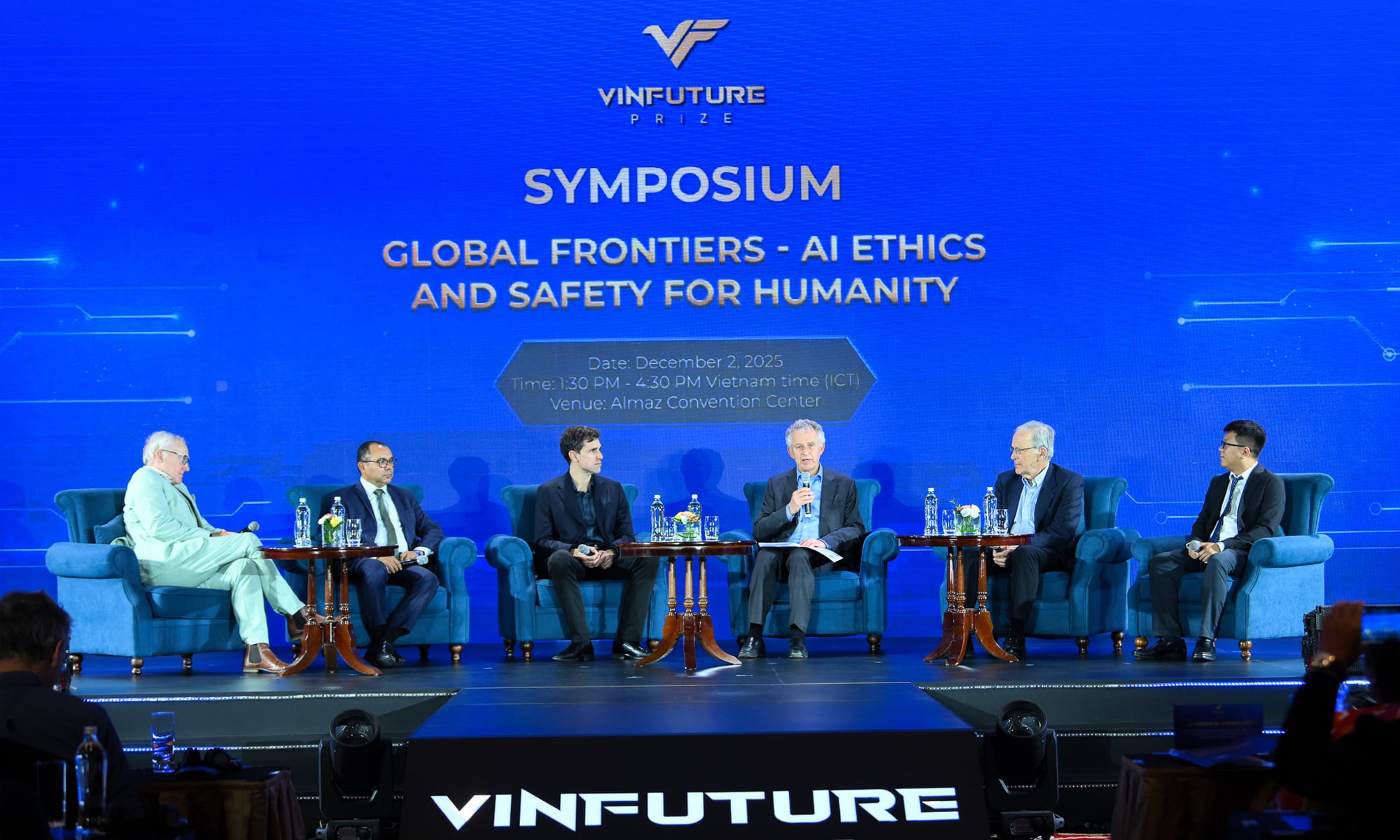
Scientists discuss at the seminar.
Sending a video message to the panel discussion, Professor Geoffrey Hinton - winner of the 2024 Nobel Prize in Physics and honored as the "Father of AI", said that AI is developing very rapidly, bringing both great benefits and potential risks.
On the positive side, Mr. Hinton said, AI creates a huge improvement in health care, education, new drug development, new materials or any field that requires prediction, creating a leap in productivity.
“ This is beneficial if it is distributed fairly in society ,” the Professor emphasized.
On the contrary, AI is gradually getting better at designing dangerous viruses or cyber attacks; creating fake videos; leading to mass unemployment...
" AI experts believe that we will develop systems that are smarter than humans. There are many different views on when that will happen, but most predict within the next 20 years. And we need to urgently think about how to live with entities smarter than ourselves. This is a situation that humanity has never faced before, it is new and we need to do a lot of research before that happens ," said Professor Hinton.
According to Professor Geoffrey Hinton, scientists and engineers have a responsibility to find stronger ways to keep AI in line with human values, and must help the public and politicians better understand the nature of AI to make the right decisions.
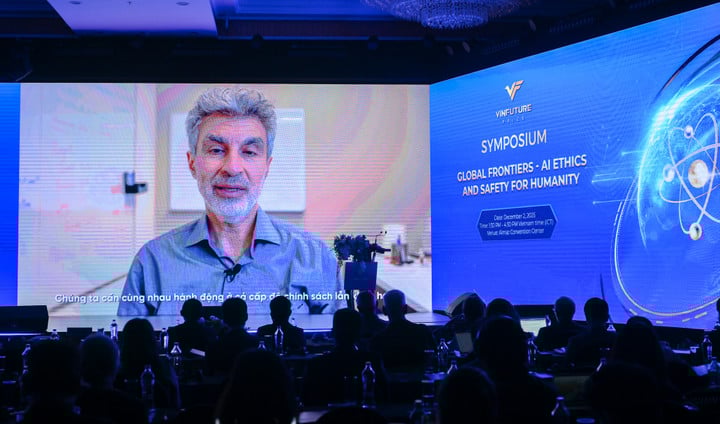
Professor Yoshua Bengio shared at the seminar.
Meanwhile, Professor Yoshua Bengo - known as the "father of deep learning" and winner of the 2018 Turing Award, said that AI has the potential to bring huge benefits to help solve many urgent challenges of the time, but this only happens when we guide it wisely.
He cites recent simulations that show AI systems can behave dangerously, such as blackmailing, deceiving, or prioritizing their own survival over human safety. In addition, some features of popular AI models today can cause users to form strong emotional attachments in unhealthy ways.
“ At extreme levels, this attachment can be dangerous to mental health, especially for vulnerable people who are at risk of self-harm, even suicide or AI-induced psychosis ,” said Professor Bengo.
From this reality, according to Mr. Bengo, we must increase safety for an advanced AI instead of just focusing on developing it to make it stronger.
" Safety and trust are not secondary factors but essential in the development process, towards the benefit of humanity. We need to act together at both the policy and scientific levels ," Professor Yoshua Bengo emphasized.
According to Professor Yoshua Bengo, in terms of policy, the world needs international cooperation. In terms of science, it is necessary to better understand how to design AI that is both superior in capabilities and harmless to humans.
In particular, the expert noted, maintaining the ability to control AI to behave safely even when humans ask them to do wrong; building technical and social barriers to ensure AI is consistent with human norms, intentions, values and interests.
From another perspective, Dr. Vinton Gray Cerf - one of the "fathers of the Internet", shares lessons from more than 50 years of Internet development to shed light on the AI era.
He outlined four major lessons from the Internet: Connectivity is everything; end-to-end communication must be secure; the system must be global, and the architecture must be open enough to allow for continuous innovation.
“ But the internet also shows that absolute anonymity makes accountability difficult. In the age of AI, that accountability becomes even more urgent as technology can create fake content, manipulate information and disrupt society, ” said Dr. Vinton Gray Cerf, arguing that fostering digital trust – based on transparency, identity and international cooperation – is an indispensable foundation for AI governance.
English
Source: https://vtcnews.vn/ai-co-the-thong-minh-hon-con-nguoi-trong-khoang-20-nam-toi-ar988937.html


























![[Photo] Parade to celebrate the 50th anniversary of Laos' National Day](/_next/image?url=https%3A%2F%2Fvphoto.vietnam.vn%2Fthumb%2F1200x675%2Fvietnam%2Fresource%2FIMAGE%2F2025%2F12%2F02%2F1764691918289_ndo_br_0-jpg.webp&w=3840&q=75)
![[Photo] Worshiping the Tuyet Son statue - a nearly 400-year-old treasure at Keo Pagoda](/_next/image?url=https%3A%2F%2Fvphoto.vietnam.vn%2Fthumb%2F1200x675%2Fvietnam%2Fresource%2FIMAGE%2F2025%2F12%2F02%2F1764679323086_ndo_br_tempimageomw0hi-4884-jpg.webp&w=3840&q=75)




















































![[Infographic] 3 timelines of the "Quang Trung Campaign"](https://vphoto.vietnam.vn/thumb/402x226/vietnam/resource/IMAGE/2025/12/04/1764800248456_fb_ava-2.jpeg)












Comment (0)