

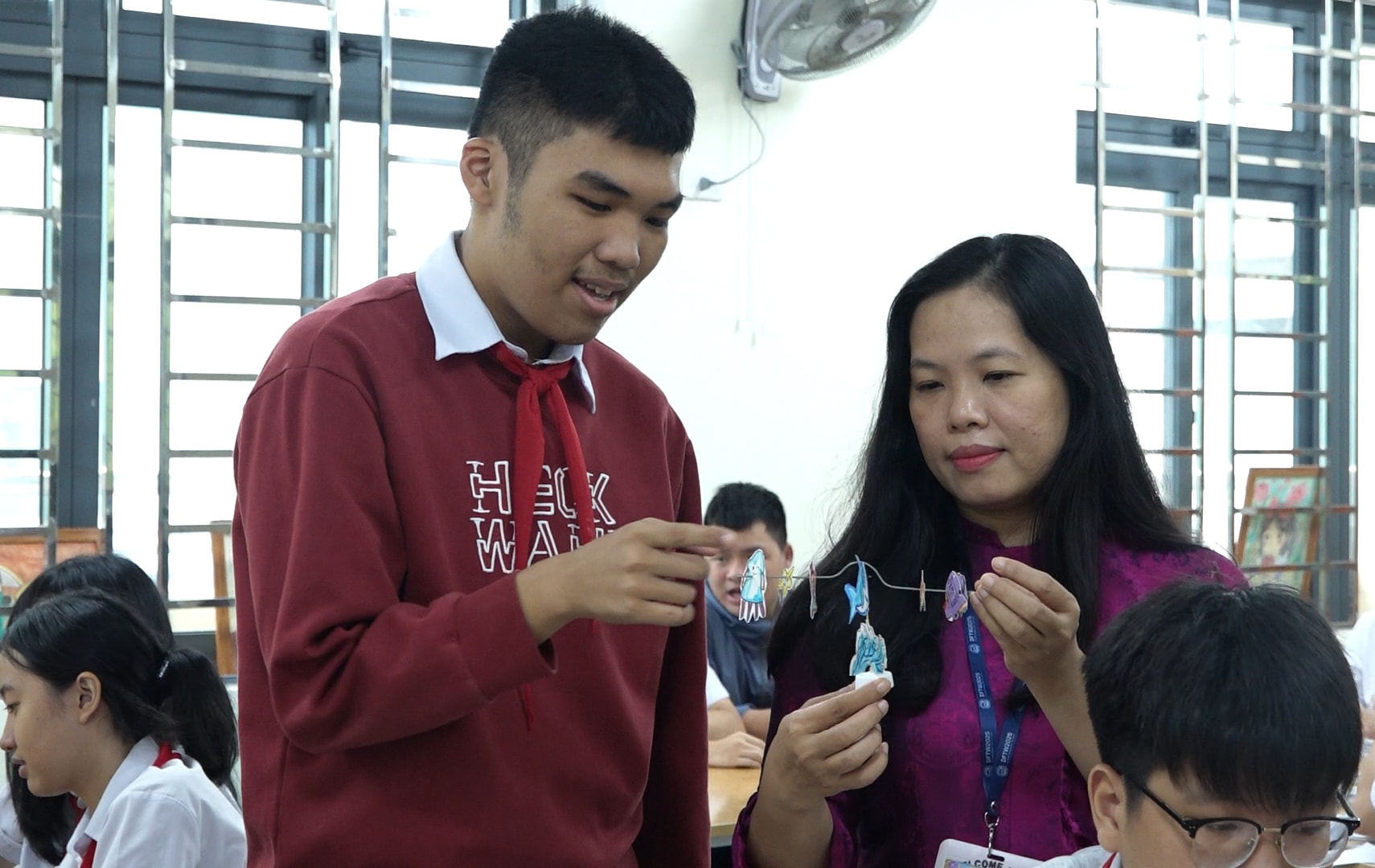
Photo: HOANG CUONG
This is one of 14 initiatives recognized by the Da Nang City People's Committee as having a positive impact on the city, in mid-September 2025.
This initiative not only makes art lessons more engaging and relatable to students, but also opens up a new approach to career-oriented education at the lower secondary level.
Based on her teaching experience, Ms. Luong Anh Thu observed that most art teachers lack appropriate teaching materials and tools. Career guidance content is often too general and too brief, preventing students from gaining a deep understanding of professions related to art.
Meanwhile, parents lack the information to support their children in career guidance; and the education sector also lacks a standardized system of materials for career guidance in fine arts.
Driven by these concerns, Ms. Thu researched and developed the "Electronic Handbook Introducing Fine Arts Professions in Career Guidance Teaching and Learning."
This handbook is a scientifically designed digital resource, incorporating QR codes for easy access by students, teachers, and parents using smartphones.
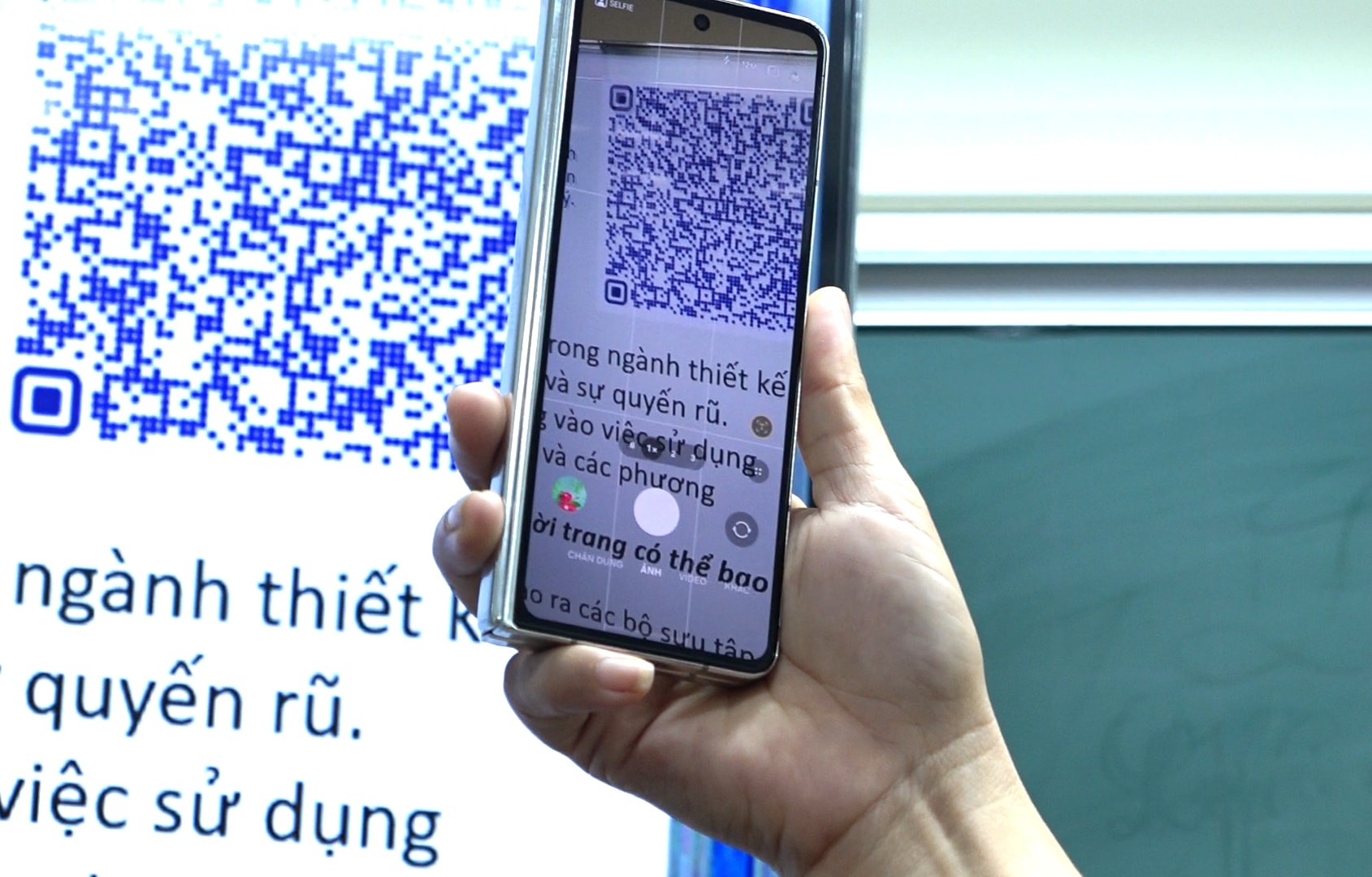
Accordingly, users simply need to scan the QR code to access information depending on their purpose, lesson requirements, or the teacher's lecture in the curriculum.
The handbook contains information about professions, training institutions, admission requirements, career development paths, and real-life stories about the application of art in daily life, presented in an easy-to-understand and accessible manner.
In particular, the handbook is presented in multimedia format, combining text, images, and audio, allowing learners to access knowledge "anytime, anywhere".
As a result, art lessons are no longer confined to 45 minutes in the classroom, but become an exciting journey of discovery, helping students understand the role of art in many fields from design, clothing, architecture, media to the creative industries…
"Applying digital handbooks to teaching helps teachers be more proactive in innovating methods, while also helping students develop self-learning and self-discovery skills. I hope that, through this tool, students can recognize their abilities and strengths, thereby orienting their future career paths early on instead of learning passively," she shared.
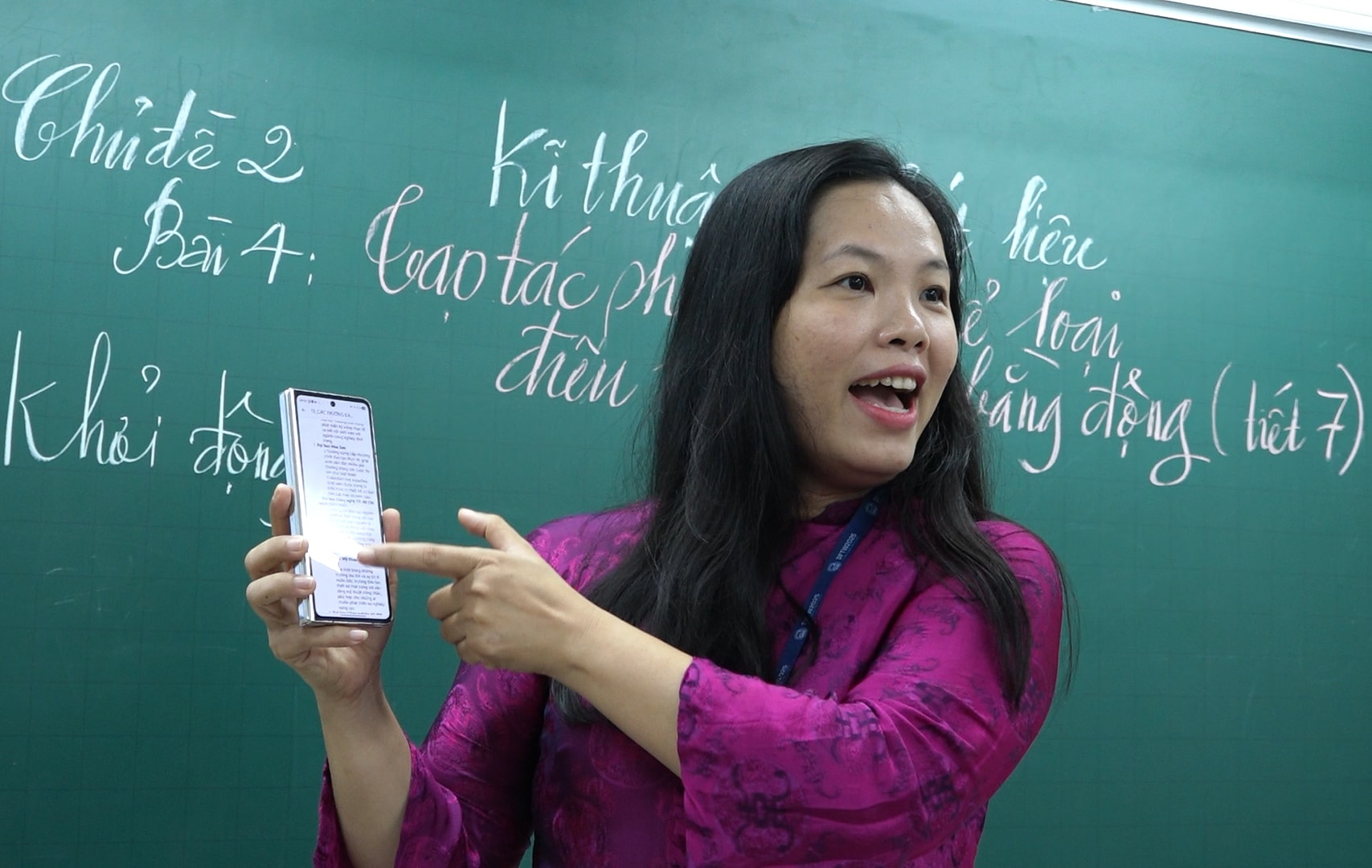
According to teacher Luong Anh Thu, every small innovation in the classroom can create a big change in students' perceptions and learning journey. The digital handbook is not only a teaching tool, but also a bridge between the school, students, and parents in career guidance.
This is a practical solution that meets the requirements of educational reform, the application of information technology, and career guidance for students.
[VIDEO] - Applying e-learning guides to art education:
Tran Nguyen Phuong Quynh, a student in class 9/2, shared that with the electronic handbook introducing professions in the career guidance topic during art classes, she and her classmates were able to learn about professions related to the subject.
By simply scanning the QR code, students can proactively explore creative fields such as design, architecture, graphic design, and applied painting, which they previously only knew about from books.
Through this, students gain a better understanding of career opportunities and the paths that art can open up in the future. The lessons therefore become more lively and engaging, with each student freely sharing their thoughts and dreams.
"I'm very excited to be learning, experiencing, and receiving guidance all at the same time. The teacher's guide has helped us see the value of the subject and nurture our career aspirations starting today," Phuong Quynh shared.
The school's innovation council and higher authorities highly appreciate teacher Luong Anh Thu's initiative for its practical application and effectiveness. The electronic handbook not only helps students develop a greater love for art but also supports them in exploring career options and choosing suitable paths after graduating from junior high school. In particular, the handbook also provides students with insights into local traditional craft villages.
Mr. Huynh Tan Lanh, Principal of Nguyen Thi Minh Khai Secondary School
Mr. Huynh Tan Lanh, Principal of Nguyen Thi Minh Khai Secondary School, shared that the movement of researching, writing, and applying initiatives at the school has created a vibrant competitive atmosphere, contributing to improving the quality of teaching and spreading the spirit of innovation throughout the entire education sector. Many initiatives have helped improve the quality of education, contributing to the achievement of goals in science and technology development, innovation, and digital transformation.
In the 2024-2025 school year alone, Nguyen Thi Minh Khai Secondary School had 23 initiatives, 16 of which received district-level recognition. This is the result of the teachers' spirit of research and innovation to improve the effectiveness of teaching.
Decision No. 1547/QD-UBND dated September 18, 2025, of the People's Committee of Da Nang City recognizes 14 initiatives that have had an impact on Da Nang City. Notable examples include: an electronic handbook introducing fine arts professions in teaching and learning on career guidance topics; integrating STEM/STEMS education into the development of preschool education programs in Lien Chieu district; and several measures for directing and managing STEM/STEMS activities and applying artificial intelligence that yield high efficiency and widespread impact at Ly Cong Uan Primary School…
Source: https://baodanang.vn/ap-dung-sang-kien-de-nang-cao-hieu-qua-giang-day-mon-my-thuat-3308334.html

![[Photo] Prime Minister Pham Minh Chinh holds a phone call with the CEO of Russia's Rosatom Corporation.](/_next/image?url=https%3A%2F%2Fvphoto.vietnam.vn%2Fthumb%2F1200x675%2Fvietnam%2Fresource%2FIMAGE%2F2025%2F12%2F11%2F1765464552365_dsc-5295-jpg.webp&w=3840&q=75)
![[Photo] Closing Ceremony of the 10th Session of the 15th National Assembly](/_next/image?url=https%3A%2F%2Fvphoto.vietnam.vn%2Fthumb%2F1200x675%2Fvietnam%2Fresource%2FIMAGE%2F2025%2F12%2F11%2F1765448959967_image-1437-jpg.webp&w=3840&q=75)











![[Infographic] Preventing students from making their own firecrackers: 7 things parents need to know](https://vphoto.vietnam.vn/thumb/402x226/vietnam/resource/IMAGE/2025/12/11/1765466656703_img_0320_20251211183542.jpeg)






























![[OFFICIAL] MISA GROUP ANNOUNCES ITS PIONEERING BRAND POSITIONING IN BUILDING AGENTIC AI FOR BUSINESSES, HOUSEHOLDS, AND THE GOVERNMENT](https://vphoto.vietnam.vn/thumb/402x226/vietnam/resource/IMAGE/2025/12/11/1765444754256_agentic-ai_postfb-scaled.png)









































Comment (0)