

These projects are creating a new look.
At the end of 2024, Mat village (Son Dong commune) was recognized as meeting the standards of a new rural area. The village has 176 households and 830 inhabitants, mostly of the Tay ethnic group. Pointing to the village's cultural center, Mr. Ngoc Van Tinh, the village head, happily shared: "In the last 5 years, the village's appearance has changed significantly. A series of essential projects such as roads, a cultural center, and a sports field have been built with state budget funds and contributions from the people." A highlight is the village's cultural center, covering over 200m², which was recently completed with a total investment of over 2.5 billion VND.
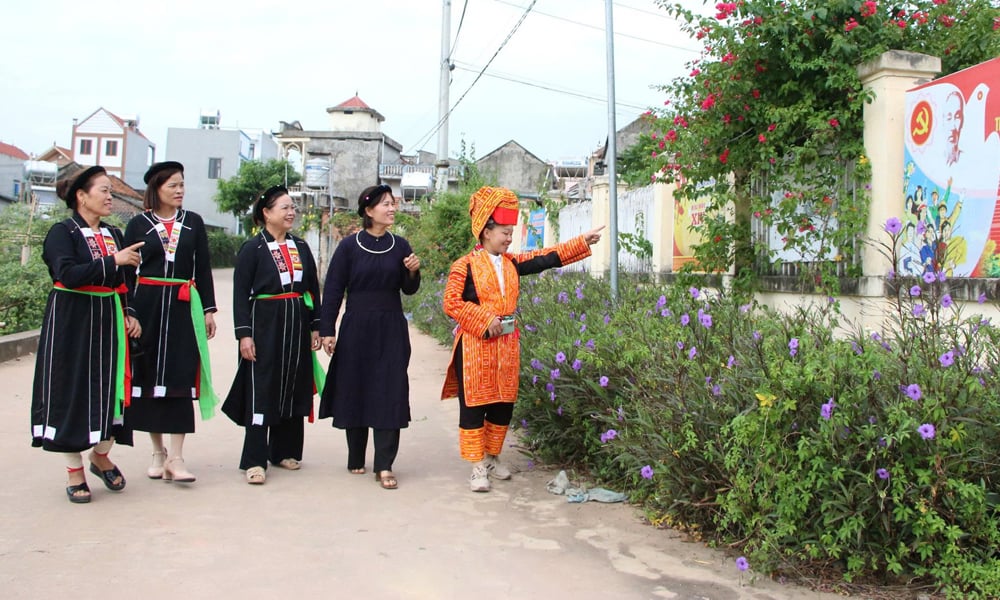 |
Ethnic minority people in Dai Son commune are building a new rural area. |
Besides contributing labor and money, the people of Mat village are also willing to donate land and dismantle their property to expand transportation routes. To build two roads, one from Mat village to Phu Hung village and the other to Hiep Reo village, dozens of households voluntarily donated land to create space for construction. Notable examples include Mrs. Chu Thi Tinh's family, who donated garden land and a fence worth over 80 million VND; Mr. Nguyen Van Sac, who donated 360m² of garden land; and Mr. Nong Van Tuan, who removed 20 lychee trees that were over 10 years old. According to a review, at the end of 2024, Mat village had only 7 poor households, a decrease of 3 households compared to the previous year, representing a poverty rate of 3.9%.
According to the Department of Agriculture and Environment, during the 2021-2025 period, the emulation movement for building new rural areas has been actively embraced by localities throughout the province. It is estimated that by the end of 2025, the province will have 51 out of 66 communes meeting the new rural area standards, 5 out of 66 communes meeting the advanced new rural area standards, 432 model villages, and 516 new rural villages. Notably, among these, 13 particularly disadvantaged villages in ethnic minority and mountainous areas will achieve new rural area status, including: Hoa, Pho Cho (Tan Son commune); Cai Can (Son Hai commune); Cau Vong (Bien Dong commune); Man, Mat, Va (Son Dong commune); Na Vang (Van Son commune); Tan Son, Tan Hiep (Dai Son commune); Trang Ban, Thai Ha, Dong Vuong (Dong Ky commune).
Towards sustainable development
Recognizing that building new rural areas is a long-term, sustained process requiring significant resources from the community, Party committees in mountainous communes have issued specialized resolutions, focusing on leadership and guidance tailored to the practical situation. Cadres and Party members directly go down to the villages and to each household to propagate and mobilize the people to work together to overcome the remaining criteria, especially those related to cultural infrastructure, the environment, and transportation. Alongside infrastructure development, localities focus on exploiting the advantages of restructuring crop patterns by introducing new, high -economic- value varieties into production. As a result, before the administrative unit reorganization, communes with large ethnic minority populations such as Dai Son, Van Son, and Truong Son had already achieved their new rural area development goals.
| By the end of 2025, the province is expected to have 51 out of 66 communes meeting the new rural standards, 5 out of 66 communes meeting the advanced new rural standards, 432 model villages, and 516 new rural villages. Notably, among these, 13 particularly disadvantaged villages and hamlets in ethnic minority and mountainous areas will achieve new rural status. |
In practice, each commune has its own suitable approach, creating a ripple effect. Comrade Hoang Van Phuong, Chairman of the People's Committee of Dai Son commune, said: “First, the locality focuses on propaganda, creating a unified understanding among cadres, Party members, and the people, clearly defining this as a comprehensive, long-term socio-economic development program, owned by the community. When mobilizing resources for construction projects, from the commune to the villages, the principle of "the people know, the people discuss, the people do, the people inspect, and the people benefit" is strictly adhered to, ensuring transparency and building trust among the people. In economic development, the commune focuses on guiding people to develop forest-based economy and expand the area of key fruit trees (apples, lychees). Currently, the criteria for income, security, order, culture, education, and environment here continue to be maintained and improved.”
Besides developing infrastructure and the economy, ethnic minority communities in the highland communes also pay special attention to preserving their traditional cultural identity. For example, in Cong Lau village (Bien Son commune), where 100% of the population are Nung ethnic people, the cultural preservation movement is well-maintained. The village has established a folk singing club for ethnic people. Elderly people directly teach the ethnic language, sew traditional costumes, and teach Then and Sloonghao melodies to the younger generation. During funerals and weddings, the local authorities encourage people to wear traditional clothing, contributing to preserving the beauty of culture in community life.
Despite achieving many positive results, living conditions in some ethnic minority areas remain difficult compared to the lowlands. In light of this reality, the Provincial People's Committee continues to allocate resources for socio-economic development, gradually narrowing the development gap between mountainous and lowland areas. Currently, the National Assembly is considering and providing feedback on a plan to merge three national target programs: New Rural Development, Sustainable Poverty Reduction, and Socio-Economic Development in Ethnic Minority and Mountainous Areas for the period 2026-2035, in order to concentrate resources. Once the policy is approved, the valuable lessons learned will continue to serve as an important foundation for Party committees, authorities, and the people, especially those in ethnic minority areas, to work together to build a more developed and sustainable homeland.
Source: https://baobacninhtv.vn/bac-ninh-xay-dung-nong-thon-moi-o-vung-dong-bao-dan-toc-thieu-so-postid432895.bbg
![[Photo] Closing Ceremony of the 10th Session of the 15th National Assembly](/_next/image?url=https%3A%2F%2Fvphoto.vietnam.vn%2Fthumb%2F1200x675%2Fvietnam%2Fresource%2FIMAGE%2F2025%2F12%2F11%2F1765448959967_image-1437-jpg.webp&w=3840&q=75)



![[Photo] Prime Minister Pham Minh Chinh holds a phone call with the CEO of Russia's Rosatom Corporation.](/_next/image?url=https%3A%2F%2Fvphoto.vietnam.vn%2Fthumb%2F1200x675%2Fvietnam%2Fresource%2FIMAGE%2F2025%2F12%2F11%2F1765464552365_dsc-5295-jpg.webp&w=3840&q=75)







































![[OFFICIAL] MISA GROUP ANNOUNCES ITS PIONEERING BRAND POSITIONING IN BUILDING AGENTIC AI FOR BUSINESSES, HOUSEHOLDS, AND THE GOVERNMENT](https://vphoto.vietnam.vn/thumb/402x226/vietnam/resource/IMAGE/2025/12/11/1765444754256_agentic-ai_postfb-scaled.png)







































Comment (0)