

62% of new manufacturers chose to lease factory space in 2025, the highest level since 2018, reflecting the vibrancy of the industrial real estate market this year.
According to Savills Vietnam's report "Industrial Real Estate Focus 2025: A Shift Towards Growth," published on December 10th, Vietnam's industrial real estate market in 2025 will witness a surge in activity in the ready-built factory and warehouse (RBF) leasing segment, driven by continuously increasing demand for production expansion, supply chain shifts, and e-commerce growth.
Demand for factory space has increased sharply.
By the second half of 2025, the total area of ready-built factory and warehouse space (RBF & RBW) in the Southern key economic region will reach 11.6 million m², with an occupancy rate of 92%, an 80% increase compared to 2024. The average rental price will reach US$4.4/m²/month, reflecting the strong appeal from investors and businesses expanding production in the electronics, components, logistics, and e-commerce sectors.
Properties in the former Binh Duong and Dong Nai regions recorded the highest occupancy rates with limited supply, while areas in the former Long An and Ba Ria - Vung Tau regions emerged with many new development land plots, especially green projects and those integrating smart management technology. Of the 1,156 new manufacturing projects in 2025, up to 62% were transactions involving the leasing of existing factory and warehouse space.
Driving force from FDI inflows and infrastructure.
Foreign direct investment (FDI) into the manufacturing and processing sector continues to grow strongly, accounting for 59% of total newly registered capital in the first 10 months of 2025, and is one of the main drivers of industrial real estate. China, Singapore, and Hong Kong are the three leading markets with shares of 33%, 21%, and 11% respectively.
In addition, a series of key infrastructure projects such as Long Thanh Airport, Ring Road 3, Bien Hoa - Vung Tau Expressway, and Ben Luc - Long Thanh Expressway, expected to be completed in 2026, are opening up regional linkages that optimize goods transportation and logistics.
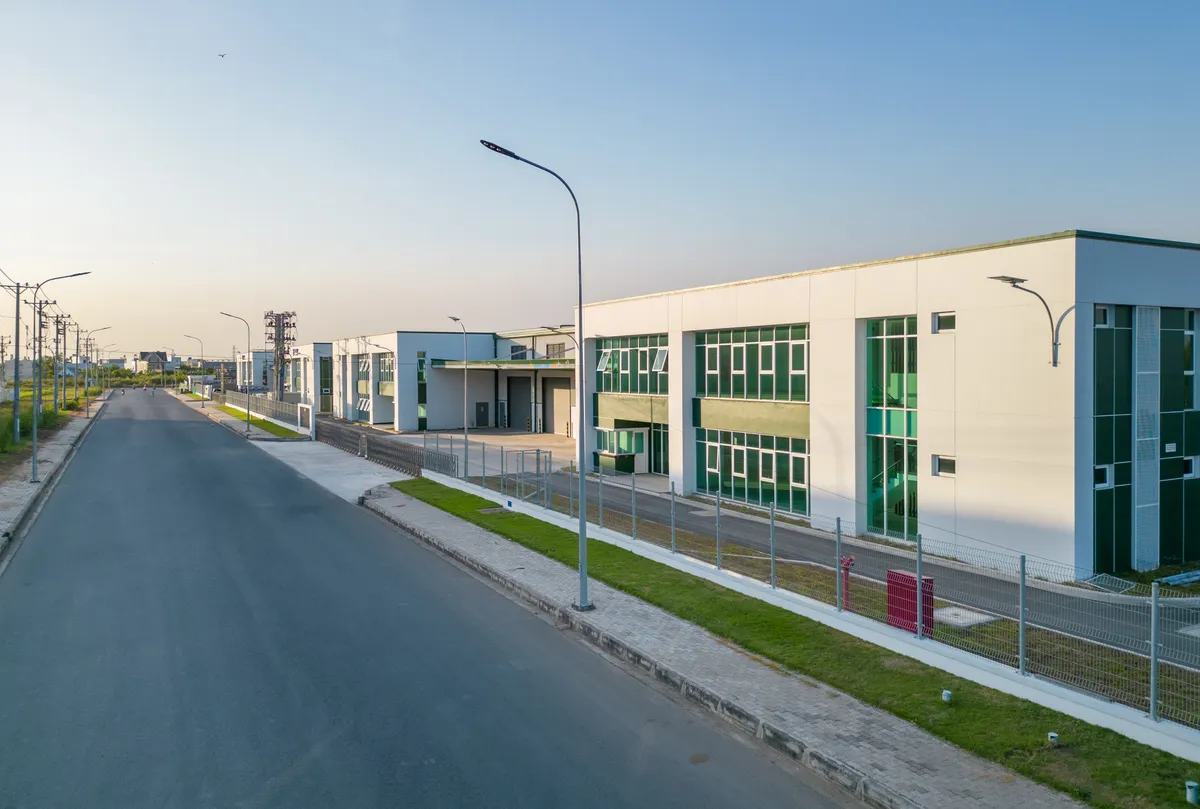
Prefabricated factory buildings in Long Hau Industrial Park, Tay Ninh province.
According to Neil McGregor, General Director of Savills Vietnam, this is a major advantage that will allow the Southeast region to continue leading in attracting investment and be the focal point of industrial real estate development in the 2025-2030 period.
Another noteworthy point is the trend towards developing green industrial parks, LEED-certified factories, and the application of energy management technology. Typical projects recognized by Savills include VSIP III (formerly Binh Duong), Prodezi Eco-IP (formerly Long An), and Deep C (Hai Phong), all aiming for an eco-industrial park model, utilizing solar energy, water recycling, and integrating smart management systems.
According to the report, developers such as BW Industrial, Core5, LOGOS, and KTG are accelerating the development of green factory and warehouse facilities, aiming for LEED Gold and Silver certification, thereby increasing their attractiveness to multinational corporations targeting ESG (Economic, Sustainable, and Sustainable) practices.
Experts predict that industrial real estate will continue to be the most dynamic segment of the market in 2026, especially the factory and warehouse rental segment. The combination of demand from FDI, synchronized infrastructure development, the trend of greening production, and the booming e-commerce is creating a new growth cycle.
"Vietnam is transforming from a production-scale model to a value-scale model, and the industrial real estate leasing segment is a crucial link helping businesses realize this transformation," the report stated.
Source: https://vtv.vn/bat-dong-san-cong-nghiep-cho-thue-dat-muc-cao-nhat-trong-7-nam-100251210215854153.htm






























































Comment (0)