

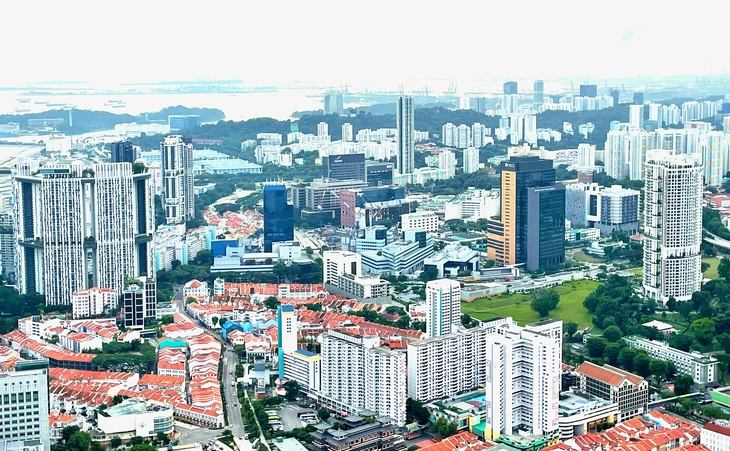
Restricting loans for purchasing a second home or more is a solution to control housing prices recently proposed by the Ministry of Construction - Photo: B. NGOC
Is the loan limit for buying a second home not exceeding 50% of the purchase contract value?
Speaking to Tuoi Tre Online , a leader of the Department of Housing and Real Estate Market Management - Ministry of Construction - said that the ministry is currently seeking feedback from five ministries and agencies on the draft resolution of the Government on the mechanism for controlling and regulating real estate prices.
Accordingly, the Ministry of Construction has proposed three mechanisms to control and curb real estate prices in the coming period.
Regarding lending policies for homebuyers, the Ministry of Construction proposes that the Government require credit institutions operating in Vietnam to apply loan limits for home purchase loans, excluding social housing.
Specifically, for the purchase of a second home, the loan limit is no more than 50% of the home purchase contract value.
For the purchase of a third or subsequent home, the loan limit will not exceed 30% of the home purchase contract value.
Furthermore, to ensure transparency in real estate transactions and curb speculation, the Ministry of Construction proposes that real estate transactions must be conducted through real estate and land use rights transaction centers established and managed by the State.
The Real Estate Transaction Center will serve as a central electronic hub connecting relevant agencies and organizations in conducting real estate transactions. Its functions include organizing, supervising, and verifying real estate transactions, including buying, selling, transferring, and leasing.
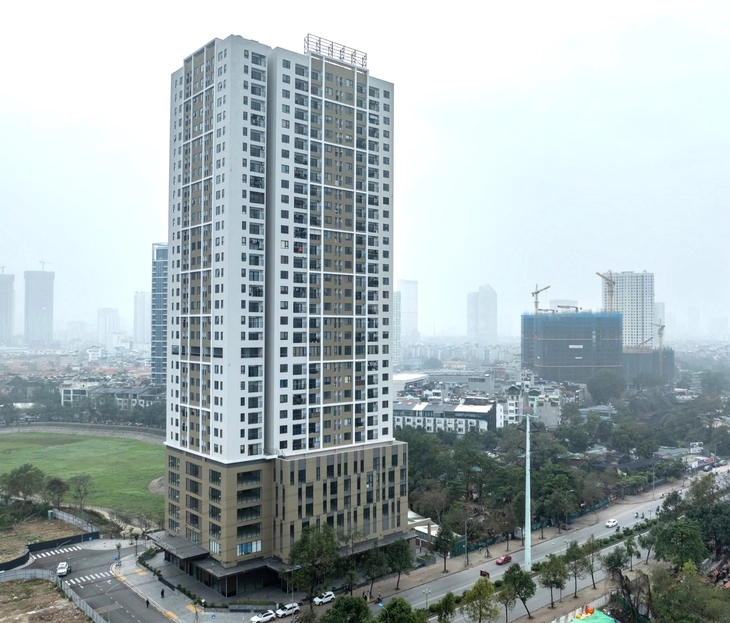
The real estate market is severely lacking in social housing projects and affordable commercial housing (pictured is the NHS Trung Van social housing project, Hanoi ) - Photo: NAM TRAN
Local authorities are requested to build affordable commercial housing.
To control and curb real estate prices in the coming period, the Ministry of Construction proposes that the Government stipulate that the People's Committees of provinces and cities, depending on the actual situation of their localities, allocate at least 20% of the total number of commercial housing projects planned for development in the 2026-2030 period to build affordable commercial housing.
According to the draft resolution of the Government, affordable commercial housing projects will be subject to the following specific policy mechanisms:
The project developer was selected without going through an auction or bidding process.
The procedures for selecting the project investor are similar to those for selecting the investor for social housing projects.
The land use fee and land lease fee for the project are calculated according to the land price table and land price adjustment coefficient as stipulated by land law.
In cases where a land price list has not yet been issued for uniform application, the provincial People's Committee shall decide on the price for calculating land use fees and land lease fees for each specific project.
Affordable commercial housing projects are also entitled to a maximum profit margin of 20% of the total investment capital for the project (including land use fees and land lease fees).
The method for determining the selling price and lease-purchase price of housing is applied similarly to that used for determining the selling price and lease-purchase price of social housing.
Affordable commercial housing projects are not required to allocate land for the construction of social housing within the project area.
Buyers of affordable commercial housing projects are not permitted to transfer their purchase or lease-purchase contracts, as stipulated by real estate business law.
For commercial housing construction projects that have received investment approval or have had their investors selected in accordance with the law, and which wish to adjust their investment objectives to affordable commercial housing projects, the competent state agency or the investor shall adjust the investment policy of the project in accordance with the provisions of investment law.
Source: https://tuoitre.vn/bo-xay-dung-de-xuat-han-che-cho-vay-mua-nha-o-thu-2-tro-len-20251007164019647.htm
![[Photo] Prime Minister Pham Minh Chinh holds a phone call with the CEO of Russia's Rosatom Corporation.](/_next/image?url=https%3A%2F%2Fvphoto.vietnam.vn%2Fthumb%2F1200x675%2Fvietnam%2Fresource%2FIMAGE%2F2025%2F12%2F11%2F1765464552365_dsc-5295-jpg.webp&w=3840&q=75)



![[Photo] Closing Ceremony of the 10th Session of the 15th National Assembly](/_next/image?url=https%3A%2F%2Fvphoto.vietnam.vn%2Fthumb%2F1200x675%2Fvietnam%2Fresource%2FIMAGE%2F2025%2F12%2F11%2F1765448959967_image-1437-jpg.webp&w=3840&q=75)




































![[OFFICIAL] MISA GROUP ANNOUNCES ITS PIONEERING BRAND POSITIONING IN BUILDING AGENTIC AI FOR BUSINESSES, HOUSEHOLDS, AND THE GOVERNMENT](https://vphoto.vietnam.vn/thumb/402x226/vietnam/resource/IMAGE/2025/12/11/1765444754256_agentic-ai_postfb-scaled.png)








































Comment (0)