

Japanese-American businessman Robert Kiyosaki, author of "Rich Dad, Poor Dad," said: "If you can't teach your children about money, someone else will do it for you later, such as creditors, the police, and even scammers. If you let these people educate your children about finance, I fear you and your children will pay a much higher price."
However, many Eastern parents tend to raise their children with the view that young children only need to focus on their studies, and that financial matters are the responsibility of adults. Therefore, they rarely teach their children about earning money, even though money is a crucial means of life. Then, when their children grow up, parents expect and pressure them to become successful, earn a lot of money to support themselves and repay their parents' kindness.
Jewish people have always believed that parents should teach their children how to earn money from a young age.
According to Jewish people, the principle of "you reap what you sow" cultivates survival skills in children, especially financial management skills. They have never considered earning money as a need to wait until a certain age to begin cultivating it. Similar to the concept of "teaching children from a young age," they always believe that "managing finances from childhood" is the best method of education.

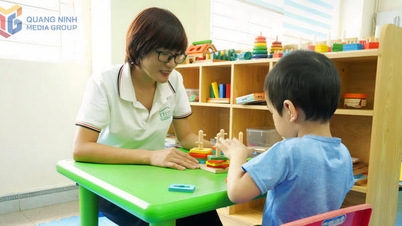
Jewish parents often teach their children financial literacy and how to earn money from a young age. (Illustrative image)
Children are taught about money from the age of 3.
In reality, the Jewish people not only leave behind material wealth, but also pass on the qualities and skills to create wealth to their descendants, things that are even more valuable than money. And that value doesn't come from inheritance but from their educational methods, specifically the asset management skills that the Jewish people grasp and apply from a young age.
Mark is three years old, and both his parents are Jewish. His family currently lives in the United States. One day, while he was playing with a rock, his father, standing nearby, asked, "Mark, isn't that rock interesting?"
"Oh, that's great, Dad," Mark replied.
"Mark, Dad has some coins. I think playing with coins is more fun than playing with those stones. Would you like to try?" Dad smiled at Mark.
"Okay, okay, but is playing with coins really fun, Dad?" Mark asked, looking up.
"Of course, son. Look, this is a one-cent coin, this is a ten-cent coin, this is a fifty-cent coin. You can use them to buy the toys you like. For example, if you like a toy truck, you can buy it with two fifty-cent coins." Dad patiently explained.
"Oh, that sounds nice. But I still can't tell the difference between the larger and smaller denominations, Dad. Could you explain it to me again?" Mark politely asked his father.
"Of course, Mark, look, this is a 1-cent coin, this is a 10-cent coin, and this is a 50-cent coin—the biggest one." Dad replied, handing Mark each coin one by one.
Mark received the coin, examined it carefully for a long time, then happily exclaimed, "Wow, the 50-cent coin is so big! Now I know what it is. But I still can't tell the difference between a 1-cent coin and a 10-cent coin."
Mark patted his head and praised him, "My Mark is so clever! In such a short time, you've already learned to distinguish between a 50-cent coin. I think you'll be able to tell the difference between a 1-cent and a 10-cent coin soon enough."
Besides understanding the value of money, Jewish people also pass that knowledge on to their children, so that future generations understand its value. Today in Israel, financial education for children is a shared responsibility of the family, school, and society. Below are some financial management skills goals that Jewish parents require of their children:
3 years old: Differentiate between banknotes and coins, recognize denominations.
4 years old: Knows that you can't buy everything, so you need to choose.
5 years old: Understand that money is the reward for labor, so it must be spent wisely.
At age 6: They can count large sums of money, begin to learn about saving money, and develop a sense of financial management.
At age 7: Compare your money to the prices of goods and determine if you can afford to buy them.
At age 8: They know how to open a bank deposit account and think of ways to earn pocket money.
At age 9: Students can plan their spending, bargain with shops, and understand buying and selling transactions.
10 years old: Knows how to save money from daily expenses to use for bigger purchases like ice skates or a skateboard.
At age 11: Learn to recognize advertisements and develop an understanding of discounts and special offers.
At 12 years old: They appreciate the value of money, understand that money is not easy to earn, and have a concept of saving.
From age 12 and up: It is perfectly possible to participate in asset management activities alongside adults in society.
Explain to children the value and purpose of money.
When their children enter the final year of primary school, Jewish parents open an independent bank account for them, depositing a sum of money that could be considered equivalent to a month's salary. They are eager to open accounts for their children not so that they can spend money freely, nor to spoil them or avoid giving them money all at once, but with the greater goal of managing their finances.
Whenever children misuse money, parents don't easily forgive them. They explain to the children that if they want something more valuable in the future, they must only buy a few inexpensive items now. Only then can children understand the serious consequences of overspending and learn to take responsibility for their spending.
In Jewish families, most 10-year-old children understand the importance of saving money. Parents also encourage their children to set aside a portion of their income to buy things they like. Once children have saved a certain amount, parents guide them towards investing that money and introduce them to safe investment methods.
Furthermore, when shopping, Jewish parents often encourage their children to compare prices of different products to cultivate their spending skills. In addition, we all know that Jewish people highly value reading; parents not only have their children read mainstream economic books but also buy them many advertising materials, helping them understand the secrets behind advertising and avoid wasteful spending.
5 stages of Jewish parenting in managing finances.
Phase 1: Recognizing Money
While still toddlers learning to speak, Jewish parents teach their children to distinguish between coins and banknotes, to understand that money can buy anything they want, and where money comes from. After this initial concept and interest in money, they delve into managing assets using money to exchange for goods.
Phase 2: Money Management Skills
They set rules for their children's spending, holding them accountable for any unwise spending habits. This helps children learn to manage their finances wisely from a young age, consider future expenses, and plan for the long term.
Phase 3: Money-making skills
Besides emphasizing saving money, Jewish parents also teach their children that increasing income is equally important. They teach their children the rules of making money, capital turnover, and simple principles of reciprocity and reward through practical examples in work.
Phase 4: Asset Management Knowledge
After teaching children how to spend wisely and earn money effectively, parents can introduce them to basic financial management knowledge and guide them in making a few small investments.
Phase 5: Asset Management Philosophy
Jewish parents cultivate financial management skills in their children not with the aim of turning them into money-making machines or hoarders. On the contrary, they view financial education as a form of moral and character education. The purpose is to help children understand the ethics of work, how to invest and manage assets, not simply to impart knowledge or develop survival skills, but more profoundly to equip them with the necessary understanding and correct values of life.
Source: https://giadinh.suckhoedoisong.vn/cach-cha-me-do-thai-day-con-ve-tu-duy-tai-chinh-and-ky-nang-kiem-tien-tu-3-tuoi-172240928205441406.htm














![[Video] Hue and Quang Ninh mark strong tourism growth](https://vphoto.vietnam.vn/thumb/402x226/vietnam/resource/IMAGE/2025/12/12/1765555481742_dung00-22-16-02still007-jpg.webp)































































Comment (0)