

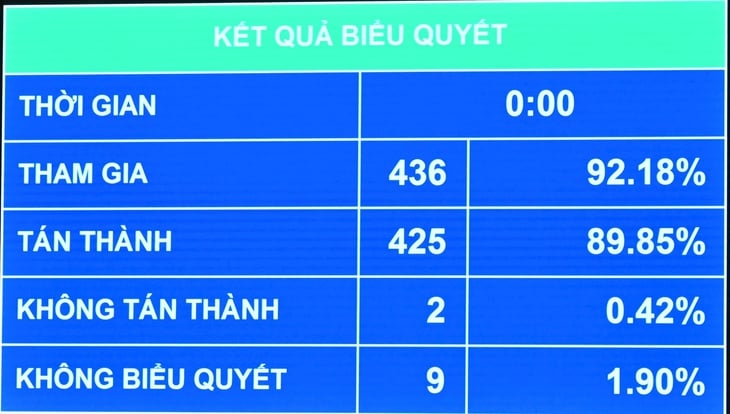
Results of the vote to pass the Investment Law - Photo: P. THANG
Additionally, two delegates voted against the bill and nine delegates abstained from voting.
According to the newly passed law, investors have the right to conduct investment and business activities in sectors and professions that are not prohibited by this law. For sectors and professions subject to conditional investment and business, investors must meet the investment and business conditions as prescribed by law.
Adding more prohibited business sectors and reducing the number of conditional investment and business sectors.
The following business sectors are prohibited from investment and operation: trading in narcotic substances; trading in chemicals and minerals as specifically regulated in the appendix attached to the law; trading in specimens of wild plants and animals of natural origin as regulated in the appendix; and prostitution.
In addition, the following are business activities: buying and selling people, tissues, corpses, human body parts, and human fetuses; business activities related to human cloning; trading in fireworks; debt collection services; trading in national treasures; and exporting relics and antiques.
In particular, the business of selling e-cigarettes and heated tobacco products is a new industry added to the list of prohibited activities.
Based on socio -economic conditions and state management requirements in each period, the Government reviews the sectors and professions prohibited from investment and business activities and submits them to the National Assembly for amendment and supplementation.
In his explanation and response before voting to pass the law, Minister of Finance Nguyen Van Thang said that the Ministry of Finance had coordinated with relevant ministries and agencies to review regulations on conditional investment and business sectors and investment and business conditions.
The goal is to screen and identify the sectors and business activities that truly require "pre-approval".
Simultaneously, industries and professions currently subject to investment and business conditions applicable to output products and services, which can be controlled by technical regulations and standards, should be shifted to a "post-inspection" mechanism, ensuring compliance with the spirit of Resolution No. 68 on the development of the private economy.
Based on that, the bill has reduced, amended, and supplemented the list of conditional business sectors with 38 related fields such as tax procedures, customs procedures, insurance support, commercial inspection; temporary import and re-export of goods subject to excise tax, frozen food, used goods; maritime safety, automobile maintenance, etc.; and reviewed and amended the scope of 20 sectors.
What is the Prime Minister 's authority to approve investment projects?
Regarding the authority to approve investment policies, the National Assembly approves investment policies for investment projects that require the application of special mechanisms and policies.
The Prime Minister approves investment policies for investment projects requiring the conversion of land use from special-use forests, watershed protection forests, and border protection forests of 50 hectares or more; windbreak and sand dune protection forests and wave-breaking and land reclamation protection forests of 500 hectares or more; production forests of 1,000 hectares or more; and projects requiring the conversion of land use from double-cropping rice cultivation land of 500 hectares or more.
Business projects involving betting, casinos (excluding electronic games with prizes for foreigners); nuclear power plants; projects by foreign investors in the fields of telecommunications services with network infrastructure, afforestation, publishing, journalism, etc.
This also includes projects requiring the resettlement of 20,000 or more people in mountainous areas, and 50,000 or more people in other regions; and investment projects related to cultural heritage, in accordance with the law on cultural heritage, regardless of the size of land area or population, within the scope of Zone I of a protected area of a monument recognized by competent authorities as a special national monument on the World Heritage List.
Furthermore, other investment projects not listed in Article 24 fall under the authority of the provincial chairman to approve investment policies. Examples include projects involving land allocation or leasing without auctioning land use rights or bidding for investor selection; projects involving land use conversion; projects allocating sea areas; housing construction projects; seaport and airport projects, etc.
Source: https://tuoitre.vn/cam-kinh-doanh-thuoc-la-dien-tu-thuoc-la-nung-nong-giam-38-nganh-dau-tu-co-dieu-kien-20251211084451555.htm

![[Photo] Prime Minister Pham Minh Chinh holds a phone call with the CEO of Russia's Rosatom Corporation.](/_next/image?url=https%3A%2F%2Fvphoto.vietnam.vn%2Fthumb%2F1200x675%2Fvietnam%2Fresource%2FIMAGE%2F2025%2F12%2F11%2F1765464552365_dsc-5295-jpg.webp&w=3840&q=75)

![[Photo] Closing Ceremony of the 10th Session of the 15th National Assembly](/_next/image?url=https%3A%2F%2Fvphoto.vietnam.vn%2Fthumb%2F1200x675%2Fvietnam%2Fresource%2FIMAGE%2F2025%2F12%2F11%2F1765448959967_image-1437-jpg.webp&w=3840&q=75)

















































![[OFFICIAL] MISA GROUP ANNOUNCES ITS PIONEERING BRAND POSITIONING IN BUILDING AGENTIC AI FOR BUSINESSES, HOUSEHOLDS, AND THE GOVERNMENT](https://vphoto.vietnam.vn/thumb/402x226/vietnam/resource/IMAGE/2025/12/11/1765444754256_agentic-ai_postfb-scaled.png)








































Comment (0)