

On October 16th, at a conference on updating endoscopic treatment for early-stage gastrointestinal cancer and biliary and pancreatic diseases organized by Nguyen Trai Hospital (Ho Chi Minh City), Dr. Nguyen Duc Thong, Head of the Endoscopy Department of the hospital, stated that the number of early-stage stomach cancer cases detected in Vietnam is currently low.
He cited a retrospective report from 2014-2019 showing that out of 1,606 cases of stomach cancer in Ho Chi Minh City, only 4% were detected at an early stage. Another study in Hue from 2013-2018 showed this rate to be 7.6%. Meanwhile, in South Korea, the early detection rate for stomach cancer is over 63%, and in Japan it is over 70%.
"There are many reasons for this problem, and screening programs are a crucial factor, but in Vietnam there is no national-level screening program. Patients are mainly screened opportunistically, that is, when they come for examination due to other illnesses or symptoms," said Dr. Thong.
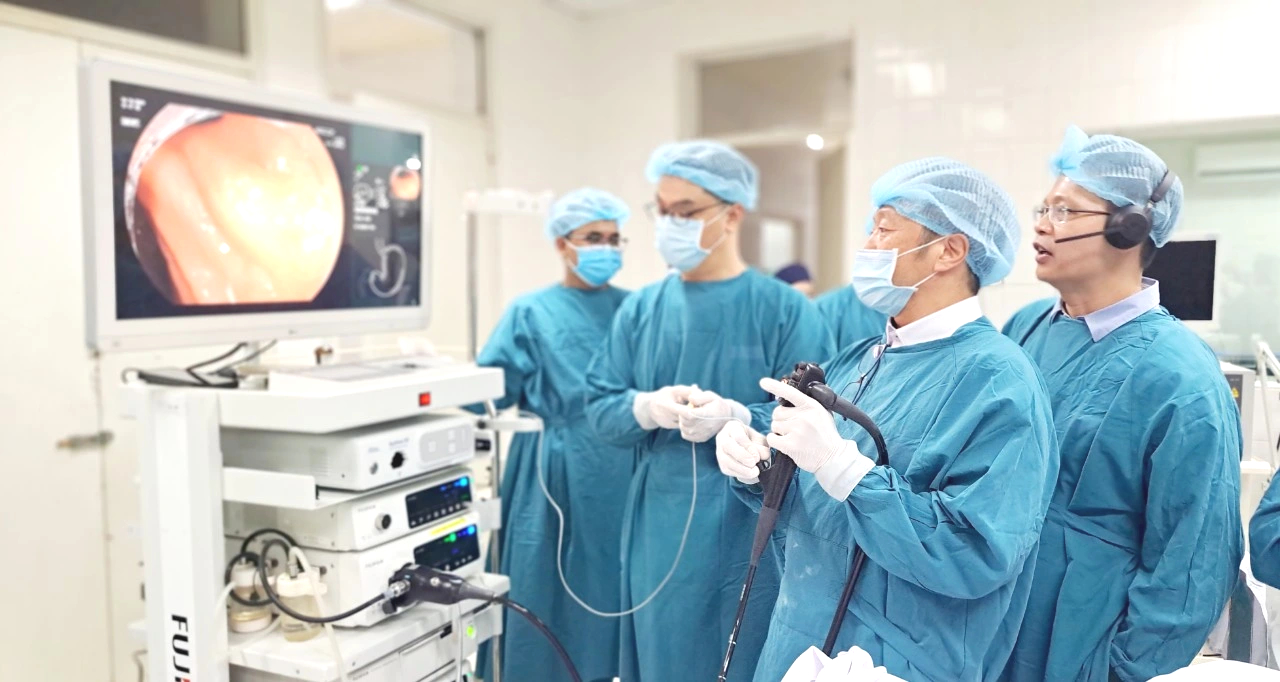
Dr. Kinoshita Koshi, Head of the Department of Gastroenterology and Endoscopy at Kyoto Miniren Central Hospital (Japan), is performing interventional endoscopy at Nguyen Trai Hospital.
Meanwhile, Japan has had a screening program since 1960 (initially using barium swallow X-rays, later gastroscopy) for patients over 40 years old, performed annually. Recently, due to a decrease in the incidence of stomach cancer in Japan, the screening program has been adjusted to include people over 50 years old, and every 2-3 years.
Dr. Kinoshita Koshi, Head of the Department of Gastroenterology and Endoscopy at Kyoto Miniren Central Hospital (Japan), further informed at the conference that gastric cancer is currently decreasing in Japan due to a reduction in the rate of Helicobacter Pylori (HP) infection. In recent years, there have been significant advances in the detection and treatment of this cancer in Japan.
To achieve the same level of success as other countries, Dr. Thong believes that a program for endoscopic screening of gastric cancer is needed for high-risk groups such as patients infected with H. pylori who have been treated but subsequently develop severe atrophic gastritis or severe intestinal metaplasia. This requires collaboration between endoscopists, outpatients, and clinical physicians to closely monitor patients.
For endoscopists, it's important to be aware of responsibilities and duties when handling the endoscope for patients, ensuring that the endoscopy technique avoids missing any lesions and that the endoscopy time is adhered to.
There is a need for manpower and formal training courses in endoscopic techniques (such as ESD) as this is a developing trend, along with investment in modern medical equipment.
The media helps people understand the benefits of early cancer screening and detection.
At the conference, in addition to providing theoretical guidance on endoscopy, diagnosis, and detection of gastrointestinal cancer, Dr. Kinoshita Koshi also performed interventional endoscopy for the diagnosis and treatment of early-stage gastrointestinal cancer at Nguyen Trai Hospital.
From 2010 to the present, the Endoscopy Department of Nguyen Trai Hospital has performed most gastrointestinal endoscopic procedures such as stomach and colon endoscopy, endoscopic polypectomy for hemostasis, gastrostomy, and foreign body removal.
Specifically, diagnostic gastroscopy is performed on 10,000-20,000 cases per year, and colonoscopy on 4,000-4,500 cases per year. Therapeutic endoscopy is performed on approximately 1,200 cases per year. Regarding endoscopic examination for gastrointestinal bleeding, in the last three years, the hospital has performed nearly 560 cases, including those caused by cancer...
In 2023 and 2024, the hospital began implementing ESD techniques.
Source: https://thanhnien.vn/can-lam-gi-de-giam-ty-le-nguoi-mac-ung-thu-da-day-185241016155325822.htm
![[Image] Hanoi Police officially crowned champions of V-League 2025/2026](https://vphoto.vietnam.vn/thumb/1200x675/vietnam/resource/IMAGE/2026/05/31/1780244769054_ndo_br_039d561b692be875b13a-jpg.webp)
![[Photo] The General Secretary, President and his wife begin their state visit to the Philippines.](https://vphoto.vietnam.vn/thumb/1200x675/vietnam/resource/IMAGE/2026/05/31/1780230559452_anh-man-hinh-2026-05-31-luc-19-28-11.png)























![[Video] Sunset at Lap An Lagoon – Where the sun sets over the fishing nets](https://vphoto.vietnam.vn/thumb/340x192/vietnam/resource/IMAGE/2026/05/31/1780192137701_beach-landscape-sea-water-nature-grass-745871-pxhere-com.jpeg)





![[Photo] Admire the coral "masterpiece" amidst the million-year-old heritage of Dak Lak province.](https://vphoto.vietnam.vn/thumb/1200x675/vietnam/resource/IMAGE/2026/05/31/1780221235105_anh-man-hinh-2026-05-31-luc-16-53-27.png)
![[Photo] Solemn bathing ceremony and Buddha procession in Hue](https://vphoto.vietnam.vn/thumb/1200x675/vietnam/resource/IMAGE/2026/05/31/1780228263543_1-jpg.webp)





















































Comment (0)