

Many countries are tightening restrictions on phone use in schools.
Singapore is not the only country tightening restrictions on phone use in schools. According to UNESCO, a survey of 200 education systems globally found that one in four countries had banned smartphones in schools through laws or guidelines.
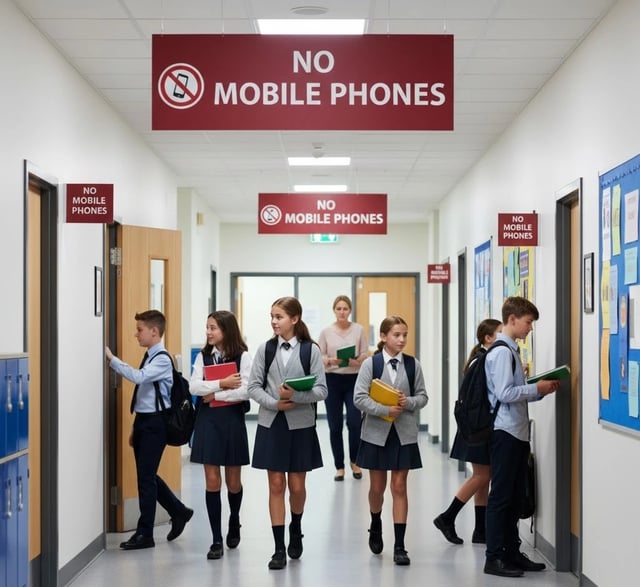
Many countries have banned smartphones in schools through laws or guidelines.
Photo: TN created using AI
France restricts the use of connected devices in primary and secondary schools, with schools potentially enforcing stricter regulations. Sweden announced a ban from autumn 2026 for students aged 7-16. In the Netherlands, following the implementation of national guidelines in January 2024, 75% of secondary schools reported students finding it easier to concentrate, and 28% noted improved academic performance.
In its 2023 Global Education Monitoring Report, UNESCO recommended that countries ban mobile phones in schools. Scientific evidence shows that excessive mobile phone use is linked to decreased academic performance. Prolonged screen time negatively impacts children's emotional stability. A UNESCO study indicated that students may take up to 20 minutes to refocus after being distracted by their phones.
Vietnam has regulations prohibiting students from using mobile phones during class, but...
In Vietnam, the use of mobile phones among students is at an alarming level. According to a 2022 Google survey, Vietnamese children on average own a phone at age 9, four years earlier than the global average of 13. This figure reflects the reality that Vietnamese parents are giving their children access to technology too early, while only 36% of children aged 12-17 receive information on how to stay safe online.
Legally, Circular 32/2020/TT-BGDĐT stipulates that students are not allowed to use mobile phones in class unless it is for educational purposes and with the teacher's permission. The remaining issue is a matter of management at the school and provincial levels, especially during recess. Circular 5512/BGDĐT-GDTrH of 2020 also provides guidance on allowing students to use mobile phones in class to support learning activities, with the decision resting with the teacher directly teaching the subject.
However, this rule only prohibits misuse. Whether it's considered appropriate or not depends on the teacher's assessment. This is a major loophole. In reality, students can secretly use phones in class, and teachers cannot monitor all 40-45 students at the same time.
In Hanoi, the Department of Education and Training has instructed schools to prevent students from using mobile phones in class for non-educational purposes. Ho Chi Minh City has gone even further with a plan to restrict phone use during recess from the 2025-2026 school year, with 16 schools piloting the measure from the first semester and implementing it nationwide from January 2026. However, these are still only local guidelines and lack nationwide uniformity.

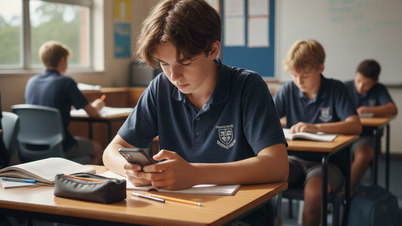
Students can concentrate better and achieve higher academic results when they are not distracted by mobile phones.
Illustration photo: Dao Ngoc Thach
3 perspectives on implementing a ban on students using mobile phones in school.
To better understand the rationale behind this policy, we need to consider it from three perspectives. First, from an educational standpoint. Banning mobile phones helps students focus on learning and direct interaction. The Singapore Ministry of Education explains that the goal is to create a learning environment that prioritizes student learning and enhances interaction, while also fostering healthier screen time habits. This is entirely logical, as scientific research has shown that screen time among students reduces the time spent on important activities such as sleep, physical activity, and social interaction with friends and family.
Secondly, from a psychophysiological development perspective, teenagers are at an age where their personalities are forming and they are easily drawn into the virtual world. Banning phones in school helps reduce screen time during the 6-7 hours of study.
Thirdly, from a cybersecurity perspective, controlling phone usage helps protect students from risks such as cyberbullying, online harassment, and the leakage of personal information. A 2020 survey by the Institute for Sustainable Management and Development Research showed that 40% of children feel unsafe, and over 70% have had undesirable experiences while using the internet.

Many schools create various activities for students during recess when implementing regulations restricting the use of mobile phones on school grounds.
Photo: Dao Ngoc Thach
How should Vietnam implement this effectively?
However, completely banning students from using phones raises several issues that need consideration. Firstly, in the age of Industry 4.0, phones are not only entertainment tools but also learning aids. Many current lectures require students to search for information and use online learning applications. A complete ban would create inconvenience for both teachers and students.
Secondly, there's the issue of emergency communication. Vietnamese parents primarily allow their children to bring phones to school for communication, especially in emergencies such as being late for pickup, schedule changes, or health problems. If the phones are kept all day, how can parents contact their children? Of course, when necessary, parents can contact the homeroom teacher or the school, but this also has many inconveniences.
Third is the issue of enforcement. With over 23 million students nationwide, do schools have the resources to implement the ban? Storing phones, managing lockers, and handling violations requires a robust management system and significant funding.
The Singapore model can be used as a reference, but it needs to be adapted to suit Vietnam's conditions. Singapore is a small country with a world-class education system, abundant resources, and strict discipline. Vietnam, with its vast education system and significant disparities in infrastructure between urban and rural areas, requires a more suitable roadmap.
Instead of an immediate, absolute ban, Vietnam should issue a unified national regulation, rather than allowing local authorities to establish their own fragmented rules. The Ministry of Education and Training needs to revise Circular 32/2020 to provide clearer regulations, such as prohibiting the use of mobile phones during class and recess. It should only be permitted in emergencies or when authorized by the teacher to support specific lesson activities. A pilot program is needed before full implementation. This should begin with junior high schools in major cities with adequate facilities and qualified teachers. Results should be evaluated after one school year before expanding nationwide.
In addition, schools need to provide individual lockers for students or secure phone storage areas. This is a necessary initial cost to implement an effective policy. Digital literacy education must also be strengthened. Instead of simply banning technology, students should be taught how to use it responsibly. Integrating cybersecurity education into technology and computer science subjects, and organizing training sessions for students and parents are also crucial.
Finally, schools need to discuss with parents the benefits of limiting phone use, encouraging them to let their children use older phones with only calling and texting functions instead of smartphones.
Singapore's policy of banning mobile phones, as well as that of other countries, is a positive sign in the global trend of protecting children from the harmful effects of technology. Given the reality of Vietnamese students using mobile phones too much and too early, adopting a similar policy is necessary and urgent.
Vietnam should not simply copy the policy but needs a suitable roadmap. Only then can the policy succeed and truly benefit students. Finally, it is important to remember that the goal is not to ban technology but to help the younger generation learn to use technology correctly and at the right time.
Opinion poll
Should Vietnam ban children under 16 from using social media and mobile phones in schools?
You can choose one option. Your vote will be made public.
Source: https://thanhnien.vn/singapore-cam-hoc-sinh-dung-dien-thoai-tu-dau-nam-2026-viet-nam-co-nen-ap-dung-185251212100748067.htm
![[Photo] Prime Minister Pham Minh Chinh holds a phone call with the CEO of Russia's Rosatom Corporation.](/_next/image?url=https%3A%2F%2Fvphoto.vietnam.vn%2Fthumb%2F1200x675%2Fvietnam%2Fresource%2FIMAGE%2F2025%2F12%2F11%2F1765464552365_dsc-5295-jpg.webp&w=3840&q=75)








































































Comment (0)