

The symbol of Warsaw, the capital of Poland, is not only its architecture, museums, and culture, but also... a palm tree.
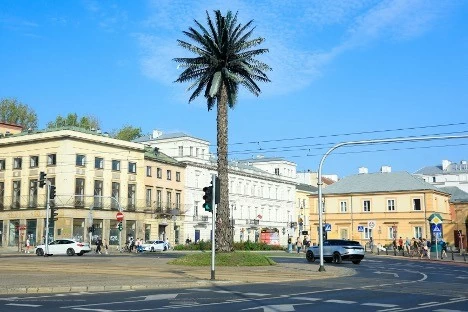 |
| An artificial palm tree in the center of Warsaw, Poland. (Source: City of Warsaw) |
The "Lonely Palm Tree," both strange and familiar, invites visitors to stop and take pictures. This artificial tree, a 15-meter-tall art installation by visual artist Joanna Rajkowska, was unveiled on December 12, 2002, to decorate the center of Warsaw. With a steel trunk covered in natural bark, leaves made of polyethylene composite, its upright form and palm fronds swaying in the wind make it look just like a real tree.
The idea of installing a palm tree in Warsaw originated after Joanna Rajkows visited Israel, in remembrance of the Jewish community that lived there before the Holocaust. Their presence is also commemorated by the name of the street where the palm tree is located, Aleje Jerozolimskie (Jerusalem Avenue).
First-time visitors to the Polish capital, taking the tram up and down at Warsaw Central Station, may be surprised to see a lone palm tree at the busy De Gaulle roundabout in the center, at the intersection of Nowy Świat (New World ) Street and Jerusalem Avenue.
Initially, the "lonely palm tree" sparked curiosity but wasn't met with much enthusiasm. However, over the past two decades, it has grown in the hearts and minds of Warsaw residents, becoming a symbol of the capital and a unique tourist attraction.
The tree is a source of delight and admiration for most visitors who come to admire it. Today, it is a well-known gathering place for political and social activists, including women, nurses, the LGBTQ+ community, environmental activists, and other groups.
The artwork carries two main messages: firstly, it encourages people to reflect on global warming and the accompanying cultural changes; secondly, it provides a social experience to find out whether the people of Warsaw are willing to accept such an unusual structure in the city. In a recent survey, 75% of respondents expressed their liking and support for the presence of the palm tree in the heart of the Polish capital.
Accordingly, the artificial palm tree in the heart of the capital demonstrates an unexpected breakthrough in imagination and community solidarity. The appearance of this tree, characteristic of warm, tropical climates, in the cold city of Warsaw shows that local people accept the right of differing viewpoints to exist, especially when it comes to public spaces.
Many first-time visitors to Warsaw are surprised to see a palm tree in a place without a tropical, humid climate. Yet, the "lonely palm tree" stands tall and solitary in the heart of the city. Furthermore, it is placed at the central roundabout, prominently as a work of art and a symbol of cultural exchange.
To this day, the palm tree is a popular spot for both locals and tourists , even becoming a recognizable symbol of Warsaw. Anyone visiting the Polish capital wants to take beautiful photos with the "lonely palm tree" in the heart of the beautiful city of Warsaw.
Reportedly, the Warsaw Museum of Modern Art is about to undertake a major maintenance and renovation of this artificial tree.
Source: https://baoquocte.vn/chiem-nguong-ve-dep-cua-su-co-don-giua-long-thu-do-warsaw-ba-lan-286078.html


![[Image] Close-up of the newly discovered "sacred road" at My Son Sanctuary](/_next/image?url=https%3A%2F%2Fvphoto.vietnam.vn%2Fthumb%2F1200x675%2Fvietnam%2Fresource%2FIMAGE%2F2025%2F12%2F13%2F1765587881240_ndo_br_ms5-jpg.webp&w=3840&q=75)



















































Comment (0)