

Minister of Home Affairs Pham Thi Thanh Tra, on behalf of the Government, signed a report to the National Assembly and its members regarding the handling of issues arising from the reorganization of the state apparatus.
Regarding institutional development, the Government stated that from June 1st to August 31st, particularly during the 9th session of the 15th National Assembly , the Government submitted 34 laws and 34 resolutions to the 15th National Assembly for approval; and submitted 120 decrees and normative legal resolutions to the Government for promulgation, containing provisions on decentralization and delegation of power, creating a complete and synchronized legal framework for localities to implement.
Request that ministries, departments, and localities report on their current staffing levels.
Regarding the restructuring and streamlining of the organizational apparatus, according to the report, when implementing the two-tiered local government model from July 1st to September 1st, localities reduced 366 specialized agencies under the provincial People's Committees (a 44% reduction compared to before the merger).
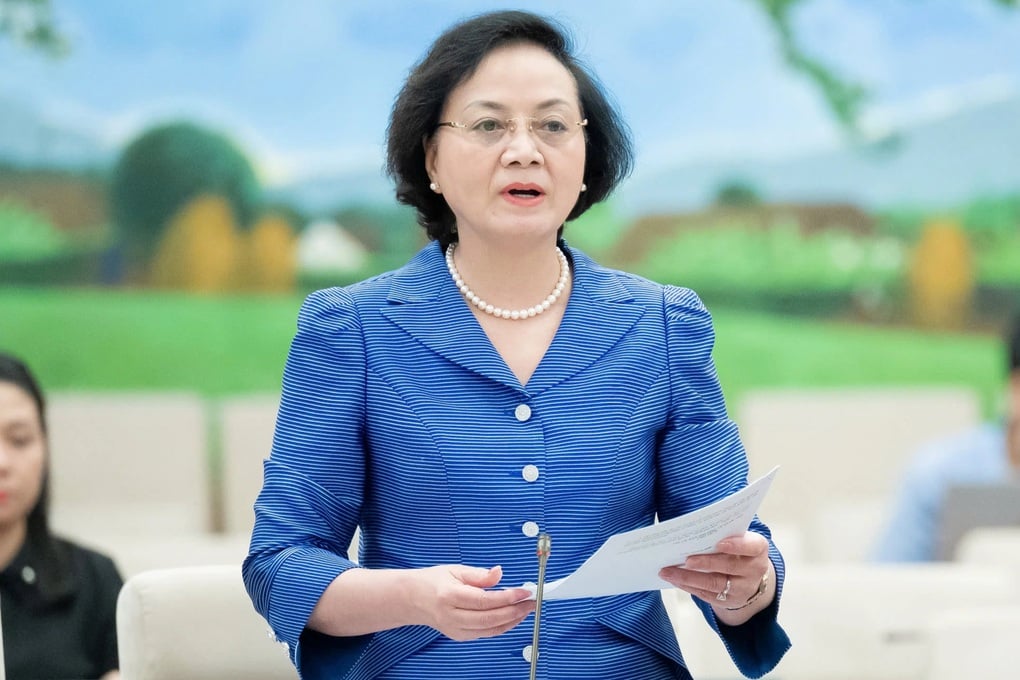
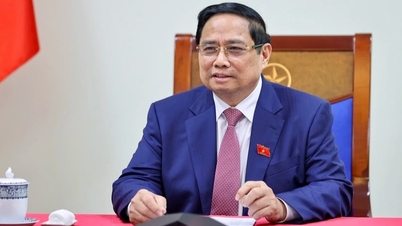
Minister of Home Affairs Pham Thi Thanh Tra (Photo: Hong Phong).
Nationwide, 465 specialized agencies under the provincial People's Committees have been established (including 12 specialized agencies organized uniformly in 34 provinces and cities and 56 specialized agencies in some localities); 9,916 specialized departments at the commune level have been established in communes, wards, and special zones.
Regarding staffing levels in localities, Minister Pham Thi Thanh Tra stated that during the period of reorganizing and merging administrative units at all levels and implementing the two-tiered local government model, the number of existing officials, civil servants, public employees, and contract workers at agencies and units will basically remain unchanged for the time being, to be assigned to work in corresponding agencies and units or to work at the commune level.
Subsequently, downsizing the workforce, coupled with restructuring and improving the quality of the workforce, will be implemented according to a roadmap, ensuring that within 5 years, the number of personnel meets the regulations.
According to the Minister of Home Affairs, the Government is directing ministries, departments, and localities (People's Committees and People's Councils at the provincial and commune levels) to report on the current staffing levels (as of July 31st), and then propose staffing levels for the 2026-2031 period for the Politburo to consider and decide.
Regarding the number of deputy positions, the government stated that after restructuring, the number may exceed the maximum allowed by regulations, but after 5 years, the number of deputy positions must be brought back to the prescribed limit.
The government is also directing research and advisory agencies to establish regulations on the number of deputy heads of agencies and organizations to be implemented during the 2030-2035 period.
The system operates smoothly and without interruption.
According to the government's assessment, the reorganized specialized agencies of the People's Committees at the provincial and commune levels immediately commenced operations, ensuring smooth, continuous, and consistent functioning, without omitting any functions or tasks, and without interruption or legal gaps.
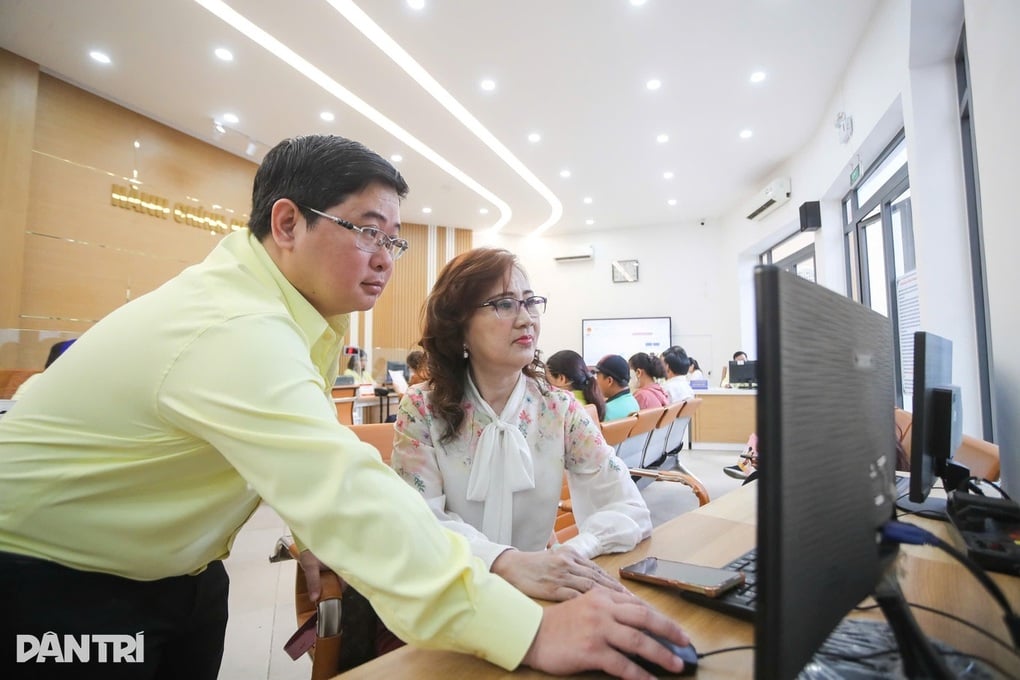
According to the government's assessment, the organizational structure of specialized agencies of the People's Committees at the provincial and commune levels has been operating smoothly after the restructuring (Photo: Trinh Nguyen).
Local authorities have also demonstrated a spirit of determination, effectively implementing decentralization, delegation of power, and delineation of authority in conjunction with the operation of a two-tiered local government organizational model based on the motto: "local authorities decide, local authorities act, local authorities are responsible," meeting the requirements of reforming legislative thinking, reforming national governance, and fostering development.
The government also acknowledges the timely resolution of entitlements and policies for officials, civil servants, employees, and other individuals during the organizational restructuring process, ensuring the effective performance of assigned tasks and preventing work interruptions.
However, the Government also frankly pointed out shortcomings such as the fact that the rate of decentralization and delegation of authority associated with administrative procedures to localities is still not high (only reaching about 56% of the requirement).
Furthermore, the quality of the workforce, including leaders and managers in some sectors, fields, and localities, remains limited and inadequate. Personnel are unevenly distributed, with many places having an excess of civil servants but a shortage of qualified professionals in fields such as science, technology, land administration, finance, healthcare, construction, and transportation.
Meanwhile, the infrastructure of the Public Administrative Service Centers, from central ministries and agencies down to the provincial and commune levels, is still not synchronized; the financial and budgetary mechanisms have not kept pace with the new model, while the administrative area is wider…
In the coming period, as the State apparatus continues to be reorganized, the Government will promptly report to the Standing Committee of the National Assembly and the National Assembly for consideration and decision in cases where issues arise that fall under the National Assembly's decision-making authority.
Source: https://dantri.com.vn/thoi-su/chinh-phu-de-xuat-bien-che-giai-doan-moi-de-trinh-bo-chinh-tri-quyet-dinh-20251018222147324.htm
![[Photo] Prime Minister Pham Minh Chinh holds a phone call with the CEO of Russia's Rosatom Corporation.](/_next/image?url=https%3A%2F%2Fvphoto.vietnam.vn%2Fthumb%2F1200x675%2Fvietnam%2Fresource%2FIMAGE%2F2025%2F12%2F11%2F1765464552365_dsc-5295-jpg.webp&w=3840&q=75)

![[Photo] Closing Ceremony of the 10th Session of the 15th National Assembly](/_next/image?url=https%3A%2F%2Fvphoto.vietnam.vn%2Fthumb%2F1200x675%2Fvietnam%2Fresource%2FIMAGE%2F2025%2F12%2F11%2F1765448959967_image-1437-jpg.webp&w=3840&q=75)






































![[OFFICIAL] MISA GROUP ANNOUNCES ITS PIONEERING BRAND POSITIONING IN BUILDING AGENTIC AI FOR BUSINESSES, HOUSEHOLDS, AND THE GOVERNMENT](https://vphoto.vietnam.vn/thumb/402x226/vietnam/resource/IMAGE/2025/12/11/1765444754256_agentic-ai_postfb-scaled.png)

















































Comment (0)