

Teacher Nguyen Xuan Khang believes that education needs clarity, transparency, and stability over many years. Therefore, the third exam subject should be fixed, ideally a foreign language.
Recently, in the draft regulations for secondary and high school entrance exams, the Ministry of Education and Training withdrew the proposal to randomly select the third subject for the 10th grade entrance exam. The third subject will not be fixed but will change annually, announced before March 31st, in order to achieve the goal of comprehensive education and avoid rote learning or unbalanced learning.
According to Mr. Nguyen Xuan Khang, Chairman of the Board of Directors of Marie Curie School, even though the phrase "drawing lots for the third subject" is no longer used, this move will still put the Departments of Education and Training in a position where "there is no other way than to draw lots to choose the third exam subject."
The reason is that making the selection based on the subjective opinions of the Department's leadership would create many problems, such as concerns about parental and student opposition, or students being able to guess the exam subjects through elimination... Therefore, this unit still has to find a way to avoid public scrutiny by using a lottery system.
“In education, things like lotteries are strictly forbidden because it’s a matter of ‘luck or misfortune.’ We cannot, because of our ‘inability’ to manage teaching and learning at the secondary school level, fearing that students will stop studying if there are no exams, put teachers, students, and parents in a situation of chance, causing tens of thousands of people to live in a state of insecurity. Education needs to be clear, transparent, and stable for many years,” Mr. Khang said.

According to Mr. Khang, all students who have been recognized as having graduated from junior high school have already met the requirements in terms of character and competence. Therefore, there is no need for this exam to "comprehensively assess their abilities during the basic education stage" anymore.
"This exam must be forward-looking, meaning it should be geared towards the high school level. Therefore, specialized schools will recruit according to their own system, while regular schools will decide on the recruitment method based on the pressure from the number of applicants," Mr. Khang said.
For example, schools with enrollment quotas equal to or less than the number of applicants can simply use selection based on academic records, eliminating the need for entrance exams to save time and money. Schools with an excess of applicants may organize entrance exams or combine both, and selection based on academic records.
In the case of organizing an entrance exam, the third subject should be standardized nationwide and remain stable in the long term. According to Mr. Khang, the best option is to organize an exam with three fixed subjects: Mathematics, Literature, and a Foreign Language (primarily English).
The reason is that at the high school level, English is one of the eight compulsory subjects for all students. Furthermore, Political Bureau Resolution No. 91 requires gradually making English the second language in schools. "Therefore, choosing a third subject as a foreign language is necessary," Mr. Khang said.
There are also some opinions that fixing the third exam subject will not promote educational activities, especially comprehensive education, and may easily lead to rote learning and unbalanced learning. Instead of drawing lots or choosing a fixed subject, students should be allowed to choose their third exam subject based on their strengths to create a foundation of specific competencies that will facilitate their studies at the high school level. Through this, students will have career orientation and streaming earlier instead of focusing only on it during the three years of high school.
However, according to Mr. Khang, this option is not feasible and could even cause problems for the localities organizing the exams because the Department of Education and Training would have to design many more exam questions in the subjects that candidates register to take.
"On the other hand, the 10th grade entrance exam is conducted from top to bottom to determine the cutoff score, making it difficult to assess and lacking fairness if candidates choose to take exams in many different subjects," Mr. Khang said.
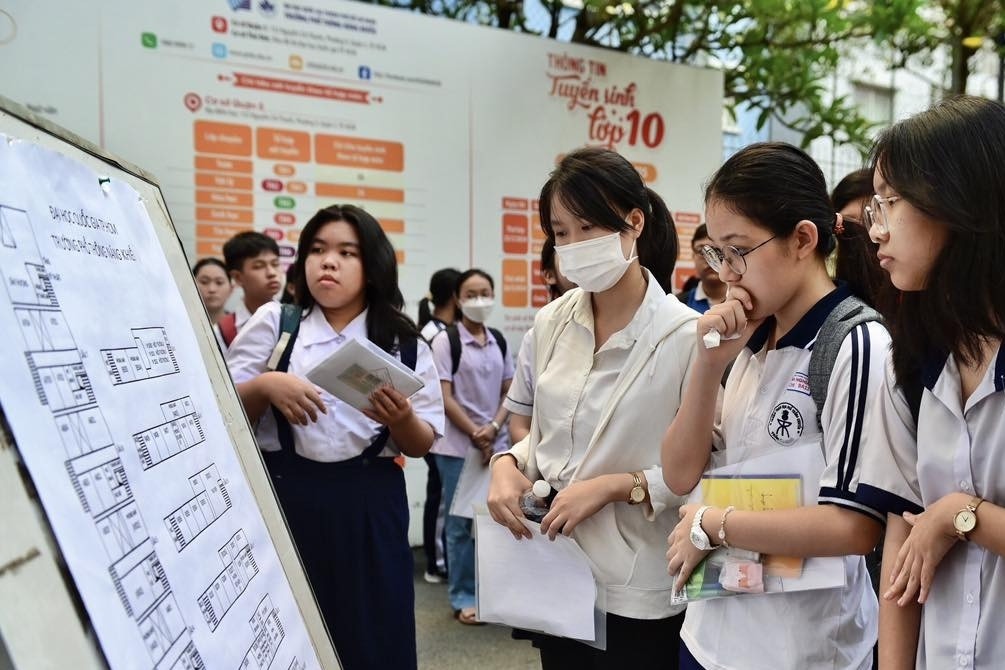
Source: https://vietnamnet.vn/chon-mon-thi-thu-3-thi-vao-lop-10-nen-co-dinh-la-ngoai-ngu-2335643.html


![[Photo] Prime Minister Pham Minh Chinh holds a phone call with the CEO of Russia's Rosatom Corporation.](/_next/image?url=https%3A%2F%2Fvphoto.vietnam.vn%2Fthumb%2F1200x675%2Fvietnam%2Fresource%2FIMAGE%2F2025%2F12%2F11%2F1765464552365_dsc-5295-jpg.webp&w=3840&q=75)











































































Comment (0)