

On December 7th, the Ho Chi Minh City Food Safety Management Board concluded its inspection of compliance with food safety laws regarding school lunch programs at collective kitchens, canteens, and food service establishments in over 2,000 schools.
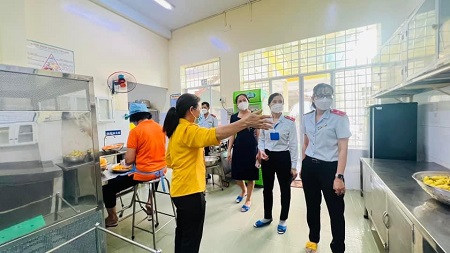
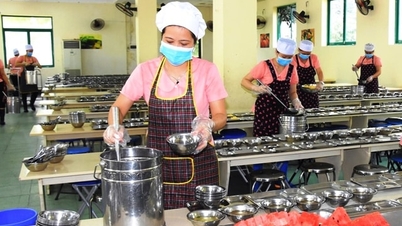
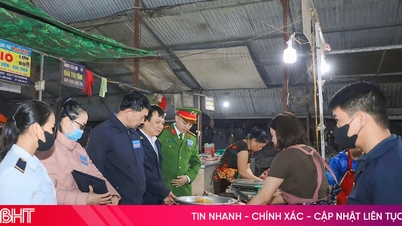
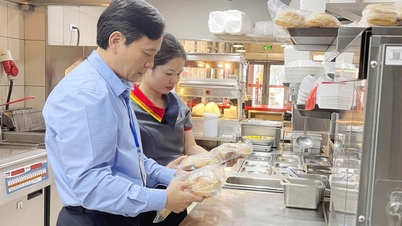
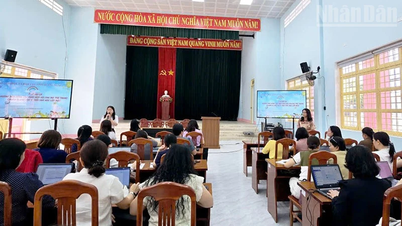
Food safety inspection team examines school lunch programs.
Accordingly, the Ho Chi Minh City Food Safety Management Board conducted food safety inspections of school lunch programs at 2,316 collective kitchens, canteens, food service establishments, and food businesses in 2,016 educational institutions (1,374 self-organized collective kitchens, 140 contracted collective kitchens, 9 self-organized canteens, 466 contracted canteens, and 325 schools receiving pre-prepared meals...). The results showed that, regarding legal documentation, the food safety inspection team noted that the schools maintained fairly complete and well-organized records that were easy to retrieve. Most schools balanced their budgets and used fresh ingredients and food daily. The origin and source of raw materials and food inputs are verifiable through contracts, invoices, and supplier capabilities (1,220 establishments have achieved "Safe Food Chain" certification, and 1,411 establishments have achieved ISO22000, HACCP, VietGap, and GlobalGap certifications). Regarding the human resources responsible for ensuring food safety in school lunch programs, the inspection team assessed that managers and those directly involved in food preparation have a good understanding of food safety principles in the use, processing, and storage of food. The schools' arrangement of health officials to regularly inspect the kitchens has also contributed to ensuring food safety in school cafeterias.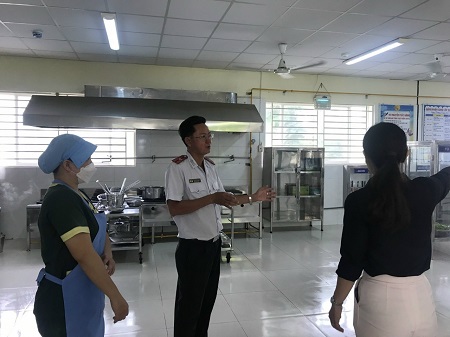
The Ho Chi Minh City Food Safety Management Board organized an inspection team to visit more than 2,000 educational institutions.
According to representatives of the Food Safety Management Board's inspection team, the inspection revealed several existing difficulties and limitations, such as: Some units providing meals to schools have processing facilities located in neighboring provinces, outside the city's jurisdiction, making inspection and supervision difficult. Some schools have not yet established canteens, so students still consume food from street vendors outside the school gates, making food safety control difficult; controlling the quality of raw materials for schools is challenging due to sourcing from multiple suppliers... At the end of the inspection, the Ho Chi Minh City Food Safety Management Board's inspection team proposed and recommended that schools strengthen their review, inspection, and supervision of food ingredient suppliers and meal providers. Encourage school kitchens, canteens, and food services to use ingredients and food from suppliers certified to participate in the "Safe Food Chain," ISO22000, HACCP, VietGAP, or equivalent standards…in order to ensure that school meals are nutritious, high-quality, and safe.Thanhnien.vn
Source link



![[Photo] General Secretary and President To Lam meets with National Assembly delegates from ethnic minorities.](https://vphoto.vietnam.vn/thumb/1200x675/vietnam/resource/IMAGE/2026/04/20/1776696701056_a1-bnd-8331-3342-jpg.webp)
![[Image] National Assembly discusses the implementation of the socio-economic development plan.](https://vphoto.vietnam.vn/thumb/1200x675/vietnam/resource/IMAGE/2026/04/20/1776696707422_ndo_br_img-20260420-185419-jpg.webp)


































































Comment (0)