

(NB&CL) “We delved deep into the story of the teacher training ordering mechanism between teacher training colleges and localities. Why are teacher training colleges willing to meet the ‘supply,’ but localities are not enthusiastic about placing orders?... Faced with the obstacles and shortcomings in practical implementation, amending, supplementing, and adjusting Decree 116 is an extremely urgent requirement,” - journalist Le Thu, representing the group of authors who just won the special prize at the National Journalism Award for the Cause of Vietnamese Education with the work “Decree 116 on ordering teacher training: ‘Supply’ is enthusiastic - ‘Demand’ is indifferent” (by the group of authors Le Thi Thu, Le Thi Hang, Tran Huu Hung, Nguyen Van Cuong), shared this in a conversation with the Journalists & Public Opinion Newspaper about the series of articles.
Overcoming challenges in teacher training to support educational reform.
+ Madam, we understand that the authors' idea originated in late 2023, when they were working on a research project about the impact of Decree 116 on teacher training orders and attracting talented students to the education sector. So, what obstacles in the implementation of the Decree are the main reasons for the authors' team to undertake this series of articles?
- Yes, that's right. The idea for this series started in late 2023, when we did a talk about the story of thousands of teacher training students being owed financial aid. Government Decree 116/2020, when first issued, was seen as a groundbreaking solution to address the nationwide teacher shortage and attract talented students to the teaching profession. The practical implementation of Decree 116 has yielded some positive results. The number of candidates interested in teacher training majors has increased year by year. The percentage of applicants, the cutoff scores, and the enrollment rates have all increased significantly. This provides training institutions with more options in the admissions process, while also setting higher standards for the quality of education.
However, nearly four years after its implementation, this humane policy has revealed many obstacles and limitations, showing a "gap" between policy and practice. The biggest obstacle is the delay in disbursing living allowances to students. Notably, as of early 2023, only 12 out of 58 schools under local authority had been assigned the task of implementing and paying tuition and living expenses for students. Many colleges and universities training teachers under local authority have not yet received the living allowance. Statistics from the Ministry of Education and Training also show that some schools commissioned by local or neighboring localities have either not received or have only received a very small portion of the funding… This reality prompted us to seek answers to the question: why is such a humane policy, aimed at attracting talented students to study education through a commissioned training mechanism, stalled in its implementation?

Journalist Le Thu received the special award.
+ In order to persuade the public on this issue, how did the authors structure the series of articles and gather information effectively, from the process of framing the problem and selecting interviews to proposing solutions, journalist?
- We developed a series of articles titled: “Decree 116 on Teacher Training Orders: Enthusiastic Supply - Indifferent Demand,” following a three-part structure: Part 1: A humane policy, why is it “stuck”? Part 2: Severe teacher shortage, yet localities remain indifferent. Part 3: Unblocking “supply” and “demand,” creating appeal from the policy. In Part 1, we explored the reasons why thousands of teacher training students are owed tuition and living expenses, and why the legitimate rights of many teacher training students are being “neglected.” In Part 2, we delved into the correlation between the teacher training order mechanism and the teacher shortage problem in localities. And we explained why many localities lack teachers but are not enthusiastic about ordering training from teacher training schools. The main difficulties observed stem from the fact that localities are not placing orders for training under Decree 116, there are still obstacles in handling training funds, and many fields are struggling to recruit. There is a desire to provide training, but there are no orders from localities; in other words, there is "supply" but a lack of "demand"...
Furthermore, after the training program is implemented, if students fail to fulfill their commitments, there are no sanctions in place. Another drawback is that students trained under this program still have to pass a civil servant recruitment exam after graduation if they want to work in the education sector. This is one of the concerns that makes both students and localities hesitant to participate in the teacher training program.
Differences in defining criteria, as well as numerous obstacles in the process of ordering teacher training, have prevented a humane government policy from being effectively implemented in practice. This reality necessitates the urgent need for solutions to "unblock" Decree 116 regarding the task of ordering teacher training. However, simply amending the Decree without additional solutions will make it very difficult to thoroughly address the difficulties in teacher training to serve the educational reform in our country in the coming years. We will focus on this issue in Part 3, the final part of this series.
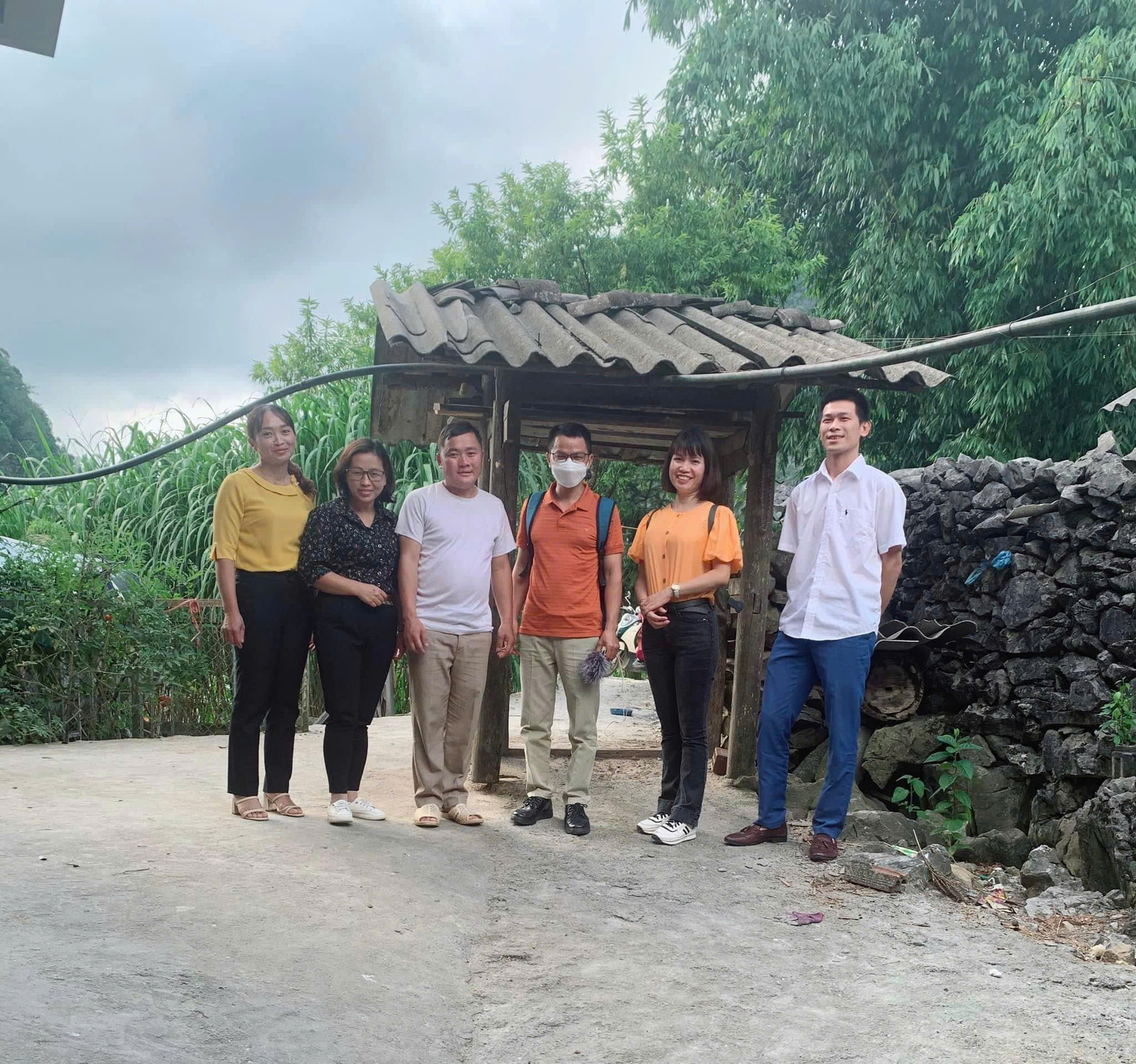
Journalists Le Thu and Huu Hung pose for a photo with the teachers while covering the series of articles.
It's not easy for those involved to speak out…
+ When undertaking a macro-level project, tackling a difficult problem, and even when it's "not easy for those involved to speak up," what were the biggest challenges for the authors when creating this work, Ms.?
- "It's not easy to get insiders to speak up," as you said, that's also a challenge for the team of authors. With radio and television, getting the subjects to speak up is even more challenging. They might be comfortable sharing during normal conversations, but when we want to record them for our interviews, they become more hesitant. For example, when we interviewed the principal of a Teacher Training University, they were very comfortable discussing the difficulties and shortcomings of local authorities not being enthusiastic about ordering training programs, but refused to specify which province. This is because they are still in the position of "offering their services" by sending invitation letters to local authorities… Therefore, the biggest challenge remains persuading the subjects we want to interview to provide the necessary information for the series, as well as specific figures.
Another challenge was writing the headline. Print and online newspapers are probably already very familiar and "masters" at creating catchy headlines to attract readers. But with radio, it's a real challenge: how to make the title encompass the topic being written about, while also having an impactful sound and wording. Ms. Le Hang, our leader and director for this series, suggested that we should convey the idea that: while teacher training colleges are very eager to train students and readily supply teachers to localities, the localities, on the other hand, are indifferent and uninterested in commissioning them. It's like two opposing sides: hot at the top – cold at the bottom… From there, the headline for the series was born from discussions and suggestions among the team members.
+ With this comprehensive series of articles, what changes do the authors hope to see in the journey of educational reform, especially regarding human resource training in the coming time?
- Faced with difficulties encountered over nearly four years of implementation, the Government has assigned the Ministry of Education and Training to lead the review, amendment, and supplementation of Decree 116. Accordingly, the draft of the new Decree will no longer include a bidding mechanism but will only assign the task of ordering training from institutions, although not making it mandatory. Regarding training costs, instead of the provincial level paying, the Ministry of Education and Training proposes that the central budget cover all costs, with localities being responsible for paying the training costs for teacher training schools under their management. Currently, the draft amendment to Decree 116 is being submitted by the Ministry of Education and Training to the Government for consideration and feedback. According to the draft amendment to Decree 116, the task of "determining training needs" is the responsibility of the localities (63 provinces/cities). However, the draft does not clarify the terms "teacher training needs" (usually calculated by the Ministry of Education) and "teacher recruitment needs" (calculated by the Ministry of Interior).
Through this series of articles, we hope to contribute our voice, along with other media outlets, to ensure that humane policies truly come to life and are more effective in practice. In this spirit, teacher training institutions should proactively work with local authorities and propose to management agencies the assignment of training tasks and the registration of truly effective enrollment quotas. This is an important prerequisite for further improving the quality of human resource training in the pedagogical sector, helping a segment of students from disadvantaged backgrounds access the State's humane policies, especially in the context of the country's "Era of Advancement," in which training high-quality human resources is one of the key tasks.
Thank you very much, journalist!
Ha Van (Editor)
Source: https://www.congluan.vn/chung-toi-mong-muan-gop-phan-dua-chinh-sach-nhan-van-thuc-su-di-vao-cuoc-song-post322170.html


![[Photo] Closing Ceremony of the 10th Session of the 15th National Assembly](/_next/image?url=https%3A%2F%2Fvphoto.vietnam.vn%2Fthumb%2F1200x675%2Fvietnam%2Fresource%2FIMAGE%2F2025%2F12%2F11%2F1765448959967_image-1437-jpg.webp&w=3840&q=75)


![[Photo] Prime Minister Pham Minh Chinh holds a phone call with the CEO of Russia's Rosatom Corporation.](/_next/image?url=https%3A%2F%2Fvphoto.vietnam.vn%2Fthumb%2F1200x675%2Fvietnam%2Fresource%2FIMAGE%2F2025%2F12%2F11%2F1765464552365_dsc-5295-jpg.webp&w=3840&q=75)









































![[OFFICIAL] MISA GROUP ANNOUNCES ITS PIONEERING BRAND POSITIONING IN BUILDING AGENTIC AI FOR BUSINESSES, HOUSEHOLDS, AND THE GOVERNMENT](https://vphoto.vietnam.vn/thumb/402x226/vietnam/resource/IMAGE/2025/12/11/1765444754256_agentic-ai_postfb-scaled.png)













































Comment (0)