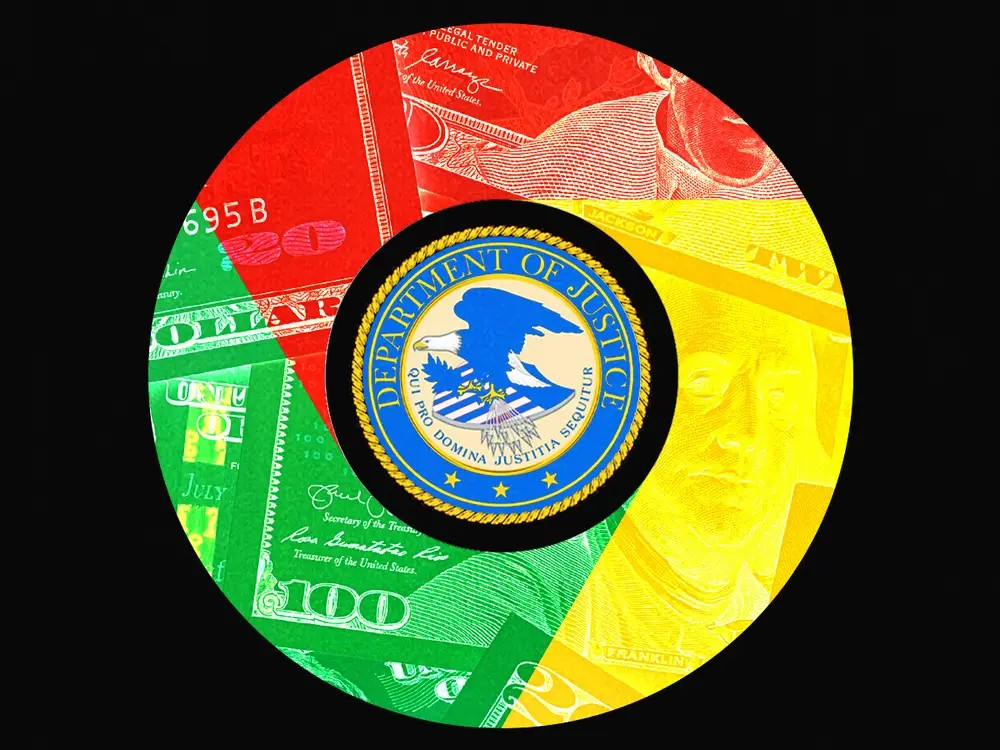
The US Department of Justice wants to force Google to sell its Chrome browser. If this happens, advertisers and internet search services would benefit the most.
In August, Judge Amit Mehta concluded that Google maintained an illegal monopoly in the search and advertising markets.
On November 21, the US Department of Justice sent a document requesting that a judge compel Google to sell its Chrome web browser.
If this happens, Google will be significantly impacted, while other internet advertisers and search engines will benefit.
According to Professor John Kwoka from Northeastern University, by separating Chrome from Google and preventing search agreements, advertisers would no longer need to pay for a dominant tool to reach potential customers.
Google relies on Chrome to develop and maintain its search advertising empire. Chrome holds 61% of the US browser market share, according to analytics firm StatCounter.
It became a value delivery tool for Google Search and a gateway to the search habits of billions of users. When you open Chrome and enter a query in the search bar, it automatically redirects to Google Search.
This doesn't happen on other browsers and non-Google devices. For example, on Windows computers, the default browser and search engine are Edge and Bing.
To become the default choice, Google has to pay billions of dollars to its partners.
Chrome helps Google avoid all this cost and complexity because it allows free control and setting of the default search engine.



With readily available distribution tools, Google collects mountains of user data from browsers and in-browser searches. This information helps make targeted advertising more valuable.
In addition, when users use Chrome to search the web, Google tracks the results they click on. It feeds this feedback back into the search engine to improve the product.
For example, if most people click on the third result, Google's tool might adjust and rank that result higher.
It's very difficult to compete with this self-reinforcing system. One way to compete is to distribute more than Google. If Chrome were a standalone product, rival search engines could get a piece of the distribution "magic."
Google also views Chrome as a way to introduce users to new AI products, including Lens, while competing with rivals like OpenAI.
Many have tried to compete with Google in the browser market but have failed. One example is Neeva, a privacy-focused search engine developed by former Google advertising executive Sridhar Ramaswamy.
Neeva only lasted four years before having to close down. He acknowledged that Google's success was not only due to a better product but also to the incredible number of distribution decisions.
Teiffyon Parry, chief strategy officer at advertising technology firm Equativ, commented that losing 3 billion monthly Chrome users would be a "significant blow" to Google.
However, the company has other ways to reach users and collect data, including Gmail, YouTube, hardware, and the Play Store. They also have a dedicated app that functions as a web browser and has the potential to effectively replace Chrome.
Parry calls this a "manageable inconvenience".
Meanwhile, independent cybersecurity expert Lukasz Olejnik expressed concern about the web market in general if Chrome were sold. He argued that Chrome is rapidly adopting advancements thanks to Google's financial support.



Browsers may struggle if they stand alone, potentially weakening the entire web ecosystem.
"The worst-case scenario is a decline in the privacy and security of billions of users, as well as an unimaginable increase in cybercrime," he warned.
One of the biggest unanswered questions is who can afford to buy Chrome. Bloomberg estimates the browser's value at least $15-$20 billion. Antitrust officials could prevent a major company from acquiring Chrome.
Google intends to appeal any ruling, potentially delaying enforcement for several more years. Lee-Anne Mulholland, Google's vice president of legal affairs, argues that the Justice Department's action would harm users, developers, and America's technological leadership at a critical time.
(According to Insider, Bloomberg)
Source: https://vietnamnet.vn/chuyen-gi-xay-ra-neu-google-phai-ban-chrome-2344542.html