

This information was presented at the workshop on assessing the current situation and development orientation of H'Mong cattle breeding and genetic resource management, organized by the Department of Animal Husbandry and Veterinary Medicine ( Ministry of Agriculture and Environment ) in collaboration with the Korea International Cooperation Agency (KOICA) on the afternoon of December 12th. At the event, domestic and international experts acknowledged this as a "rare opportunity" to unlock the potential of one of Vietnam's most valuable indigenous cattle breeds and enhance its competitiveness in the international market.
"Hanwoo's dream" for Vietnamese cattle.
Mr. Kim Soo Ki, the project leader from South Korea, shared that it took South Korea about 50 years to successfully build the Hanwoo beef brand, transforming it from a small-scale, indigenous breed into a high-value meat product. According to him, with its current technological foundation and accumulated experience, Vietnam doesn't necessarily need to follow such a long process.

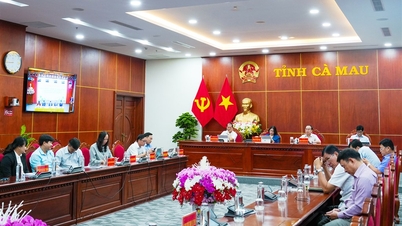
A workshop to assess the current situation and development orientation of H'Mông cattle breeding and genetic resource management was held on the afternoon of December 12th. Photo: Linh Linh.
Mr. Kim Soo Ki stated that KOICA agencies, along with a team of Korean experts, are working closely with Vietnam to provide technical support, guidance on production organization methods, and access to aid for the H'Mong cattle development project. The focus of this support is on sharing breeding experience, selecting breeds, and improving the quality of Hanwoo beef.
According to Mr. Kim Soo Ki, if appropriate technical solutions are implemented synchronously, Vietnam can create significant improvements in the quality of H'Mong cattle within about 5 years. He emphasized that this is a fundamental step in the process of building a brand for this indigenous breed, provided that all relevant parties cooperate and implement the project consistently.

Mr. Kim Soo Ki, Project Manager from the Korean side. Photo: Linh Linh.
From a state management perspective, Mr. Phan Kim Dang, Deputy Director of the Department of Animal Husbandry and Veterinary Medicine (Ministry of Agriculture and Environment), believes that Vietnam's livestock industry is facing the need to change its development mindset. In the context of modernization, increasing the number of livestock is no longer the sole objective; instead, the focus must be on improving the quality and added value of products.
According to Mr. Dang, this direction has been clearly defined in the Livestock Development Strategy for the period 2021-2030, with a vision to 2045, as well as the Project for the Development of the Livestock Breeding Industry until 2030. These documents not only focus on industrialization and modernization to meet production demands, but also particularly emphasize the development of high-quality and high-value livestock breeds.

Mr. Phan Kim Dang, Deputy Director of the Department of Animal Husbandry and Veterinary Medicine (Ministry of Agriculture and Environment). Photo: Linh Linh.
Since 2021, the livestock industry has conducted surveys, assessments, and orientations to identify potential indigenous breeds for development in this direction. Recently, with the support of KOICA experts and domestic experts, the H'Mong cattle has been identified as one of the breeds with potential for development towards improving quality and value. The assessment has considered the origin, genetic characteristics, and value of this breed.
However, Mr. Phan Kim Dang also frankly acknowledged that Vietnam's previous efforts have mainly focused on preserving genetic resources, while the true economic value of the H'Mong cattle breed has not been adequately exploited. Therefore, referencing South Korea's experience in developing the Hanwoo cattle breed is considered an important basis for guiding the next phase.
Data and organizational gaps are similar.
From a technical perspective, Dr. Hongrip Min, Head of the Genetic Improvement Center at the NACF Livestock Research Institute (South Korea), believes that the current situation of H'Mong cattle in Vietnam shares many similarities with Hanwoo cattle in their early stages of development. These include small population sizes, unique genetic values, but a lack of a systematic breed management system.
According to Dr. Hongrip Min, in localities like Tuyen Quang and throughout Vietnam, there is currently no long-term structured breeding plan for H'Mong cattle. Coordination among relevant organizations is limited, leading to significant disparities in productivity among individuals. One of the major weaknesses is the lack of a system for collecting data and evaluating genetics, while the criteria for selecting breeding bulls and cows have not been standardized. The limited application of artificial insemination also affects the ability to uniformly improve the quality of the cattle herd.
Drawing on South Korea's experience, this expert proposed a three-stage roadmap for improving H'Mong cattle. The first stage (1-2 years) focuses on breed identification and registration, establishing a data collection system, and piloting productivity testing. The next stage (3-5 years) involves forming a core herd, developing artificial insemination centers, producing semen, and gradually applying modern genetic tools. The long-term stage (over 5 years) aims to build a brand for H'Mong beef, establish a quality classification system, and integrate it with the local economy and tourism.
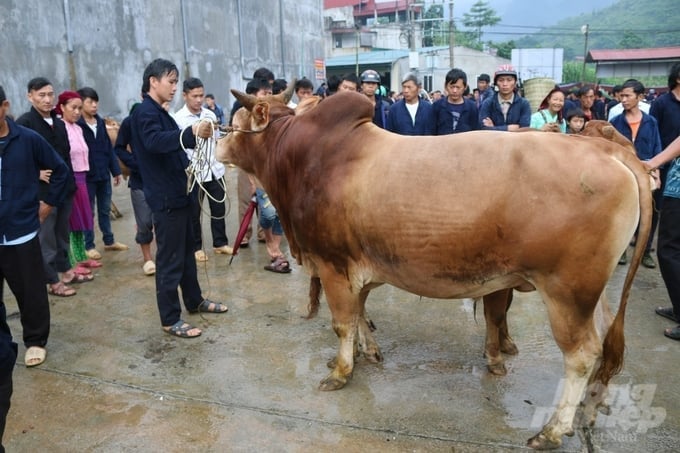
The Mong cattle breed was introduced to Vietnam by the Mong ethnic group over 300 years ago during their migration. Photo: DT.
According to Dr. Hongrip Min, the key lesson from South Korea is the need for long-term support policies, using data as the foundation for genetic progress, building a system of bull testing in parallel with cow selection, and organizing a coordinated national system.
Reporting at the workshop, Mr. Nguyen Van Xuc, representative of the Department of Agriculture and Environment of Tuyen Quang province, stated that the presentation focused on the situation of H'Mong cattle farming (also known as H'Mong yellow cattle) in Tuyen Quang province during the 2023-2025 period and the development plan for the future.
Despite its potential, the locality also pointed out major limitations such as small-scale and nature-dependent livestock farming, inconsistent breed management, limited deep processing, and an unstable consumer market.
Besides technical proposals, Vietnamese experts also recommended a more comprehensive support mechanism in terms of policy and market to ensure the H'Mong cattle development project achieves tangible results. Establishing quality standards and a pricing mechanism linked to meat quality and breed origin is considered a key factor in motivating people to shift from small-scale farming to commercial production, while ensuring a harmonious balance of interests between farmers, businesses, and all project participants.
Source: https://nongnghiepmoitruong.vn/co-hoi-hiem-co-de-xay-dung-thuong-hieu-bo-hmong-tu-kinh-nghiem-han-quoc-d789051.html



































































Comment (0)