

Sitting at a table by the window, bathed in autumn sunlight, waiting for me was a small, agile man with sharp eyes. He was Associate Professor, Doctor of Science, paleontologist, and musician Nguyen Lan Cuong.
“I don't want to write a motivational song.”
Answering the question “How did the musician come up with the idea to write the song Lagerstroemia in the Storm ?”, he immediately said: “On the night of September 7th and early morning of September 8th, my neighborhood (Nguyen Huy Tuong Street, Hanoi - PV) witnessed a terrible scene: trees fell down, pressing down on the power lines, causing the entire neighborhood to lose power.
Witnessing the devastation of Typhoon Yagi , I was determined to write a song about the strongest typhoon in the past 30 years that swept through Hanoi. I lit a candle, sat quietly at the piano, and my emotions were overflowing. I did not intend to write a song to encourage and call for help, but I wanted to compose a song that touched the hearts of listeners. That was not easy.”
In the song, the image of the Lagerstroemia tree appears throughout as a symbol of beauty, faith and hope. This is also a familiar tree to the people of Hanoi, the purple color evokes romance in love: “First love under the shade of the Lagerstroemia tree…”. He revised the song over and over again to make it perfect with the idea that although the musician could not go directly to the “front”, he could use music to encourage everyone.
Musician Lan Cuong expressed: “After sending the song to dozens of musicians and friends, I received many positive responses. Professor, Doctor, Hero of Labor Nguyen Anh Tri commented: 'The song talks about storms and floods but is not sad but enough to awaken and move compassion for the loss caused by natural disasters and especially strengthens the belief that everything will pass, to live optimistically with life. The lyrical music is reasonable, not too dramatic but still awakens human emotions'".

Speaking to VietNamNet, musician Lan Cuong said he had great trust in his close friend, People's Artist Pham Ngoc Khoi, and therefore invited him to play the piano accompaniment for "The Crape Myrtle Tree in the Storm ." People's Artist Pham Ngoc Khoi was the first person to hear the song and contributed many valuable suggestions to the author.
Singer Le Anh Dung was also a name the songwriter had in mind from the beginning because he has a soulful voice, not flashy with technique but easily able to resonate with listeners. The recording process took only two days because both of them quickly absorbed the song.
Loves music, good at acting, good at drawing but spends his whole life with skeletons
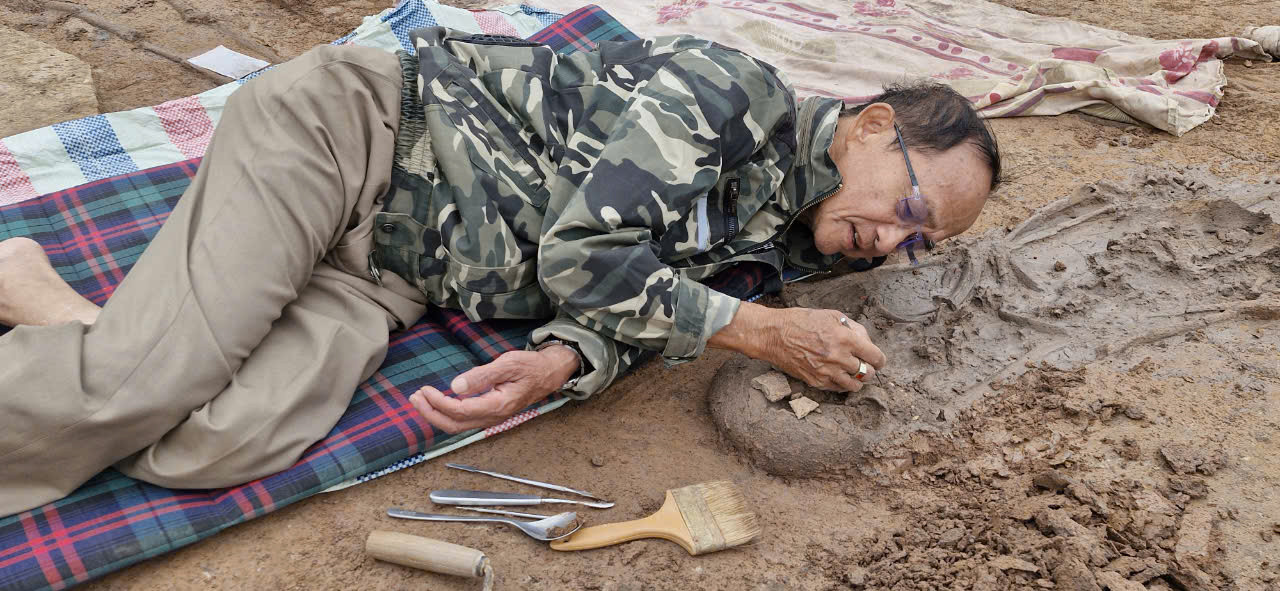
When the reporter asked, "Is there a contradiction between the work of a researcher or archaeologist, which requires precision and detail, and the free-spirited soul of an artist?", Associate Professor Dr. Nguyen Lan Cuong smiled brightly and recounted how he came to art.
“At the age of 10, I went to China to study music, learning from Mr. Pham Tuyen and Mr. Nguyen Huu Hieu - the first person to conduct a choir in Vietnam and Mr. Tuc (Chinese). When I returned to Vietnam, I was in charge of a 100-person choir and a 20-person orchestra at Ly Thuong Kiet School (now Viet Duc School) in Hanoi. My friend Phu Quang played the horn in the band and later became a famous musician. In 1960, when I was 19, I composed my first song , Muong singing , and then the choir, Singing on wooden rafts , both of which won prizes in competitions for students in Hanoi.
Because my family did not encourage me to pursue art, I chose to study Biology at the University. However, at the beginning of 1961, I secretly took the exam and was accepted into a drama team of 15 people (including my friend Trong Khoi, who later became the People's Artist and Director of the Vietnam Drama Theater) selected from several hundred candidates, belonging to the Art Troupe of the Ministry of Culture sent to the Soviet Union to study for 5 years. However, because of the international situation at that time, the drama team had to stay, so I was content to continue studying.
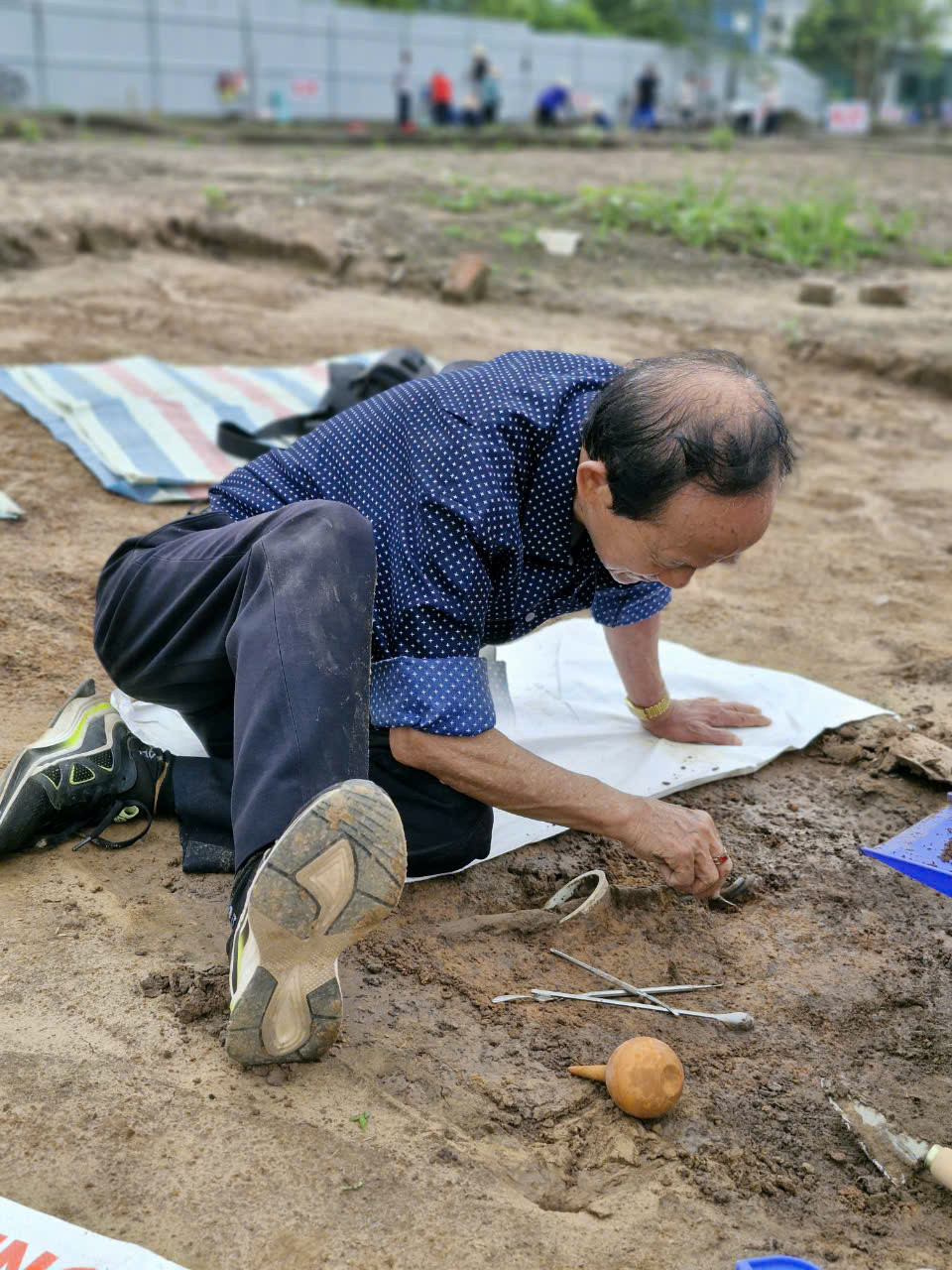 |  |
Later, when working in science, Associate Professor Dr. Nguyen Lan Cuong was still passionate about composing. Therefore, over the past 60 years, along with important research projects on paleoanthropology, he also has about 80 musical works. Many of his compositions originated from hot diary entries about current events such as the victory of the Vietnam Football Team, the fight against Covid..., creating closeness with listeners as well as strong influence. The Geological Song, consisting of 3 chapters and winning an award from the Vietnam Musicians Association, was inspired by Associate Professor Dr. Nguyen Lan Cuong's arduous archaeological work trips.
Besides the touching works such as: The general of the people's hearts, Come back, My dear, Maybe it's like that, Song about the island soldiers, After the oath, Feelings of the Imperial City... musician Nguyen Lan Cuong also has many children's songs such as: My doll, Stop at red lights, only go at green lights, What job do you like?, We celebrate Dien Bien's 60th flower season...
“Once while riding a motorbike, I saw a father and son. The father sped off when the light had not turned green yet, and the child grumbled: 'In class, my teacher taught me that when the light is red, stop, when the light is yellow, prepare, and when the light is green, go.' The idea came to me. I parked my motorbike right next to the sidewalk and wrote the song right on the food ticket, the only piece of paper I had with me at that time. Later, the song won the highest prize in a traffic safety contest with a prize of 25 million VND. I used that money to buy a piano, which made composing easier than the old organ,” the musician recalled.
Musician Lan Cuong tells an interesting story about writing music for children:
He added: “Writing children's music is both difficult and inexpensive, but I still like it because I love children, love their honesty and innocence. The difficulty is that the musician cannot use the thoughts and perspectives of adults to write for children. The pitch must also be moderate, not too high or too low, or the children will have difficulty singing. Children are very innocent, so they will be the most impartial judges. If they don't love it, they won't sing it.”
In particular, the book "Diary on the G Clef" by musician Nguyen Lan Cuong contains works, memories, and feelings of friends about the multi-talented scientist.
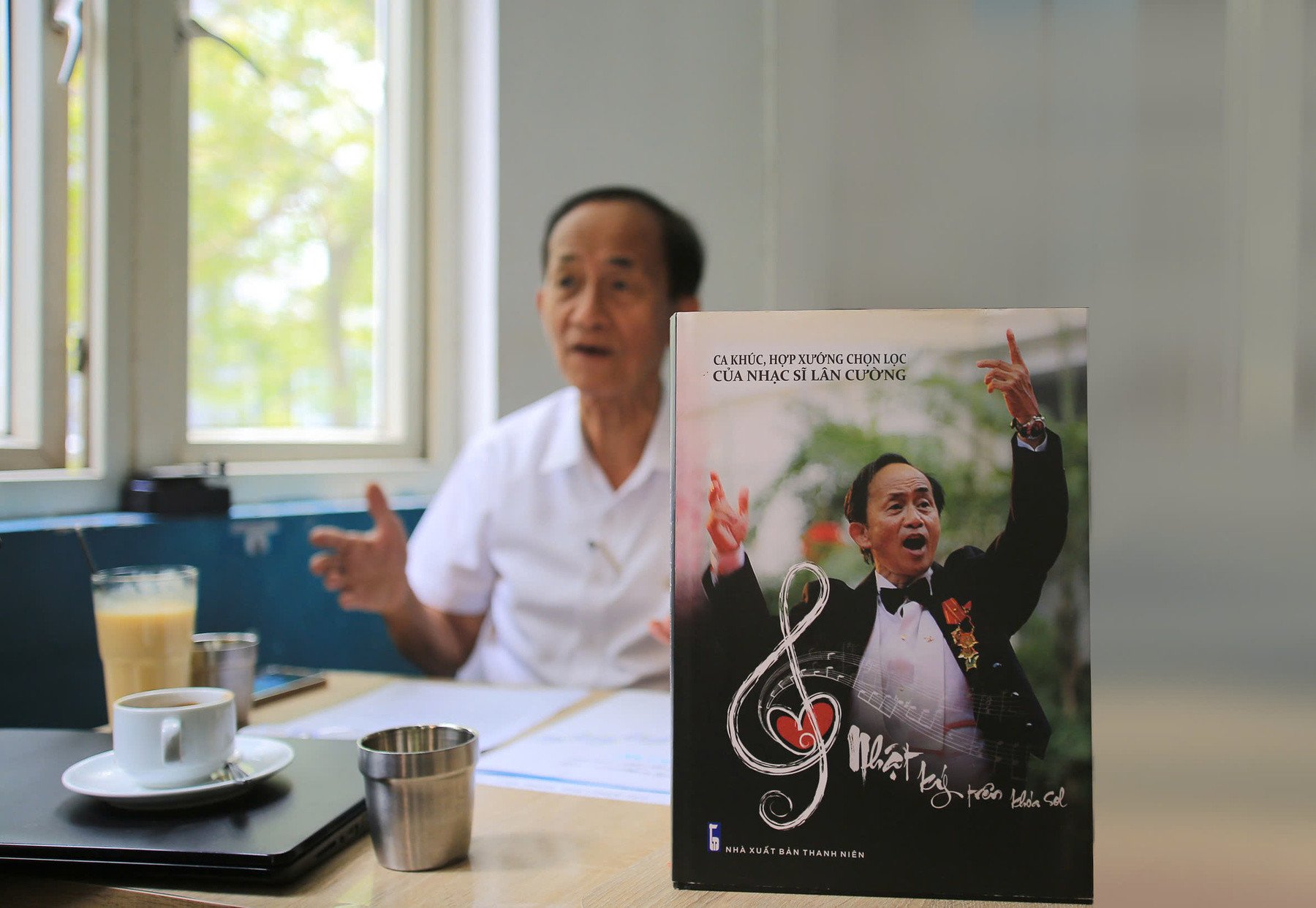
In addition to archaeological research and music composition, Associate Professor Dr. Nguyen Lan Cuong is also talented in painting. He has been painting oil paintings since 1962. One of his proudest works is the book What the Skeleton Tells You , which includes 320 illustrations of human skeletons drawn by the Associate Professor himself. “There are drawings that take about 4 hours to complete, I draw each detail very meticulously. Unlike drawing internal organs, drawing bones or teeth does not require color to distinguish, so I only use tiny black dots, which makes the work much more interesting,” said the Associate Professor.
"My wife always supports me wholeheartedly"
Associate Professor Dr. Nguyen Lan Cuong married and had children relatively late in life. He didn't get married until he was 41 years old. His wife is his strong support system, single-handedly managing the household and raising the children while he is constantly away on archaeological expeditions.
The first daughter was born on September 2, 1982, and was given a unique name by the couple, Hoa Cuong. She is living with her parents. The son, Nguyen Lan Chuong, majored in English, then continued his studies at RMIT, majoring in finance and banking, and studied abroad in Japan. Currently, he teaches and works as a programmer at a Japanese language center in Hanoi.

"Interestingly, in the Nguyen Lan extended family, all the sons, grandsons, great-grandsons... if they are male, have the word 'Lan' after their surname. When we all gather, my extended family has about 80 people, forming a very special community," he said.
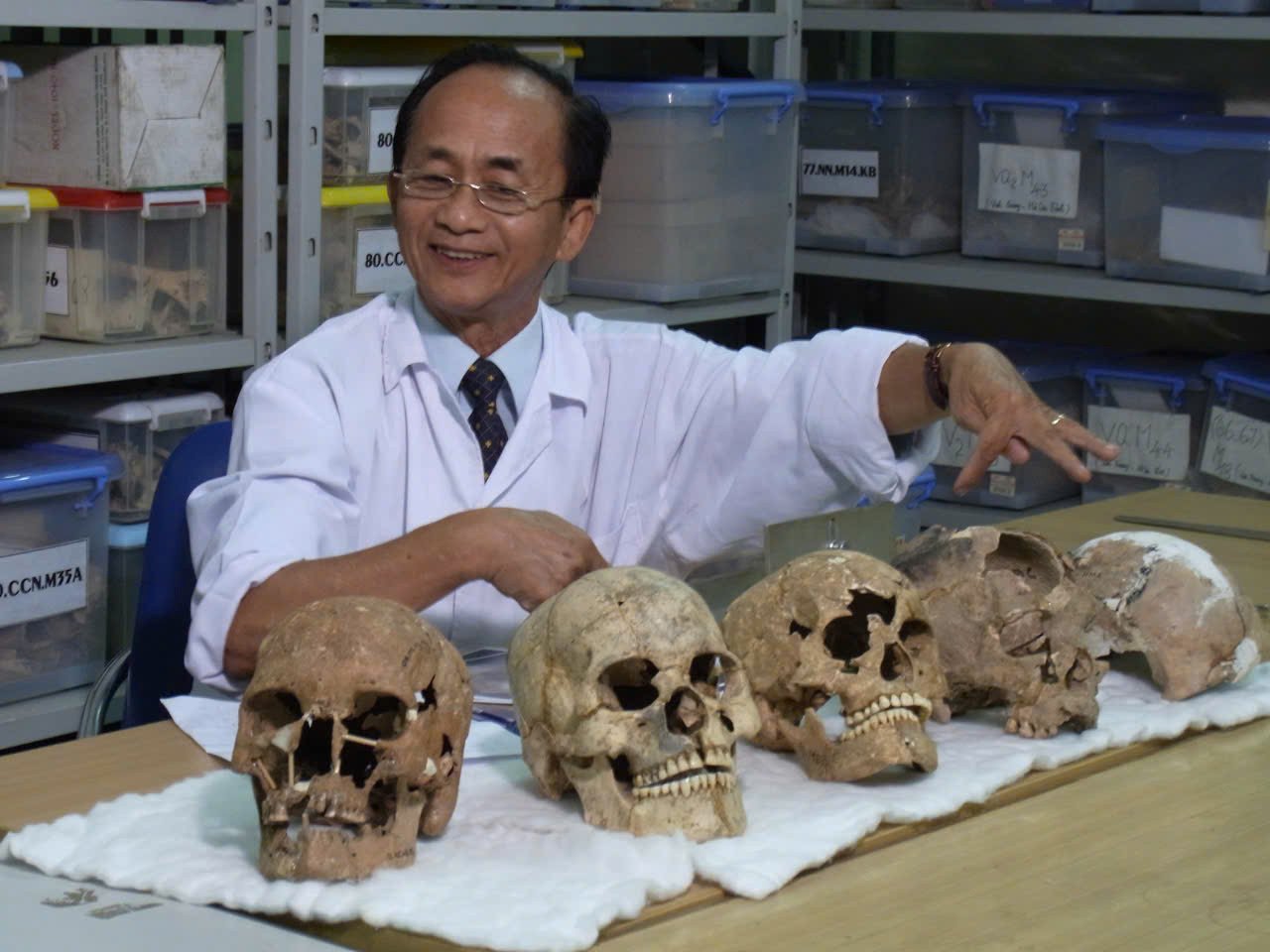
At the age of 83, the leading paleoanthropologist, awarded the title "The person who has researched the most ancient Vietnamese human remains in Vietnam: 1,093 individuals" by the Vietnam Record Organization, still rides his motorbike at speeds of 50-55 km/h to archaeological excavation sites around Hanoi.
"I ride my motorbike regularly, and to ride fast, you need to train your eyesight and, especially, the steadiness and agility of your hands to handle situations on the road," he proudly boasted.
 |  |
Discussing his future plans, Associate Professor Dr. Nguyen Lan Cuong said: “In the near future, I will release the book Following the Traces of Ancient Tombs , but it will not only focus on professional factors but will tell the story in a vivid way. In it, I share the journey to find the tomb of Princess Ly Kieu Oanh with the famous psychic Hoang Thi Thiem, or the compound tomb in Dao Garden or two very majestic tombs of the Luc Trieu period in the Ciputra urban area (Hanoi).
"I always jokingly tell my students that even in the afterlife, I'll still be making music, teaching, and doing archaeology," Associate Professor, Doctor, and musician Nguyen Lan Cuong reminded the VietNamNet reporter before parting ways.
Photos, clips: Linh Dan
Associate Professor, Doctor, Musician Nguyen Lan Cuong was born in 1941, he is the fourth son of the late People's Teacher Nguyen Lan. Associate Professor, Doctor, Musician Nguyen Lan Cuong is famous as a leading expert in paleoanthropology as well as the head of national projects on research, restoration, and repair of four Vietnamese bodies in pagodas: Dau, Tieu Son and Phat Tich..... He was formerly the Permanent Vice President of the Hanoi Music Association, now the Head of the Inspection and External Relations Committee of the Hanoi Music Association, General Secretary of the Vietnam Archaeological Association and conductor of the Hanoi Harmony Choir.

Source: https://vietnamnet.vn/pgs-ts-nguyen-lan-cuong-tuoi-83-hanh-phuc-ben-vo-con-van-hang-say-lam-viec-2326886.html


![[Photo] The captivating scenery of the fragrant maple forest in Quang Tri](/_next/image?url=https%3A%2F%2Fvphoto.vietnam.vn%2Fthumb%2F1200x675%2Fvietnam%2Fresource%2FIMAGE%2F2025%2F12%2F10%2F1765353233198_lan09046-jpg.webp&w=3840&q=75)

![[Photo] Explore the US Navy's USS Robert Smalls warship](/_next/image?url=https%3A%2F%2Fvphoto.vietnam.vn%2Fthumb%2F1200x675%2Fvietnam%2Fresource%2FIMAGE%2F2025%2F12%2F10%2F1765341533272_11212121-8303-jpg.webp&w=3840&q=75)


























![[Video] The craft of making Dong Ho folk paintings has been inscribed by UNESCO on the List of Crafts in Need of Urgent Safeguarding.](https://vphoto.vietnam.vn/thumb/402x226/vietnam/resource/IMAGE/2025/12/10/1765350246533_tranh-dong-ho-734-jpg.webp)





























































Comment (0)