

The oldest known tombs of modern humans (Homo sapiens), dating back 120,000 years, are found in caves such as the Qafzeh Caves in Israel.
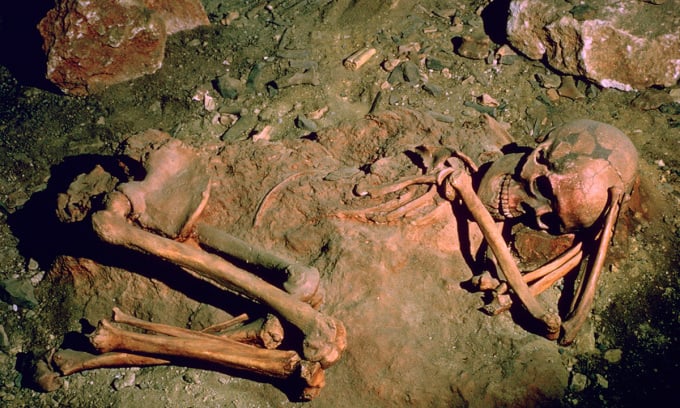
An example of a Paleolithic tomb in France. Photo: CM Dixon/Print Collector/Getty
Many cultures around the world choose to honor the deceased through burial. The rituals associated with this activity are deeply rooted in history and tradition, and can vary from culture to culture. So, when did humans first practice burial?
There is no definitive answer to this question because not all tombs have been preserved, let alone discovered and studied. However, the oldest evidence to date dates from the Middle Paleolithic period (approximately 300,000 - 30,000 years ago).
At least 120,000 years ago, people were intentionally buried, according to Mary Stiner, a professor of anthropology at the University of Arizona. Stiner doesn't rule out the possibility of even older burial sites, but suggests that the most compelling examples of modern humans ( Homo sapiens ) burying the dead come from the mid-Paleolithic period. Some studies suggest that extinct relatives of humans buried the dead around 300,000 years ago, in what is now South Africa, but this remains controversial.
The oldest tombs of modern humans, dating back 120,000 years, are found in caves such as the Qafzeh Cave in Israel. There is also evidence of Neanderthal tombs in caves dating back 115,000 years, according to the Australian Museum. Stiner notes that humans used caves extensively during the mid-Paleolithic period for eating, living, and social interaction.
Many researchers, such as Stiner, believe that these ancient tombs were the result of deliberate human activity, not natural causes (e.g., cave collapse), because the bones were arranged in specific positions (e.g., fetal position), and there were also human artifacts. In some cases, there were even clear traces of older sediment being disturbed for burial.
Scientists don't fully understand the origins of burial practices, but ancient people had many reasons for handling bodies both inside and outside caves. Humans and many animals have an "inherent aversion" to decomposition, according to Trish Biers, manager at the Duckworth Laboratory at the Centre for Human Evolutionary Research, University of Cambridge.
Humans needed to find ways to dispose of bodies as they began to decompose, emit odors, and expose the living to flies, pathogens, and scavengers. Initially, burial or other forms of disposal might have simply addressed these practical issues, but over time, the problem became more complex.
The development towards more complex burials did not necessarily follow a linear pattern. A study published in The Oxford Handbook of the Archaeology of Death and Burial (Oxford University Press, 2013) suggests that complex burials in Eurasia appeared and disappeared at the end of the Paleolithic period (45,000–10,000 years ago).
The authors also stated that it is difficult to draw definitive conclusions about the nature and significance behind these late Paleolithic tombs because scientists have only found a small number of such tombs. Furthermore, these ancient tombs vary depending on the region.
According to Biers, the way people buried their dead depended on many factors, including the environment and available materials. Cremation was a much later method, with the earliest recorded cremation site being the Mungo Lady in Australia, dating back approximately 40,000 years.
Thu Thao (According to Live Science )
Source link





























![[Photo] Prime Minister Pham Minh Chinh holds a phone call with the CEO of Russia's Rosatom Corporation.](/_next/image?url=https%3A%2F%2Fvphoto.vietnam.vn%2Fthumb%2F1200x675%2Fvietnam%2Fresource%2FIMAGE%2F2025%2F12%2F11%2F1765464552365_dsc-5295-jpg.webp&w=3840&q=75)












































Comment (0)