

Farmers struggle to get rid of rats…
Mr. Kim Nguol, residing in Cau Tre hamlet, Phu Can commune, Tieu Can district, said: his family has 0.2 hectares of rice fields, and when it gets dark (around 7 PM), 10-20 rats emerge from his family's rice fields each night.
Despite setting traps and using rat poison, it was ineffective. After killing a few rats, no more came to eat the bait; the number of rats causing damage in the fields also increased.
In just over 20 days, from planting to May 31st, the family lost more than 200 square meters of young rice plants to rat damage; the most affected areas were on dry, hilly land. Currently, in Tieu Can district, 9,600 out of 10,170 hectares of summer-autumn rice have been planted; mainly in the seedling stage.
According to Comrade Vo Quang Cuong, Deputy Head of the Agriculture and Rural Development Department of Tieu Can District: the summer-autumn rice crop currently in the fields is being damaged by rats to varying degrees.
In light of the above situation, the district is also implementing a plan to "eradicate rats to protect crop production" in accordance with Decision No. 870/QD-UBND, dated May 22, 2024, of the People's Committee of Tra Vinh province.
Speaking about the situation of rats damaging his family's rice crop and that of neighboring households, Mr. Nguyen Van Thu, from Hamlet 1, Phong Thanh Commune, Cau Ke District, said: his family has 0.45 hectares of rice land; the summer-autumn rice crop is currently nearly 30 days old.
Due to the increasing number of rats, which often appear in the fields to damage the rice crops after 7 PM and between 2 AM and 3 AM, the family has used methods such as setting traps, using rat poison, digging burrows, and setting nets... since the beginning of the summer-autumn rice crop season, they have eliminated nearly 300 rats.
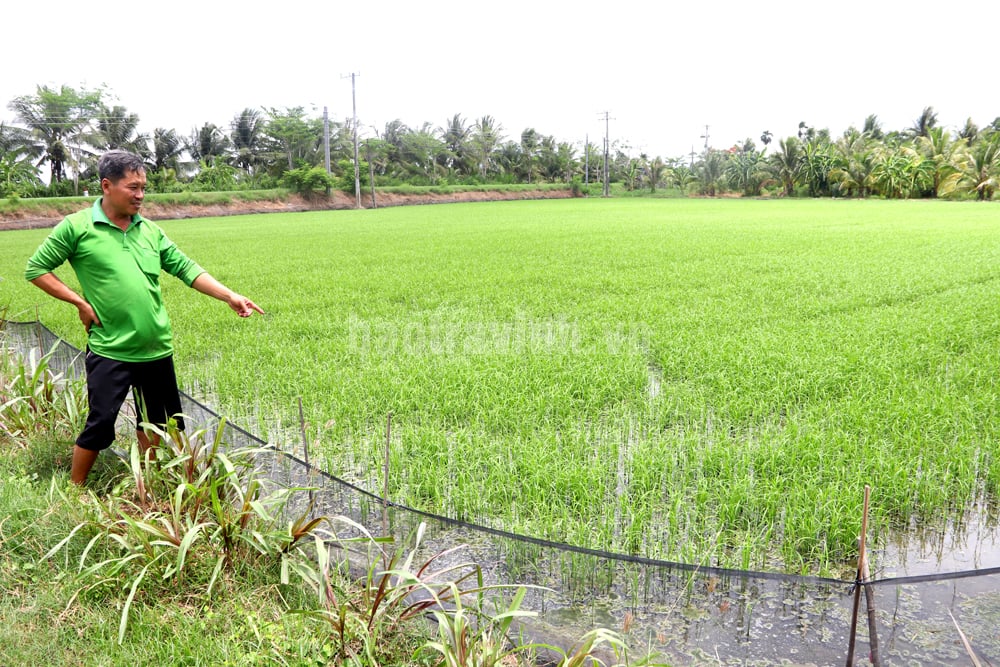
Besides setting rat poison, farmers in Dai Truong hamlet, Phu Can commune, Tieu Can district, Tra Vinh province also protect their rice crops by enclosing them with nets to prevent rats from entering.
Mr. Tran Van Chung, Director of Phat Tai Agricultural Cooperative (O Tre Lon hamlet, Thanh My commune, Chau Thanh district), said: currently, methods of rat extermination are only effective in the initial days.
Because rats are quite "intelligent," traps and poison bait used by farmers were very ineffective. Faced with rat infestations, many households had to put up mosquito nets and plastic sheeting around their rice fields to prevent rats from entering and damaging the crops.
Gardens and fields intertwined – an “ideal” hiding place for rats.
Mr. Son Sa Ret, from Dai Truong hamlet, Phu Can commune, Tieu Can district, said: currently, coconut groves and fruit orchards are often interspersed around rice fields.
Therefore, dealing with and catching rats is very difficult because during the day, rats take shelter in gardens; at night, they come out into the fields to gnaw and destroy rice crops. These are the "ideal" hiding places for rats, and they often build nests and burrows in gardens and embankments. Rice farmers are very afraid of rats, due to their rapid reproduction rate and cunning nature.
Ms. Thach Huyen, from Hamlet 1, Phong Thanh Commune, Cau Ke District, said: her family owns more than 1.2 hectares of rice fields, but because they are located next to an old orange orchard that the owner doesn't care for and leaves overgrown with weeds, it has created a shelter for rats.
To prevent rats from the garden from coming down to the rice paddies, the family had to use netting to surround the base of the garden, with a length of nearly 150 meters.
According to Mr. Kim Nguol, rats used to be very afraid of people because every household in the countryside kept a few dogs and cats; these are the animals that rats greatly fear.
The family itself had three dogs and two cats; whenever they spotted a mouse in the trees or peeking out at dusk, the dogs and cats would chase it. But since the theft of dogs and cats started, the family lost all their dogs and cats; since then, mice have appeared in greater numbers.
Implement comprehensive solutions for rodent control.
To protect agricultural production from the increasing number of rats causing damage, implementing individual rat control measures at each farmer's household has proven highly effective.
Dr. Ho Van Chien, former Director of the Southern Plant Protection Center, said: the rat population is increasing very rapidly and in a short period of time, and the range of their activity is very wide.
Furthermore, because rats are rodents and are cunning, rat poison is usually only effective for a short time, after which its effectiveness diminishes as the rats become wary of the bait (stop eating it).
Due to the ability of rats to travel long distances, it is necessary to organize community rat traps or crop traps; and rat damage prevention and control measures must be implemented from the very beginning, during the preparation phase for the production season.
Instructions: Prepare approximately 1,000 m² of land in the middle of the production area, which will be able to protect about 50 hectares; the community rat trap should be set up about 15 days before the simultaneous sowing of the entire field.
Around the 1,000m² plot of land, dig a ditch running around the area and build access roads into the land that cross the ditch (approximately 4 access roads in 4 directions); on the outside of the land bordering the ditch, erect a nylon fence about 1m high. The embankments across the ditch will serve as pathways to lure rats in, with two traps placed at the end of each path.
At this time, the rice in the fields chosen as rat traps has sprouted, attracting rats to find food. Every day, households in the area will check the traps and catch rats. This community rat trapping model requires the participation of many farming households to be effective.
On May 22, 2024, the Vice Chairman of the People's Committee of Tra Vinh province, Nguyen Trung Hoang, signed Decision No. 870/QD-UBND approving the plan for rodent control to protect agricultural production in the province.
Comrade Le Van Dong, Deputy Director of the Department of Agriculture and Rural Development of Tra Vinh province, said: In the Plan, rodent control is identified as a regular and continuous task. Organize concentrated rodent control campaigns in districts, towns, and cities at the right time, before the rodent breeding season and during the transitional periods between production seasons throughout the year.
Coordinate with local departments, agencies, and organizations to launch rat eradication campaigns, and organize community rat eradication teams in concentrated campaigns during periods when rats are not yet breeding, and before and after production seasons.
Implement two concentrated rat extermination campaigns per season, eliminating at least 3 million rats per year. Gradually develop and expand rat extermination models using various types of rat traps in localities with large areas of intercropping and those transitioning to multi-cropping...
Source: https://danviet.vn/con-vat-quai-ac-nao-dang-rinh-pha-hoai-tai-san-khien-pho-chu-tich-tinh-tra-vinh-ky-quyet-dinh-nay-2024062414132269.htm














![Passion fruit 'capital' faces sustainability challenge: [Part 3] Building supply chain linkages](https://vphoto.vietnam.vn/thumb/402x226/vietnam/resource/IMAGE/2025/12/12/1765517075835_1232-akk00534-130606_948.jpeg)











![[Photo] Prime Minister Pham Minh Chinh holds a phone call with the CEO of Russia's Rosatom Corporation.](/_next/image?url=https%3A%2F%2Fvphoto.vietnam.vn%2Fthumb%2F1200x675%2Fvietnam%2Fresource%2FIMAGE%2F2025%2F12%2F11%2F1765464552365_dsc-5295-jpg.webp&w=3840&q=75)

















































Comment (0)