

Weapons have existed since early in human history. Along with the development of human civilization and global conflicts, weapons have gradually become more diverse, sophisticated, and dangerous.
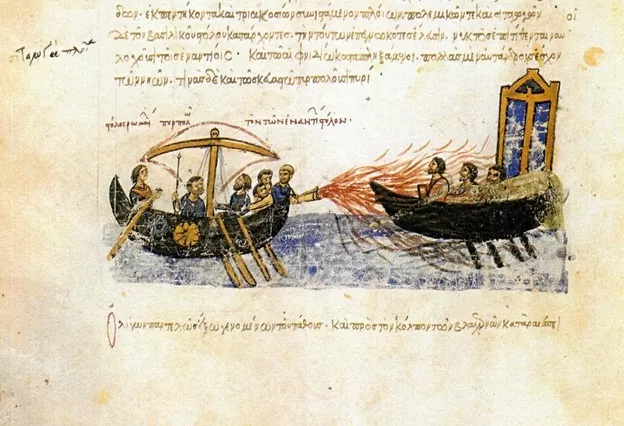 |
| Byzantine sailors unleash Greek flames on enemy ships. (Source: Heritage Images) |
From rocks to missiles, weapons of war have evolved over time. Among the myriad of different lethal weapons, some have emerged as revolutionary tools, changing the course of warfare and impacting the lives of millions.
Below are some of the weapons that the world's oldest encyclopedia, Britannica , considers to be among the most devastating in history:
Greek Fire – The Mysterious Weapon of the Middle Ages
Greek Fire is a well-known chemical weapon used by the Byzantine Empire (Eastern Roman Empire) from the 7th century. It is a highly flammable mixture that can flare up intensely and is particularly dangerous when spread over water.
Thanks to this power, Greek fire became a terror to enemies, especially in naval battles with the Arab fleet.
The exact formula for Greek fire remains an unsolved mystery. Theories suggest it consisted of petroleum, sulfur, and quicklime. When in contact with water, the quicklime produced a heat-generating reaction, causing the mixture to burn more intensely instead of extinguishing. This property gave the Byzantines a significant advantage in naval warfare.
Greek fire was spewed from special tubes or contained in containers for throwing by hand, similar to modern-day Molotov cocktails. Its terrifying power lay not only in its ability to destroy ships but also in the psychological terror it inflicted on the enemy, causing panic among troops facing a fire that could not be extinguished by water.
Today, Greek fire remains a symbol of military technology far ahead of its time. A modern version of it is the napalm bomb, first used in World War II, causing significant damage in air raids on Dresden and Tokyo in 1945.
Maxim machine gun – A symbol of transformation
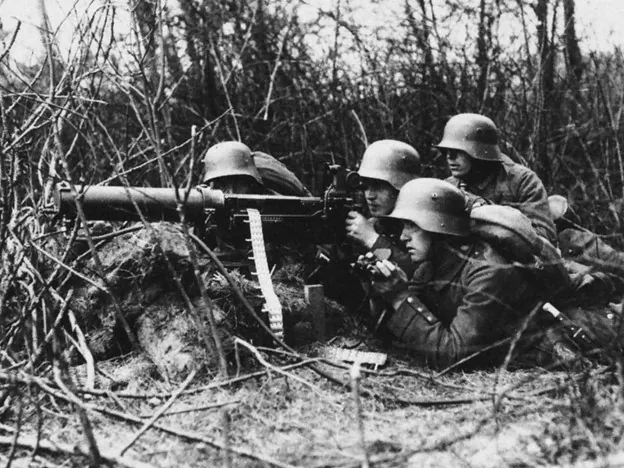 |
German infantrymen using machine guns in World War I. (Source: Imperial War Museum) |
The 19th century marked a major turning point in weapon technology with the introduction of the Maxim machine gun in 1884. This was the world's first automatic rifle, invented by American engineer Hiram Maxim. The gun operated using recoil from each shot to reload and fire continuously, significantly increasing firepower without manual operation.
The Maxim pistol typically uses 7.62 mm or 8 mm ammunition and has a rate of fire of 500-600 rounds per minute. To prevent overheating, the gun is water-cooled via a water jacket surrounding the barrel. The ammunition feeding system uses a long magazine, allowing for hundreds of rounds to be fired without needing to reload.
However, the weapon's drawbacks include its heavy weight and bulky design, making it difficult to move and deploy. Additionally, its reliance on water cooling means the gun requires a constant water supply to operate. Despite this, its high reliability and ability to fire continuously make the Maxim a formidable weapon.
The Maxim machine gun played a crucial role in many major wars, such as the Boer Wars in South Africa (1880-1881 and 1899-1902), the Russo-Japanese War (1904-1905), and especially World War I (1914-1918). Particularly in trench warfare, the Maxim's powerful firepower helped armies gain the upper hand.
The introduction of the Maxim machine gun completely changed military tactics, ushering in an era of modern warfare where the advantage belonged to armies possessing superior firepower. The Maxim was not just a weapon, but also a symbol of the transition from classical warfare to industrialized warfare.
Rifles: The primary weapon of the infantry.
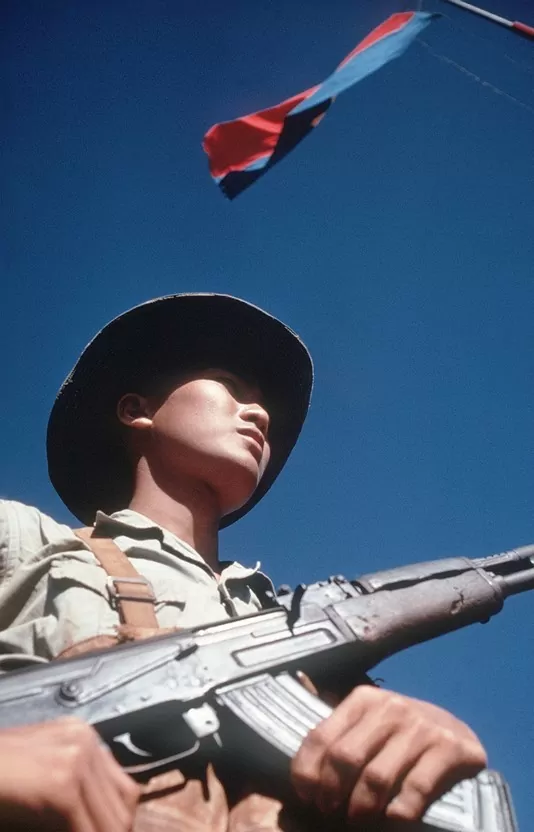 |
A soldier of the Vietnam People's Army stands next to an AK-47 rifle, February 1973. (Source: U.S. Department of Defense ) |
Rifles are long-barreled personal weapons designed for accurate firing at longer distances than pistols and other handguns. They have been the primary weapon of infantry from the 19th century to the present day, with significant improvements over time.
To date, modern rifles have many variants, from assault rifles like the M16 and AK-47, to specialized sniper rifles like the Barrett M82. These rifles are often equipped with optical sights, suppressors, and other accessories to increase combat effectiveness.
The AK-47 assault rifle is perhaps the quintessential military weapon of the 20th century. Countless guerrilla movements, struggles, and revolutions have used this weapon. An estimated 100 million AK-47s were in circulation by the beginning of the 21st century.
The role of rifles lies not only in offensive capabilities, but also in tactical support, defense, and area control. With their accuracy, long range, and powerful firepower, rifles remain indispensable weapons in military forces around the world.
(to be continued)
Source: https://baoquocte.vn/nhung-vu-khi-chet-choc-nhat-lich-su-ky-1-cong-cu-thoi-trung-co-khung-bo-tinh-than-bi-mat-an-giau-van-chua-co-loi-giai-295385.html




























































































Comment (0)