

The Chechen Republic's Akhmat special forces were ordered to leave the Rostov province in southern Russia and return to their combat positions after the Wagner Group withdrew.
"After being temporarily deployed to the city of Rostov-on-Don and Rostov Oblast to deal with the armed rebellion, the Akhmat soldiers are returning to the operational area of the special military operation," Apty Alaudinov, commander of the Akhmat special forces of the Chechen Republic of Russia, said on June 25.
A day earlier, Chechen Akhmat special forces were ordered to move to Rostov province to deal with the situation after the Wagner private military group revolted and seized control of the headquarters of the Southern Military District in Rostov-on-Don. Chechen leader Ramzan Kadyrov said the Akhmat special forces arrived in Rostov "to control the situation if necessary."
However, Alaudinov said that the Akhmat special forces did not withdraw all their forces from the battlefield in Ukraine, but only redeployed the units that had just been replaced. "Currently, the Akhmat units are gradually returning to the combat zone to continue the operation in Maryinka," he said, referring to the city in the Donetsk province in eastern Ukraine.
Kadyrov described the Chechen units as having marched rapidly to the city of Rostov-on-Don with a readiness to carry out their mission, but the crisis ended without a direct confrontation between Akhmat and Wagner.
The Chechen Republic's Akhmat special forces unit has long been known for its loyalty to President Vladimir Putin. This force has also repeatedly clashed with Wagner over the conflict in Ukraine.
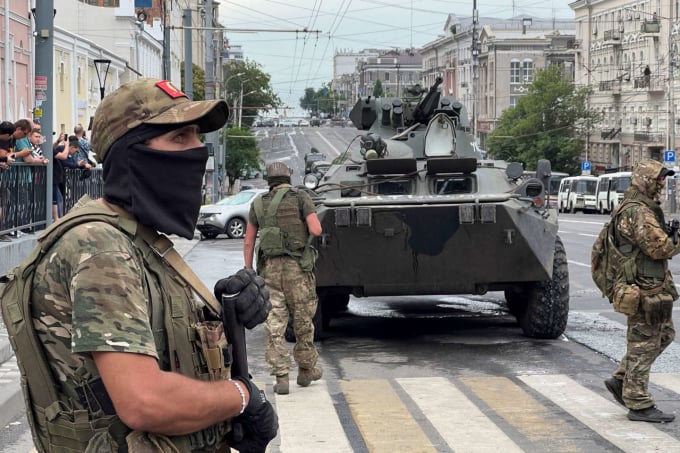
Wagner soldiers and armored vehicles in the city of Rostov-on-Don on June 24. Photo: AFP
Voronezh Governor Alexander Gusev also announced today that Wagner forces are nearing completion of their withdrawal from the province. "The withdrawal process is proceeding smoothly and without incident," Gusev said, adding that travel restrictions will be lifted.
The Voronezh province will assess the damage and pledge compensation to families affected by Wagner's rebellion. Gusev also thanked the local people for their "resilience and rationality" on June 24th.
Wagner Group leader Yevgeny Prigozhin accused Defense Minister Shoigu of going to Rostov and directing the missile attack on Wagner's camp on June 23 in Ukraine, which killed many of the group's fighters. The Russian Ministry of Defense denied the accusation.
Prigozhin then mobilized manpower and weapons, organizing a "marching for justice" into Russian territory demanding that the military leadership be held accountable for the attack.
In less than 24 hours, Wagner troops advanced from the Donbass region into Rostov province, taking control of military facilities in the cities of Rostov-on-Don and Voronezh.
When Wagner units had moved to within about 200 km of Moscow, Prigozhin unexpectedly announced a withdrawal to avoid bloodshed, in accordance with an agreement reached with the President of Belarus. Following Prigozhin's announcement, Wagner forces began retreating to their barracks.
The Kremlin later confirmed that Wagner would leave Russia for Belarus and would not be prosecuted. However, observers believe this will also mark the end of Prigozhin's political ambitions.
Thanh Danh (According to TASS, AFP )
Source link



















![[Photo] Prime Minister Pham Minh Chinh holds a phone call with the CEO of Russia's Rosatom Corporation.](/_next/image?url=https%3A%2F%2Fvphoto.vietnam.vn%2Fthumb%2F1200x675%2Fvietnam%2Fresource%2FIMAGE%2F2025%2F12%2F11%2F1765464552365_dsc-5295-jpg.webp&w=3840&q=75)











































Comment (0)