

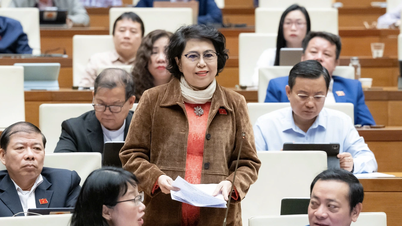
Discussing the draft Resolution of the National Assembly regarding breakthrough mechanisms for the protection, care and improvement of people's health at the National Assembly this morning, delegate Tran Khanh Thu ( Hung Yen delegation) was concerned about the issue of training medical staff . The delegate emphasized that the draft only focuses on postgraduate training, while early and remote solutions are still open.
According to the delegate, medical human resources play a decisive role in the success of public health care. However, the current human resources at the grassroots level "do not really meet the requirements, are not attractive places and do not ensure conditions for professional development for each doctor".

Delegate Tran Khanh Thu. Photo: National Assembly
The Ministry of Health's report shows that the country has 214 medical personnel training facilities, including 66 universities (18 public schools training medical doctors). In 2024, nearly 11,300 doctors will graduate, but this number is still "insignificant", when the total medical workforce is about 431,700 people, much lower than the target of 632,500 people according to the medical human resource planning for the period 2011-2020.
The delegate pointed out the reality: "The medical profession at public schools has always had the highest standard score in the past 10 years; the study time is long, the tuition is high because public schools operate financially autonomously, the main source of income is from tuition. Tuition fees at all schools are very high, beyond the ability of low-middle income families. This has become a barrier for many students who want to pursue a medical career."
Commenting on the draft revised Law on Higher Education, delegate Tran Khanh Thu once proposed to amend the regulations so that the state budget can ensure funding for training medical doctors. However, Report No. 2028 of the Ministry of Education and Training stated that this content falls under the scope of expertise regulated by the Ministry of Health.
"I propose to add the medical doctor training subjects of public training institutions to the group of subjects guaranteed by the state budget, with tuition support during the training period; with a commitment that after graduation, they will work as assigned by the State. Thus, the source of students, especially students in difficult circumstances, will have the opportunity to achieve their wish to become doctors, at the same time solving the problem of medical human resources in remote areas, areas lacking doctors", Ms. Thu said.
The Ministry of Health is responsible to the Government for training resident physicians.
Commenting on the specialized training content of the medical sector, delegate Nguyen Anh Tri (Hanoi delegation) proposed the regulation: "The Ministry of Health is responsible to the Government for implementing state management of training of medical specialists and resident doctors".
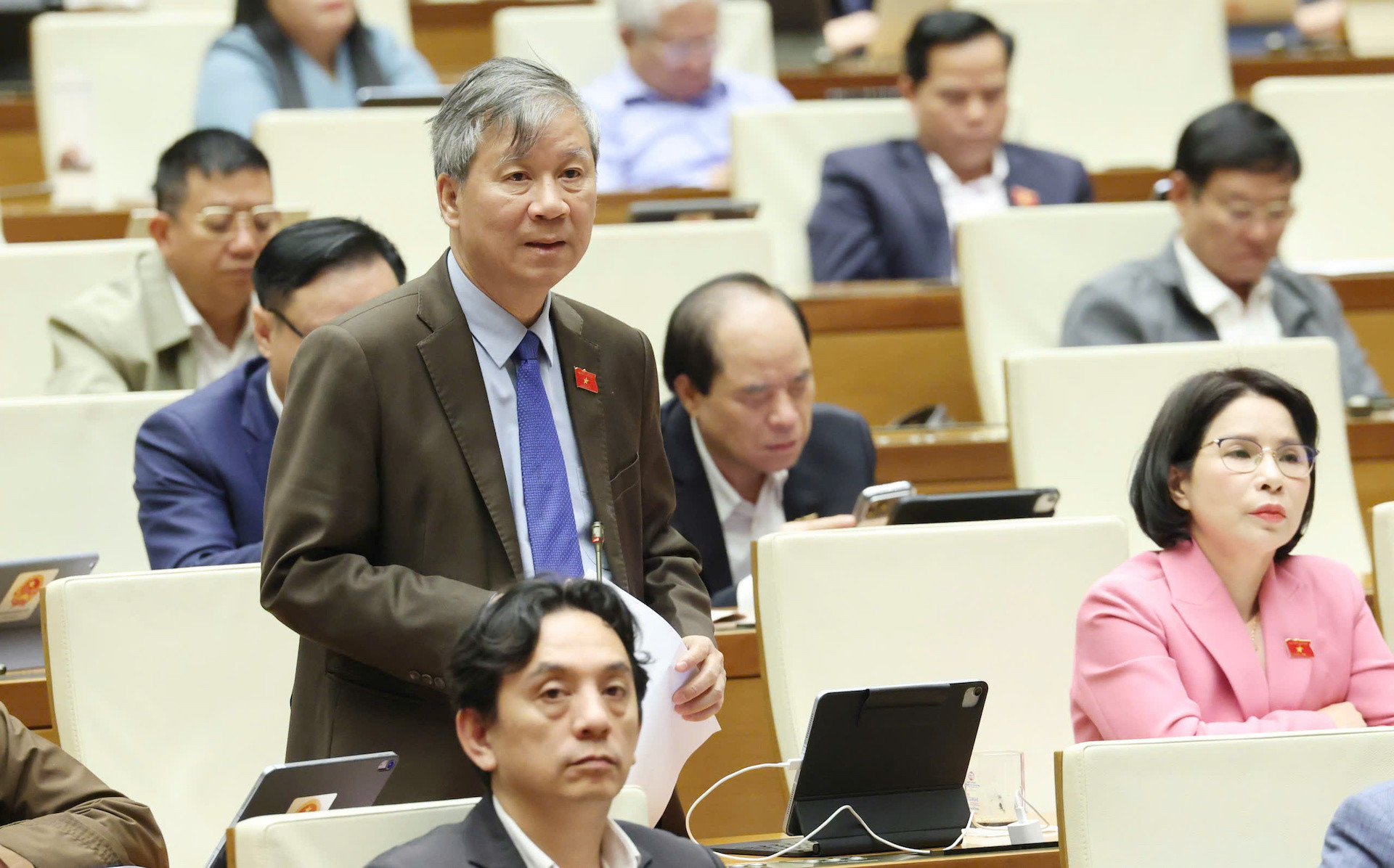
Delegate Nguyen Anh Tri. Photo: National Assembly
Delegates suggested that when drafting detailed regulations on specialist training, the Ministry of Health should combine specialist 1 and specialist 2 training into a single level training system, lasting 4-5 years depending on the specialty, with maximum priority given to clinical practice.
The Ministry of Health needs to regulate residency training as a form of selective training for excellent and fair graduates, through strict entrance exams, with priority given to the highest quality, studying mainly at large hospitals, centers and large testing departments.
According to the delegate, the "specialist" and "resident doctor" degrees under the national education system can bear the signatures of both the Ministry of Health and the Ministry of Education and Training, as is done by many prestigious universities around the world.
Delegate Nguyen Tam Hung (Lam Dong) also said that the policy of training specialists and advanced specialists is in the right direction. According to the delegate, to create a real breakthrough, it is necessary to consider adding requirements to recognize certificates and diplomas of advanced specialist training in Vietnam according to appropriate international standards to facilitate the integration of medical human resources, attract talents and ensure the competitiveness of Vietnamese medical human resources in the future. This also contributes to promoting medical training facilities to innovate and improve quality.
Vietnamnet.vn
Source: https://vietnamnet.vn/de-nghi-mien-hoc-phi-cho-sinh-vien-nganh-y-truong-cong-lap-2468490.html
![[Photo] Parade to celebrate the 50th anniversary of Laos' National Day](/_next/image?url=https%3A%2F%2Fvphoto.vietnam.vn%2Fthumb%2F1200x675%2Fvietnam%2Fresource%2FIMAGE%2F2025%2F12%2F02%2F1764691918289_ndo_br_0-jpg.webp&w=3840&q=75)






















![[Photo] Worshiping the Tuyet Son statue - a nearly 400-year-old treasure at Keo Pagoda](/_next/image?url=https%3A%2F%2Fvphoto.vietnam.vn%2Fthumb%2F1200x675%2Fvietnam%2Fresource%2FIMAGE%2F2025%2F12%2F02%2F1764679323086_ndo_br_tempimageomw0hi-4884-jpg.webp&w=3840&q=75)






























































Comment (0)