

TP - At the National Assembly Standing Committee meeting on October 8th to discuss the draft Law on Teachers, Minister of Education and Training Nguyen Kim Son proposed a policy of waiving tuition fees for the biological and legally adopted children of teachers currently working in the field. If the policy comes into effect, the estimated annual expenditure would be approximately 9,200 billion VND. The proposal has met with much opposition, including from teachers currently teaching; some argue that it is unlikely to be effective and is not feasible.
The proposal from the drafting agency of the Law on Teachers immediately sparked much debate, with some arguing that while teachers are special civil servants who need special preferential treatment, this should not create privileges and advantages that lead to unfairness compared to other professions.
Ms. Bui Minh Khuyen, a teacher at Pa U Ethnic Boarding Primary School in Muong Te District, Lai Chau Province, said she was very happy and excited about the Ministry of Education and Training's proposal, which she considers humane and highly encouraging. Over the years, many teachers have worked hard but their salaries haven't been sufficient to meet their living expenses. Furthermore, good policies and preferential treatment will also attract talented individuals to the teaching profession.
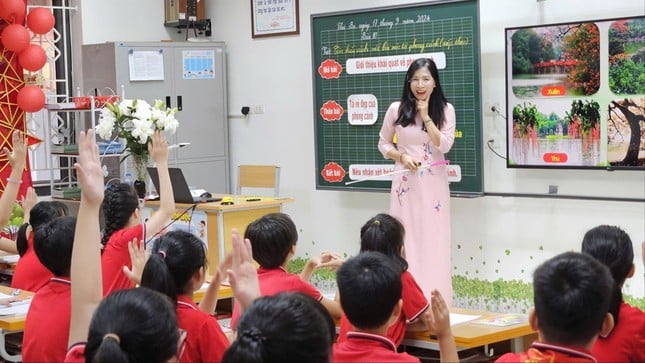 |
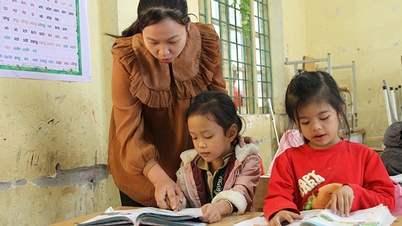
Many people have expressed concerns after the Ministry of Education and Training proposed waiving tuition fees for the children of teachers. (Photo: Ha Linh) |
Ms. Nguyen Thi Thanh Ha, a teacher at a junior high school in Hanoi , believes that there should be no inequality between teachers and other professions. She suggests that the Ministry of Education and Training should propose waiving tuition fees for all students, which would be a humane and wonderful policy. “Then all students wouldn’t have to worry about tuition fees, significantly reducing the burden on parents. Teachers, although not earning high incomes, would still have an advantage over some other professions such as manual labor or factory work… which are more arduous and difficult,” Ms. Ha said.
Difficult to be effective
Dr. Pham Hung Hiep, Director of the Institute for Educational Research and Knowledge Transfer at Chengdu University, stated that the root cause of the Ministry of Education and Training's proposal to waive tuition fees for teachers' children in the draft Law on Teachers stems from the fact that the current Law on Public Employees and the Law on Civil Servants lack sufficient basis to address the income issues of teachers. While separating teachers from the Law on Civil Servants has broadened support for them, it remains insufficient. Because they are still subject to the general policies for public employees, the Law on Teachers is being developed to attempt to resolve the obstacles and difficulties that the Law on Public Employees fails to address for teachers.
One of the issues being addressed is preferential treatment and priority for teachers. This preferential treatment and priority has long been discussed. Education is a top national priority, but teachers face many difficulties and need support. Specific, sufficiently strong policies to address this issue are still lacking, although some policies exist, such as a 40% allowance for secondary school teachers and a 25% allowance for university lecturers. Compared to other sectors, teachers' incomes remain at an average level. These priorities must be groundbreaking, and the proposal to waive tuition fees for teachers' children is part of the intention of those drafting the law.
“If teachers' children are exempt from tuition fees, it could have a positive impact on their motivation, but it could lead to other issues such as social equity. Why should other parents' children pay tuition fees while teachers' children don't? Furthermore, there will be issues of equality within the school due to discrimination. This has a negative impact on the educational environment. Therefore, attention to teachers should be shown through other policies such as salaries and allowances, rather than necessarily exempting teachers' children from tuition fees. In Germany, there are no special privileges for teachers compared to other professions. Currently, the states compete to attract teachers mainly through salaries and working conditions.”
Dr. Nguyen Van Cuong, University of Potsdam, Germany
“Everyone sees that teachers should have many priorities. Decree 116, which supports tuition and living expenses for teacher training students, is an initial support policy to attract talented students to the teaching profession. But the proposal to waive tuition fees for the children of teachers, in my opinion, is unlikely to be effective,” Mr. Hiep said. The State is currently waiving tuition fees for 5-year-old preschoolers, primary school students, and many localities have already waived fees for lower secondary school. Thus, only upper secondary and university levels remain free. Meanwhile, tuition fees at public high schools are not high. If we include both upper secondary and university levels, the number of beneficiaries is not large. In reality, the most difficult time for teachers is when they first enter the profession. According to Mr. Hiep, a fund should be established to provide loans or additional support for young teachers just starting out. “At over 40 years old, when their children start high school or university, teachers' lives are already stable. Then, when tuition fees are waived, how will they choose? Will it be waived at public or private schools, at domestic or international schools? When designing a policy with so many variables, not to mention that the beneficiaries may not necessarily need it, the policy may have good intentions but its implementation will be problematic and it may not be highly effective,” Mr. Hiep commented.
Further calculations will be done.
Mr. Vu Minh Duc, Director of the Department of Teachers and Educational Management Staff (Ministry of Education and Training), explained that during the drafting process of the Law on Teachers, the drafting committee received feedback from teachers, experts, etc. Among the feedback on preferential policies for teachers, there was a request to waive tuition fees for the biological and legally adopted children of teachers. “The purpose of this policy is to create a favorable environment for teachers in their professional activities. Developing preferential policies helps teachers have a stable life, feel secure in their work, and attract talented people to the profession,” Mr. Duc said.
According to Mr. Duc, with a proactive spirit, the drafting committee always listens to the opinions of educators, public opinion, and relevant agencies to further refine the draft Law on Teachers, ensuring its appropriateness, feasibility, and fairness compared to other professions. This avoids creating inconsistencies in the regulations and policies for teachers compared to other civil servants, even though teachers are special civil servants with unique work. "We will review the contents of the draft and make further calculations to suit our socio-economic conditions so that the proposed content does not become a burden on the state budget," Mr. Duc said.
Source: https://tienphong.vn/de-xuat-chi-9200-ty-dong-mien-hoc-phi-cho-con-nha-giao-co-cong-bang-post1681246.tpo



































































Comment (0)