

Policies and regulations on the use of AI in education need to be enacted.
At the seminar "Vision and Future Orientation for Education in the AI Era" held on the morning of March 20th in Ho Chi Minh City, Professor Dr. Le Anh Vinh - Director of the Vietnam Institute of Educational Sciences - stated that the benefits of AI include increased access to education, promotion of personalized education, enhancement of self-learning, innovation and improved teaching effectiveness, and the creation of lifelong learning habits.
The challenges include widening the digital divide, ethical issues in AI, data security, the accuracy and objectivity of content, and reliance on technology.
Considering that AI has a comprehensive impact on the three pillars of education—curriculum, teaching and learning processes, and assessment—Professor Le Anh Vinh specifically analyzed: AI supports teachers and administrators in the teaching and learning process by assisting in building lesson plans, creating teaching materials, designing tests, grading, analyzing results, and supporting personalized feedback for learners.
"Teachers need to be more proactive in using technology. New technologies are constantly emerging; the issue isn't just about keeping up with technology, but about acquiring technological skills to support teaching and learning, and equipping students with the skills to adapt to an ever-changing technological world ," Professor Le Anh Vinh recommended.
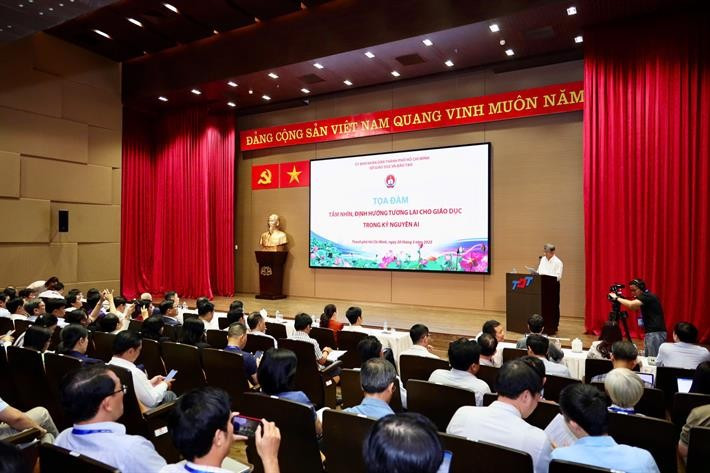
According to the survey results from the Vietnam Institute of Educational Sciences on the use of AI with 11,000 high school students nationwide, Professor Dr. Le Anh Vinh stated: The faster the adaptation, the more effective and practical it becomes for teaching, thereby preparing students for a life full of changes and uncertainties.
Associate Professor Dr. Le Anh Cuong, Head of the Computer Science Department at Ton Duc Thang University, also believes that the general goal of AI education in high schools should aim to help students utilize AI effectively, responsibly, ethically, and safely; developing new competencies that enable students not only to use AI but also to master AI in their future work and lives.
According to Associate Professor Dr. Le Anh Cuong, applying AI tools in teaching, learning, and management will improve the quality of student learning, develop critical and creative thinking, enhance equity in education, use AI in assessment to ensure fairness and improve quality, improve the quality of lectures and teaching methods, and enable smart education management using AI.
To use AI effectively, safely, and responsibly, Associate Professor Dr. Le Anh Cuong mentioned several solutions. These include: issuing policies and regulations on the use of AI in education; training teachers on how to use AI effectively to help students develop critical thinking and fact-checking skills; monitoring and limiting the use of AI in learning assessment; protecting student privacy and data; and building a suitable AI ecosystem for education.
Associate Professor Dr. Le Anh Cuong also proposed building a digital technology and AI ecosystem specifically for education. This includes developing a large-scale language model for education, creating digital textbooks integrated with AI tools, and building a digital system for assessing student competencies.
Leverage what the world has already done and the practices currently underway to take action.
Speaking at the seminar, Deputy Minister of Education and Training Pham Ngoc Thuong stated that the current context is favorable for integrating AI into general education. He referred to Resolution 29-NQ/TW on fundamental and comprehensive reform of education and training, and Resolution 57-NQ/TW on breakthroughs in the development of science, technology, innovation, and national digital transformation. He affirmed that breakthroughs must clearly be achieved through science, technology, digital transformation, innovation, focusing on people, training teachers and administrators, and prioritizing students.
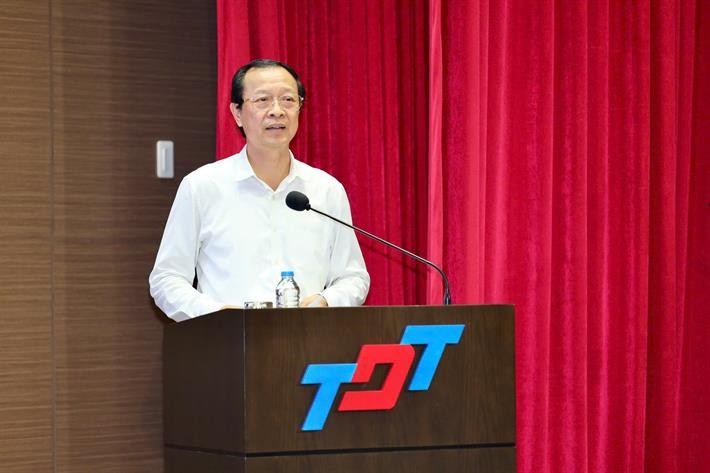
Emphasizing keywords such as: unlimited opportunities, challenges, decisive action, and appropriateness, Deputy Minister Pham Ngoc Thuong stated that AI entering life and education presents more opportunities than challenges. “We must be decisive, and move faster in applying AI. We need to leverage what the world has already done and the current practices to take action. We must act immediately and decisively, proactively, creatively, and appropriately to the practical conditions of each place.” Referring to these requirements, the Deputy Minister also mentioned the broad scope of education, hence the need for steps and pilot programs.
The Deputy Minister requested that the Departments of Education and Training pay attention to training, fostering, and encouraging teachers to use AI appropriately, and piloting it in educational institutions. With the view that "teachers who know how to use AI will replace teachers who do not," Deputy Minister Pham Ngoc Thuong requested guidance and direction from the Ministry of Education and Training, along with proactive efforts from the Departments of Education and Training and schools.














































































Comment (0)