

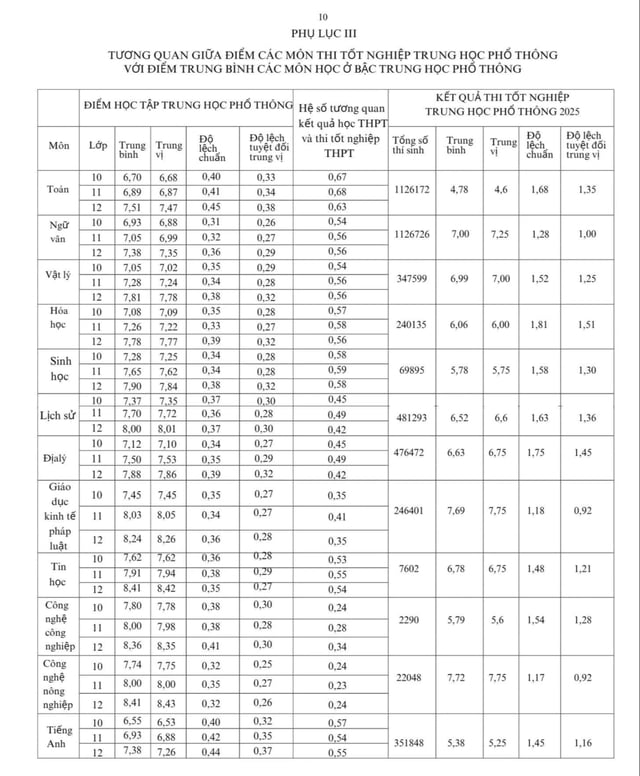
Looking at the comparison table from the Ministry of Education and Training, it can be seen that for all subjects, the GPA is higher than the high school graduation exam scores, with the difference varying depending on the subject.
Notably, the average math score in the high school graduation exam was 4.78. Meanwhile, the average math score on high school transcripts was 6.7 in grade 10, 6.89 in grade 11, and 7.51 in grade 12. The correlation coefficients were 0.67, 0.68, and 0.63, respectively.
Another easily noticeable trend is the significant increase in average grades across all subjects in high school, particularly in 12th grade. For example, the average math score in 10th and 11th grade was 6.70 and 6.89 respectively, rising to 7.51 in 12th grade; and the literature score increased from 6.93 in 10th grade to 7.35 in 12th grade...

Students taking the high school graduation exam in 2025
PHOTO: TUAN MINH
Many years ago, according to regulations for high school graduation, 12th-grade academic transcripts accounted for 30% of the assessment, while exam scores accounted for 70%. However, by 2025, a notable change is that academic transcripts will account for 50% of the graduation assessment, a significant increase from the previous 30%.
This means that the learning process throughout the three years of high school will play a more important role, rather than relying solely on exam results.
The Ministry of Education and Training believes that increasing the weight of academic transcripts and calculating scores from all three years of high school, instead of just grade 12 as before, aims to help students prepare over the long term and avoid the mentality of rote learning or focusing only on certain subjects, rather than concentrating all their efforts on exam preparation in a short period of time.
Comparison table between exam scores and academic transcript scores for each subject, compiled by the Ministry of Education and Training:
Are schools too lenient when it comes to grading?
Mr. Vu Khac Ngoc, a teacher specializing in exam preparation in Hanoi , analyzed: "Just look at the average GPA of the academic transcript and the exam scores to see how much of a difference there is."
In this case, the grades in the report card are higher than the exam scores in all subjects, indicating that grading in the report card at school is clearly "easier" than grading in the exam (especially for subjects considered difficult this year such as math and English).
Standard deviation values indicate the degree of differentiation in scores. Higher standard deviations in graduation exam scores reflect a significantly better level of differentiation compared to academic transcripts. This suggests that the graduation exam has done a better job of classifying students' actual abilities than their academic transcripts.
"The correlation coefficient between academic transcript scores and exam scores indicates whether those transcript scores accurately reflect the student's abilities (compared to the exam scores). The higher this coefficient, the better the 'accuracy' of the reflection," according to Mr. Ngoc.
Based on the above analysis, Mr. Ngoc stated: "The high school graduation exam still plays an extremely important role in ensuring fairness and classification. Academic transcripts should not be used for admission to highly competitive majors; if used at all, it should be combined with other admission tools. The Ministry of Education and Training's requirement to convert scores from academic transcripts to the same scale as other admission methods to ensure fairness is necessary."
However, many opinions also point out that the discrepancy between academic transcript scores and high school graduation exam scores mentioned above does not fully reflect the reality of the "lenient" approach to regular testing and evaluation at the high school level, due to the disparity in the number of students studying and taking exams in most subjects.
Except for mathematics and literature, which are two compulsory subjects in this year's high school graduation exam, all other subjects are optional. Candidates choose which subjects to take the exam in, basically focusing on their strengths.
Therefore, comparing the academic results of all students who studied with the exam results of the few candidates who chose to take the exam and whose academic transcript scores were higher than their exam scores only partially reflects the discrepancies between these assessment methods.
From the perspective of university admissions, the Ministry of Education and Training proposes: "Educational institutions using high school academic results in admissions should base their decisions on this data to develop and publish equivalent admission scores and entrance thresholds for each program, major, group, or field of study."
However, perhaps the Ministry of Education and Training itself needs to look at these comparative results to reconsider whether using 50% of academic transcript scores for high school graduation assessment is truly reassuring. Or perhaps they could question whether the difficulty and differentiation of the exam questions are appropriate for the nature of the high school graduation exam.
Source: https://thanhnien.vn/diem-hoc-ba-tat-ca-cac-mon-deu-cao-hon-diem-thi-tot-nghiep-thpt-185250722172822073.htm















































































Comment (0)