

Each year, the EU imports nearly $3 billion worth of three product groups – coffee, timber, and rubber – from Vietnam.
The EU's Regulation on Deforestation (EUDR) came into effect on June 29, 2023. Of the seven product groups subject to the EUDR – palm oil, soybeans, timber, cocoa, coffee, livestock, and rubber – Vietnam currently has three items – coffee, timber, and rubber – that are subject to this regulation.
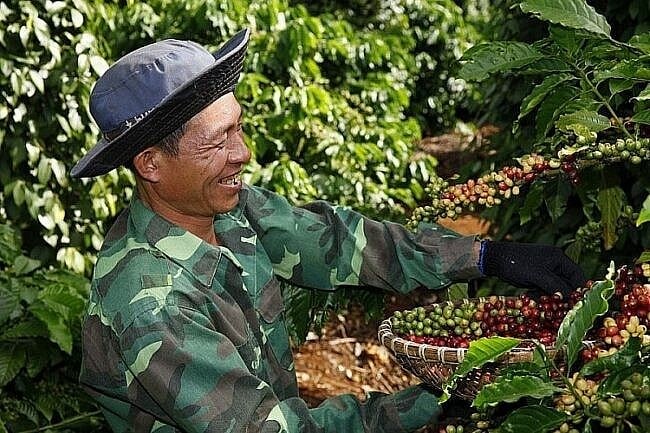 |
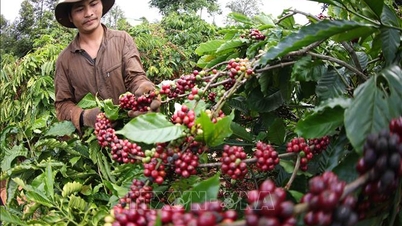
| Coffee is one of three Vietnamese agricultural and forestry products subject to EU anti-deforestation regulations. |
To be allowed to circulate these goods in the EU, importing businesses from the EU must ensure that the products are legal and do not cause deforestation or forest degradation (hereinafter referred to as deforestation), with deforestation occurring from December 30, 2020 onwards. Businesses have 18 months (large businesses) or 24 months (small and medium-sized businesses) after the EUDR comes into effect to prepare to meet the EUDR requirements.
Given that the EU is one of Vietnam's most important trading partners, importing nearly $3 billion worth of three product groups – coffee, wood, and rubber – from Vietnam annually, meeting the requirements of the EUDR is of particular urgency for Vietnamese export businesses in particular and all stakeholders involved in these three sectors in Vietnam in general.
According to Mr. To Xuan Phuc, a policy analyst at Forest Trends, coffee, wood, and rubber are three important product groups currently being exported to the EU by Vietnamese businesses.
Currently, the Vietnamese government is implementing a policy of closing off natural forests. The areas newly converted from natural forests to plantations, coffee, and rubber account for only a small percentage.
According to EUDR regulations, these three Vietnamese agricultural sectors are generally at low risk of being classified as high-risk for deforestation and forest degradation, as the production area for these three commodities has been stable since before 2020.
However, proving this in practice faces many challenges due to a lack of necessary legal evidence. Specifically, the legal status of agricultural land owned by farming households is unclear; the supply chain is complex with many intermediaries; and farmers have difficulty accessing information about mechanisms and policies.
Many recommendations have been made.
With less than 18 months remaining before the official implementation of the EUDR, reviewing risk points in the supply chain related to farmers is extremely urgent. This needs to be implemented systematically and strategically to promptly collect and process information on millions of farmers as required by the EUDR.
However, given the generally limited capacity and resources of farming households, Mr. To Xuan Phuc believes that the participation of many stakeholders is necessary, especially export businesses and management agencies at all levels.
Accordingly, the Government and government agencies need to urgently research, develop, and update information including: maps of the current state of forests, deforestation, and forest degradation; land status – digitized maps, locations and current status of land plots without land use certificates, accuracy of the location and boundaries of land plots according to issued land use certificates, etc., and share this information with relevant parties such as associations, businesses, and the EU.
Furthermore, the government needs to assign relevant ministries and agencies to review the supply chains of various industries – starting with wood, coffee, and rubber – to assess the risks and the ability of producers, traders, and businesses to meet the EUDR requirements as outlined above.
Based on this, the Government will direct relevant ministries and agencies, especially local authorities, to organize information dissemination and capacity building activities for farming households, particularly in areas with large ethnic minority populations.
In addition, the government needs to consider implementing appropriate policies to quickly legalize the land plots of households that currently lack land use certificates but are not located in areas at risk of forest loss and degradation.
On the part of businesses, it is necessary to quickly review their supply chains and work with local authorities and their suppliers to assess the ability of their current supply chains to meet EUDR regulations.
The assessment also needs to identify shortcomings in the supply chain. Based on this, the business will develop plans to address these issues.
Addressing these shortcomings may require human and financial resources, as well as the active participation of stakeholders, especially local authorities – the agency responsible for building a database on the legal status and geographical location of household agricultural land plots.
Meeting traceability requirements necessitates businesses reorganizing their supply chains, particularly formalizing transactions between households and the trading system. Formalizing transactions requires simplifying requirements at these stages.
Shortening the supply chain by establishing links between households and processing companies in sustainable certified sourcing area development projects is one of the good ways to simplify the chain.
“Several companies in the wood, coffee, and rubber industries that have participated in sustainability certification programs for many years have stated that traceability is a mandatory requirement in these programs. Therefore, businesses that need to export to the EU market in the future but have not yet participated in certification can consider this option to overcome upcoming barriers,” said Mr. To Xuan Phuc.
Farmers need to be trained to raise awareness about the legality of agricultural and forestry products in general and the new regulations in the EUDR in particular, so that they understand the importance of traceability, thereby actively and proactively taking necessary actions to enhance transparency regarding product origin and minimize risks in the supply chain.
The private trade network, acting as a bridge between millions of farmers and large processing and exporting businesses, needs to participate in capacity building activities, dissemination of information about EUDR to understand and grasp the newly arising regulations, and to collect sufficient and accurate information necessary for agricultural product traceability.
Regarding regulations on the geographical coordinates of production land plots, businesses and local authorities need to cooperate to help households obtain information about the location coordinates of their land plots so that they can provide this information to buyers when requested.
Because the practical difficulties in dividing the product supply chain are significant, requiring households to provide this information when selling products to any buyer needs to be implemented uniformly to ensure traceability.
Businesses and local authorities need to create databases of households and land parcel maps, as well as software for households to self-declare information, to facilitate continuous traceability in the future. These tools must be provided free of charge and easily accessible to households and any interested parties.
Source link



















![[Photo] Prime Minister Pham Minh Chinh holds a phone call with the CEO of Russia's Rosatom Corporation.](/_next/image?url=https%3A%2F%2Fvphoto.vietnam.vn%2Fthumb%2F1200x675%2Fvietnam%2Fresource%2FIMAGE%2F2025%2F12%2F11%2F1765464552365_dsc-5295-jpg.webp&w=3840&q=75)












































Comment (0)