

Genetic research reveals that comb jellies may be the first group of multicellular animals to appear, even though they have a more complex nervous system than sponges.
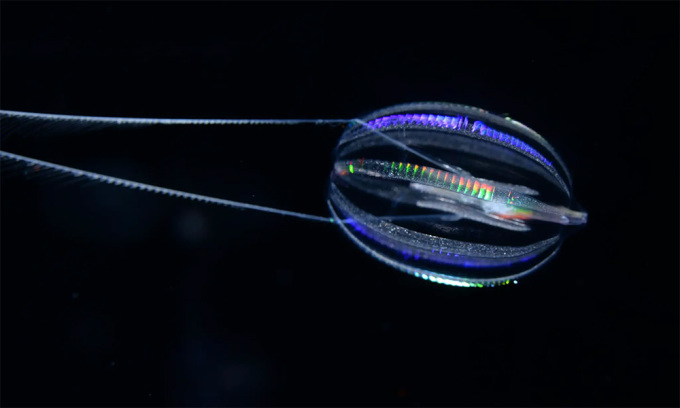
Hormiphora californensis - a species of comb jelly. Photo: Darrin Schultz/2021 MBARI
Sponges ( Porifera ) have long been a leading contender for the title of the first multicellular animal due to their anatomical simplicity, for example, their lack of a nervous system. However, new data suggests that comb jellies ( Ctenophora ) take the top spot, despite having a more complex nervous system. New research by an international team of scientists, published in Nature on May 17th, shows that evolution is not a purely simple to complex journey.
"The most recent common ancestor of all animals probably lived 600 or 700 million years ago. It's difficult to know what they were like because they were mollusks and didn't leave any direct fossil traces. But we can use comparisons with existing animals to learn about this common ancestor," explains molecular biologist Daniel Rokhsar of the University of California Berkeley, a member of the research team.
Previous gene sequencing analyses yielded conflicting results, with some suggesting sponges appeared first, while others pointed to comb jellies. In the new study, the team compared the genomes of comb jellies, two types of sponges, two groups of single-celled organisms (choanoflagellates and amoebas), a fish-parasitic microorganism related to animals and fungi (ichthyosporea), and other modern animal species.
As a result, sponges and more modern animals share characteristics from a rare type of chromosomal fusion and rearrangement event. But this is absent in comb jellies, whose genomes are arranged more like those of single-celled organisms. Therefore, it is more likely that comb jellies evolved first, followed by sponges. Sponges then passed on their new chromosomal arrangement to their descendants.
"Traces of this ancient evolutionary event are still present in the genomes of animals hundreds of millions of years later. The new research provides us with context to understand what made animals what they are. The work will also help us understand the basic functions that we all have, such as how we sense our surroundings, how we eat, and how we move," said Darrin Schultz, a bioinformatics expert at the University of Vienna.
Thu Thao (According to Science Alert )
Source link


![[Photo] The captivating scenery of the fragrant maple forest in Quang Tri](/_next/image?url=https%3A%2F%2Fvphoto.vietnam.vn%2Fthumb%2F1200x675%2Fvietnam%2Fresource%2FIMAGE%2F2025%2F12%2F10%2F1765353233198_lan09046-jpg.webp&w=3840&q=75)
![[Photo] Explore the US Navy's USS Robert Smalls warship](/_next/image?url=https%3A%2F%2Fvphoto.vietnam.vn%2Fthumb%2F1200x675%2Fvietnam%2Fresource%2FIMAGE%2F2025%2F12%2F10%2F1765341533272_11212121-8303-jpg.webp&w=3840&q=75)





























![[Video] The craft of making Dong Ho folk paintings has been inscribed by UNESCO on the List of Crafts in Need of Urgent Safeguarding.](https://vphoto.vietnam.vn/thumb/402x226/vietnam/resource/IMAGE/2025/12/10/1765350246533_tranh-dong-ho-734-jpg.webp)




































































Comment (0)